
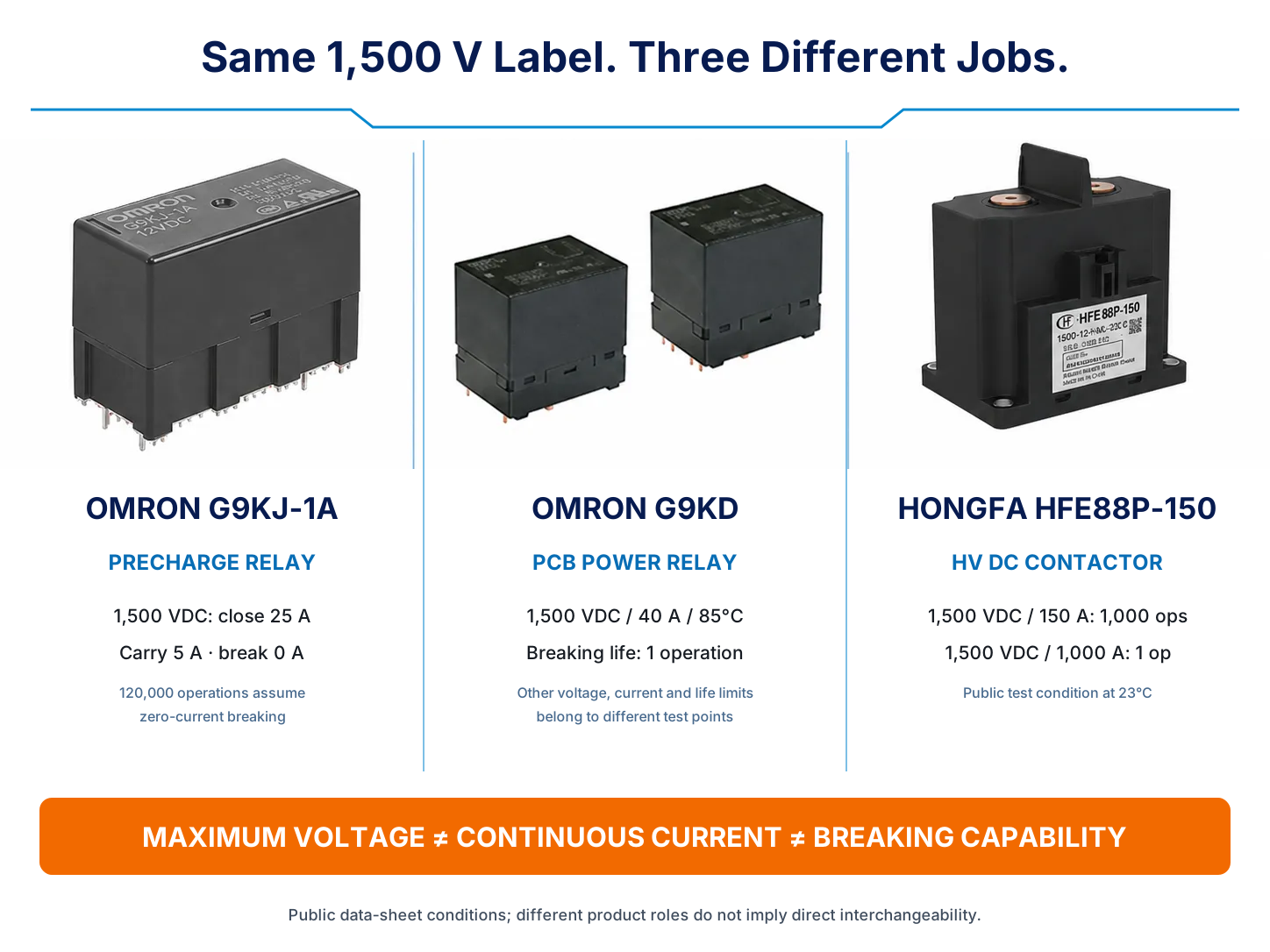
Many high-voltage relays carry a 1,500 VDC headline, yet their practical capabilities are radically different. Omron's 16 g G9KJ-1A is a lightweight precharge device. The G9KD is aimed at board-mounted power switching. Hongfa's roughly 1 kg HFE88P-150 can interrupt kiloampere-level fault current. All three may be described as 1,500 V high-voltage relays, but they do not belong to the same application tier.
The most dangerous selection mistake is to lift maximum voltage and maximum current from separate lines of a data sheet and combine them into an operating point that was never specified. A device may close a precharge circuit but be unable to break current under load. Another may interrupt a kiloampere once but have no recurring switching life at that condition. Selecting by headline numbers can lead to contact erosion, blown fuses or complete system shutdown.
The governing rule is simple: a rating is meaningful only with its operating condition, action type and operation count. Precharge closing, continuous current, routine breaking and fault isolation impose different requirements.
1. At 1,500 V, a precharge relay may close but not break the main circuit
Omron's G9KJ-1A, introduced in 2026, is a PCB precharge relay designed specifically for 1,500 VDC systems. At that voltage it can close at 25 A and carry 5 A continuously, but its specified breaking current is 0 A. Its 120,000-operation electrical-life figure also assumes zero-current breaking.
Its actual loaded breaking rating is only 40 VDC/5 A for 6,000 operations. The device is intended to close the high-voltage-bus precharge path and limit capacitor inrush. It is not a fault interrupter or a load-breaking relay.
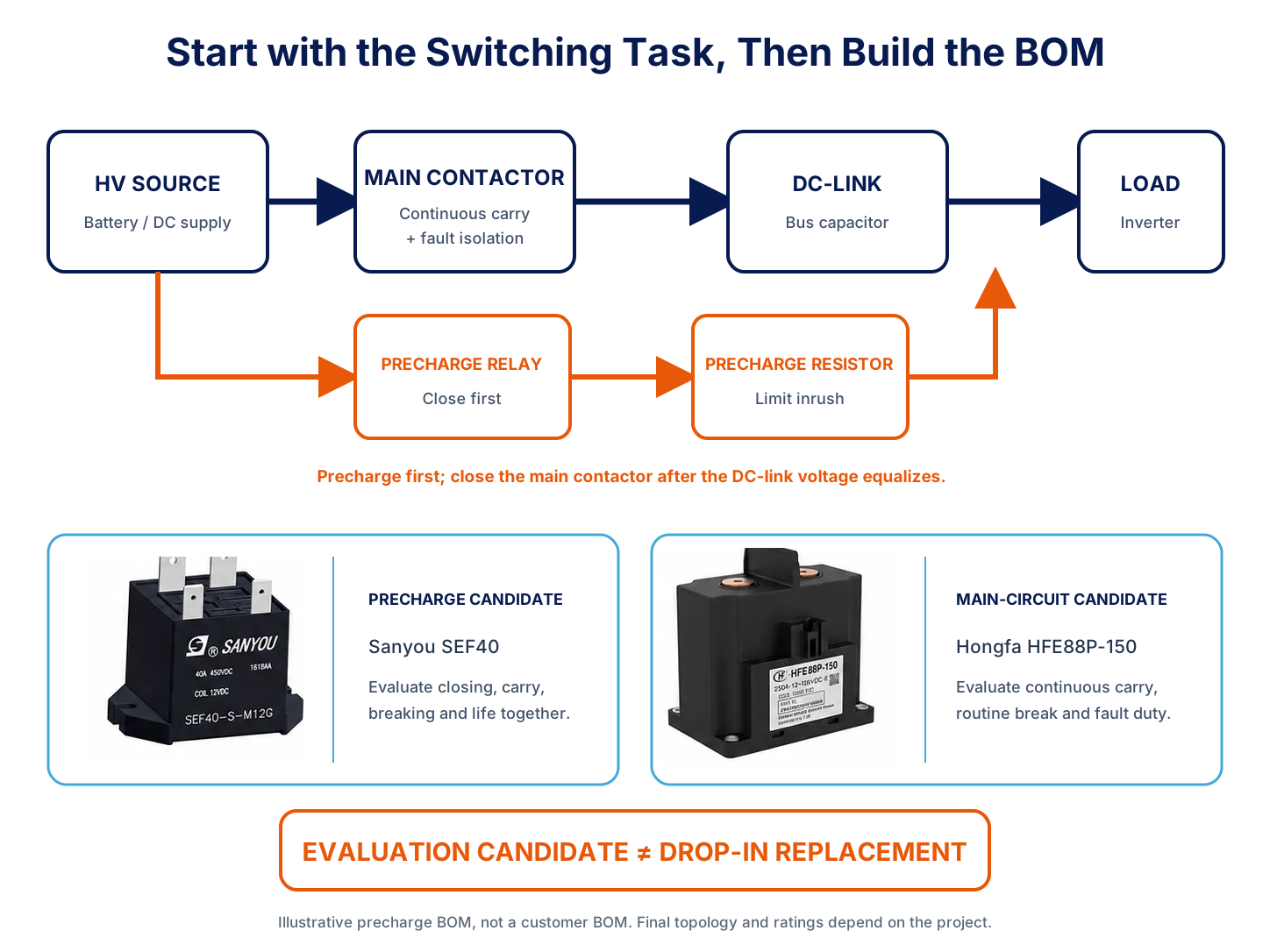
That division of labor is standard in energy-storage, photovoltaic and high-voltage power systems. During startup, the precharge relay closes first so the DC-link capacitor charges gradually through a resistor. After the bus-voltage difference falls, the main contactor closes and the precharge branch leaves the circuit. Because the precharge relay generally opens near zero current, it does not need the arc-extinguishing system of a main contactor.
Among China-based alternatives, Sanyou's SEF40 is also positioned for precharge in new-energy vehicles and high-voltage storage. It specifies a 40 A contact rating, operation from -40°C to 85°C and 500,000 mechanical operations. Public material does not currently provide a complete matrix directly matching the G9KJ's 1,500 V closing, carrying, breaking and electrical-life conditions. It can therefore be evaluated as a candidate, but not declared a drop-in substitute.
2. “1,500 V” and “150 A” cannot be combined freely
Omron's G9KD data sheet lists both a 1,500 VDC maximum voltage and a 150 A maximum current. Reading those two limits together could suggest that the relay breaks 150 A at 1,500 V. Its test matrix shows otherwise: the limits belong to different operating conditions.
With a resistive load at 85°C, the G9KD is rated for 6,000 electrical operations at 1,000 VDC/50 A. At 1,000 VDC/100 A, the figure falls to 20 operations. At 1,500 VDC/40 A, it is a one-time interruption. The 150 A maximum applies only to a one-time 1,000 VDC condition at 70°C.
These are individual boundary points, not a universal operating envelope. Maximum voltage, maximum current and maximum life generally cannot all be achieved at the same time.
Away from the absolute limits, the G9KD's strength is board-level integration. Initial contact resistance is no more than 4 mΩ. It can carry 100 A continuously at 85°C or 150 A at 70°C. Some variants include an auxiliary contact and an IEC-compliant mirror-contact structure for state feedback. That makes it better suited to frequent, reliable board-level power switching in energy storage, charging infrastructure and vehicle-to-everything systems than to main-circuit fault protection.
3. A 1,000 A interruption is a one-shot safety boundary
Hongfa's HFE88P-150 is a 1,500 VDC main-circuit contactor for energy-storage systems, placing it in a different class from the two PCB relays. It can carry 150 A continuously at an ambient temperature of 85°C and has contact resistance as low as 0.12 mΩ. Its arc control, mechanical structure and thermal path are intended for a high-power main circuit.
Its electrical-life ratings are explicitly tiered: 2,000 breaking operations at 1,500 VDC/100 A and 1,000 at 1,500 VDC/150 A. The widely noted 1,500 VDC/1,000 A breaking capability is specified for one operation only.
That is not a defect. A kiloampere short-circuit interruption is an extreme fault event. One successful operation can isolate a dangerous current and protect the rest of the system; the contactor will probably require inspection or replacement afterward. The rating describes an ultimate fault-protection boundary, not a recurring switching life.
The HFE88P-150 also integrates an economizer for the coil, drawing roughly 50 W at pickup and about 5 W while held. The coil must not be driven with a slowly rising voltage. This condition reinforces a broader point: selection cannot stop at the contacts. Coil drive, mounting direction, busbar layout, temperature rise and system control logic all affect production reliability.
4. For a China-based alternative, classify the job before comparing price
The common substitution mistake is to put every product in one table labeled “1,500 V, current rating and price.” A precharge relay, a board-mounted power relay and a main-circuit contactor perform different jobs and do not share a universal replacement relationship.
Sanyou's SEF40 is aimed at the precharge branch. Its SEL200 family targets the main power path with a 200 A nominal current and 1,000 VDC withstand rating, plus 8,000 A short-circuit withstand and one-time 800 VDC/2,000 A breaking capability. Because its maximum voltage is 1,000 VDC, it cannot directly replace the HFE88P-150 in a 1,500 V system.
A defensible alternative-selection process has three steps. First, classify the function: precharge closing, continuous carrying, routine breaking or fault isolation. Second, compare on the same basis: voltage, current, temperature, load type and operation count. Third, validate in hardware, including temperature rise, soldering or busbar connection, coil drive, surge behavior, fuse coordination and lot-to-lot consistency.
Mechanical life and electrical life must also remain separate. Hundreds of thousands of no-load mechanical operations do not prove stable switching under high-voltage load. Room-temperature laboratory data do not automatically transfer to a hot cabinet. A “maximum breaking current” must be tied to resistive, capacitive or inductive load and to the circuit time constant.
Conclusion
1,500 V is an entry condition, not a capability grade. The G9KJ specializes in high-voltage precharge closing with zero-current breaking. The G9KD balances board integration, continuous current and routine switching. The HFE88P-150 provides extreme fault interruption in a high-power main circuit. Their labels look similar, but they are three different tools.
Avoid “rating assembly” and define five items before discussing a replacement: working voltage, actual carried current, action type, ambient temperature and required operation count. Only after those conditions are complete does a comparison among models or suppliers become meaningful.
This article is based on public manufacturer material and is intended for industry discussion only. It is not a part-number or procurement recommendation. Confirm capabilities and substitution decisions against the latest data sheets, sample testing and complete-system validation.