What changed across the component market and what it means for a BOM. Every piece links to the categories, suppliers, and parts it covers; China-based suppliers and parts are marked.
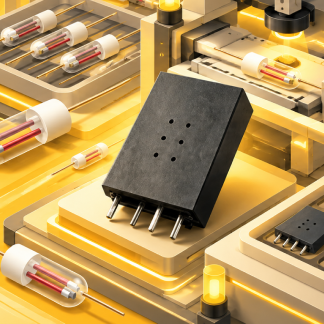
A guide to mainland Chinese thermistor, varistor and potentiometer suppliers, distinguishing sensing, inrush limiting, protection and adjustment from finished sensor and heater assemblies.
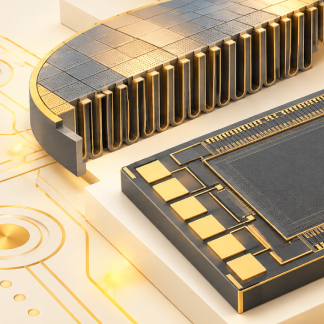
An overseas-facing review of Chinese silicon-capacitor entrants and the validation steps from product launch to repeat supply, with unsupported source-manuscript claims clearly identified.
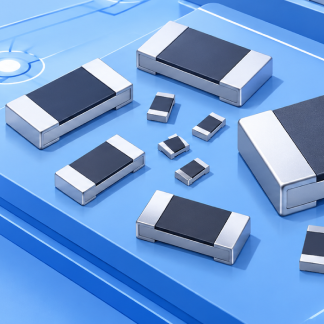
A product-level guide to mainland Chinese chip resistor suppliers, covering thick-film, thin-film and alloy sensing families, their operating limits and disclosed development stages.
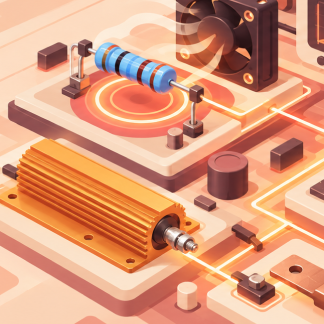
A guide to resistor construction, circuit functions and selected mainland Chinese suppliers, with practical distinctions between product specifications, sampling, qualification and volume supply.
A product-based map of Chinese supercapacitor suppliers, covering small backup devices, dry-electrode and hybrid products, large cells and AI power modules, with commercial stages identified.
A guide to tantalum and niobium routes beyond aluminum electrolytics, with Chinese supplier examples. It separates anode materials, cathode systems and package structures, and distinguishes commercial products from material research.
Twelve additional manufacturers or groups expand the combined aluminum electrolytic capacitor index to 26, covering package formats, electrolyte technologies and circuit applications.
A guide to 13 ceramic-capacitor suppliers in China, comparing high-capacitance MLCCs, resonant and RF devices, safety discs, and products for high-reliability microassemblies.
A product-based guide to wet, solid-polymer and hybrid aluminum electrolytics from 14 suppliers, covering bulk storage, low ESR, mounting height and temperature.
SGMICRO and 3PEAK multiplexers provide several channel arrangements for shared-ADC designs. Compare supply ranges, leakage, settling and board-level validation.
NOVOSENSE digital isolators and Hall current sensors address distinct power-control tasks. TI and Allegro provide references for channel direction, conductor loss and package choices.
LINEARIN LTP753H and ETEK ET559XX offer different priorities for portable power. Compare standby consumption, noise, PSRR and load conditions, with TI TPS796 as a higher-current reference.
Southchip current-sensing products are assessed alongside Allegro and TI, with attention to accuracy definitions, thermal limits, isolation and system-level replacement costs.
Nexperia China is rebuilding supply on a local 300mm platform while addressing product coverage, technical support, rights arrangements, customer approvals and reconstruction costs.
A stage-by-stage look at Chipown and Oriental Semiconductor server-power devices, covering bus conversion, branch protection, GPU regulation and peripheral point-of-load supply.
Level translators from 3PEAK, SGMICRO and EnergyMath illustrate the choices in thresholds, output type, channel count, direction control and board validation.
CXMT adds 24Gb LPDDR5X and two package options on its G5 platform. Comparisons with Micron, Samsung and SK hynix separate die density, product formats and customer adoption from the start of production.
Rsemi’s reported adoption in the GAC Aion N60 shows progress in China’s automotive SerDes supply chain. Comparisons with Analog Devices and Valens examine camera aggregation, cable choices, protocol compatibility and the evidence needed beyond link-rate specifications.
Black Sesame’s Aura Devkit delivery to AUBO and SemiDrive’s layered robotics portfolio offer different development starting points. Their disclosed customer progress is compared with the integration, software-support and robot-level validation work that remains.
Winbond’s proposed acquisition of Infineon’s NOR Flash and F-RAM business sharpens the focus on portfolio breadth. GigaDevice’s automotive deliveries and expanding NOR choices are assessed alongside Shunming’s company-level shipment record and further ferroelectric-memory research.
Oriental Semiconductor and Hynetek, NOVOSENSE, and JoulWatt address different positions in AI server power. Recent products clarify the roles of PFC control, GaN gate drive and multiphase Vcore control, with shipment and sampling claims kept at their disclosed product scope.
Fenghua’s 42-year development connects ceramic materials and manufacturing processes with precision resistors and high-capacitance MLCCs. A personal recollection accompanies product-level comparisons and the company’s latest reported qualification and production milestones.
MORNSUN is expanding its role in industrial equipment through integrated interfaces and dedicated test supplies. Recent products clarify its approach relative to MEAN WELL, RECOM and TDK-Lambda, while adoption and sales remain to be established.
An ultra-thin package solves only part of the problem. Compare assembly tolerances, footprint, ESR and temperature-derated ripple ratings before choosing an MTL part.
A reported ¥40 billion investment plan serves two distinct needs: shorter high-current power paths and signal isolation in optical-transceiver bias circuits.
A 600 W rating is only the starting point. Check standoff and clamping voltages, pulse conditions, temperature and PCB layout against the protected circuit.
Compare high-voltage bulk capacitance, compact hybrid designs and high-temperature ripple ratings, with the test conditions that make each specification meaningful.
A reference collection covering thin decoupling, advanced packaging and RF silicon capacitors, with careful distinctions between capacitance and voltage metrics.
China-developed sensing PMICs now match many headline requirements, but validation support, safety evidence and platform maturity still decide adoption.
Silicon-capacitor competition now spans near-die decoupling, advanced packaging, broadband optical links and RF. The decisive test is no longer one headline specification, but a validated device-package-model-supply solution.
China-based MCU vendors now cover nearly every major application tier. The harder task is turning broad catalogs into stable, reusable platforms that engineers trust for long-lived production programs.
YT99 has crossed the line into production vehicles, but broader platform reuse still depends on configuration-specific yield, software, safety evidence and repeatable supply.
The move to 3.2T optics raises routing density and channel-loss demands. We examine how Launchip's 22 nF, 01005 silicon capacitor addresses package area, 110 GHz characterization and production readiness.
Chipown is assembling a power platform that spans 800 V auxiliary conversion, 48 V intermediate buses, multiphase VRMs, DrMOS, eFuses and point-of-load rails. Production status is only the start; platform validation decides adoption.
Higher server power is creating different capacitor jobs at the high-voltage bus, intermediate outputs and load point. Jianghai is expanding three complementary technologies, but long-duration reliability—not nameplate capacity—will determine design wins.
DDR4 spot quotes are rising as major vendors redirect capacity, yet buyers remain reluctant to chase the market. The result is a supply-led price increase with limited transaction volume.
GÖPEL's Video Dragon 6222 combines frame capture and generation to verify pixels, timing and sideband communication across modern automotive and industrial video links. It closes the data-test loop, but cannot replace optical inspection or production takt-time design.
Molex's seven-channel liquid-cooled busbar is publicly rated up to 15,000 A with a 15°C temperature rise, while its roadmap targets 25,000 A. The product shows power distribution becoming an electro-thermal-fluid system—but it does not yet prove a 1 MW rack or a direct comparison with AVIC Jonhon branch connectors.
Three 1 μF parts from Yuyang Technology, TDK and Launchip solve different jobs. The real comparison is board position, rail voltage, effective capacitance, thickness and parasitics—not a blanket silicon-versus-ceramic ranking.
TDK's EP21 brings 20.3–35 A ratings, low DCR and reflow assembly to a compact common-mode choke platform. Selection still depends on impedance, thermal derating and mechanical retention—not the 35 A headline alone.
Infineon is pushing TMR into automotive angle, current and overcurrent sensing, while China-based suppliers already have production parts. The hard gap is no longer making a TMR IC; it is proving the complete magnetic, algorithmic and functional-safety system.
BRC Solar has selected Infineon 100 V CoolGaN transistors for M600-E and M605-M module-level power optimizers. The design win is confirmed, but the exact GaN part, procurement volume, and shipment scale remain undisclosed.
GigaDevice says cumulative automotive-memory shipments exceeded 450 million units in July 2026. Domestic automotive Flash is moving from comparable specifications toward certification, volume delivery, and named production cases, while each BOM introduction still requires exact hardware, software, safety, PPAP, and vehicle validation.
As BGA and QFN packages hide more joints and dense boards lose physical test points, Boundary Scan restores electrical visibility through on-chip test cells. GÖPEL's CAN-FD/LIN expansion combines structural test, programming, debug, and interface function testing without claiming that one method replaces the others.
Domestic 18-cell BMS AFEs have crossed the product-availability threshold. Substitution depends less on whether accuracy says ±1 mV or ±3 mV than on lifetime diagnostics, daisy-chain reliability, functional-safety evidence, and stable integration with the complete BMS software stack.
TI UCC34141-Q1 and UCC33420 integrate the planar transformer, isolated power stage, and protection for gate-drive and communications bias supplies. They simplify small isolated power islands in server PSUs and BBUs—not CPU or GPU core power.
As capacitors move from the PCB toward the die, selection depends on the current path as well as capacitance. Multiterminal silicon capacitors compete for the final high-frequency PDN loop with ultrathin structures and interleaved VDD/VSS terminals.
The ic.net dashboard shows a 33.4% increase in the X5R price index and a 28.9% decline in its inventory index, yet only 7.1% of sampled X5R parts rose. Part-level data separate genuine inventory consumption from channel repricing and end-of-life transitions.
The Agilex 9 Direct RF-Series AGRW039 brings eight 10-bit receive ADCs, eight transmit DACs, programmable logic, DSP, and Arm processing into one chiplet package at up to 64 GSPS. Its architectural target is the board-level JESD204B/C data path, not the entire RF front end.
NXP MCX C15/C16 integrates analog and power-control peripherals at the entry level. GigaDevice GD32E230, Geehy APM32F035, and MindMotion MM32SPIN0280 counter through different system-BOM strategies rather than one-for-one parameter matching.
Motorcomm's YT80 automotive PHY family has exceeded 15 million cumulative shipments, YT99 switches are deployed across vehicle programs, and YT78/YT79 SerDes remains in automaker validation. The three stages show why automotive substitution must be measured by exact product and milestone.
JAE's KN07 combines up to 32 power and 40 signal contacts in one IP67 interface for robots and industrial equipment. It can reduce panel interfaces, but current derating, EMC, harness mechanics, sealing, and service risk become more concentrated.
SK hynix and Sandisk published the first open High Bandwidth Flash specification in August 2026. HBF proposes a high-capacity, nonvolatile tier closer to the GPU than SSD, but its practical role is more likely to keep selected data out of HBM than to replace HBM itself.
An AI accelerator is increasingly a team of compute chiplets, HBM stacks, interposers, substrates, and thermal components. Competition is shifting from fabricating advanced transistors to assembling expensive dies into a testable, coolable, high-yield system.
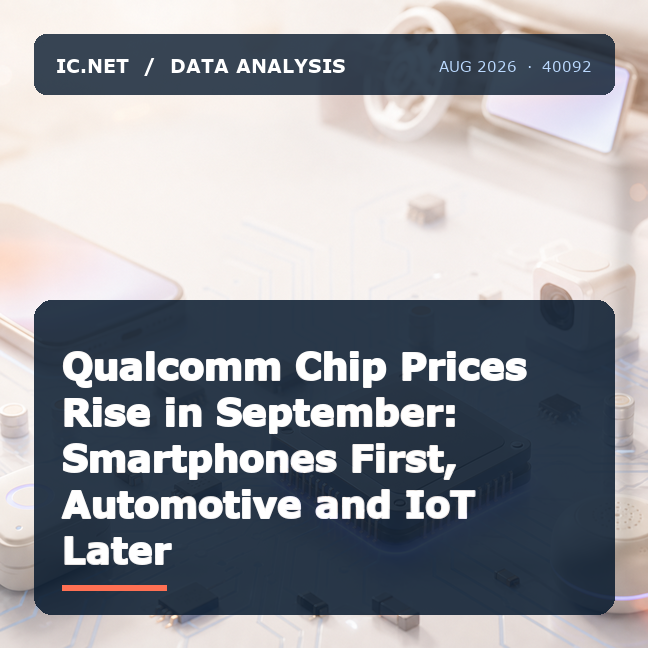
Qualcomm has confirmed chip-price increases from September 1, 2026, while a customer notice describes a double-digit adjustment. Exact changes still vary by part, region, and contract, and shipment date—not order date—is the key commercial trigger.
A supply-chain claim says a DRAM shortage has left about $1 billion of Apple 2 nm silicon waiting at TSMC. Neither company has confirmed the figure. The more defensible risk is that N2 wafers, known-good dies, or work in process could wait upstream of final packaging when qualified LPDDR does not arrive on schedule.
Chinese vendors now offer 12- and 16-phase PWM controllers for AI power. The remaining barrier is not phase count alone, but the complete controller, DrMOS, magnetics, tools, protocols, transient behavior, and platform-validation package.
Some advanced AI PCB orders are reportedly visible into Q1 2027, while high-end electronic-glass looms carry 18-24 month lead times. The constraint is structural: qualified low-loss materials, high-layer-count yield, and customer-approved capacity cannot be created simply by adding factory floor space.
Forecasts put the advanced ABF substrate gap as high as 20%-40%, with visibility extending into 2027-2028. What remains scarce is not floor space or film alone, but effective high-end capacity that has passed material, process, packaging, yield, and customer qualification.
An August 2026 listing sample spanned roughly eighteenfold across five STM32 devices, but the useful comparison is the complete task, peripheral set, software burden and lifecycle risk.
Smart switches are taking low-voltage diagnostic loads while relays and contactors retain high-voltage, high-current and physical-isolation duties. The BOM boundary matters more than a replacement slogan.
A forecast for a 120% to 170% second-half contract-price increase was alarming, but long-life designs face the harder problem: replacing a qualified legacy NAND device before the supply window closes.
Selected devices can survive demanding repetitive short-circuit tests, but a production BOM still depends on thermal design, capacitive and inductive loads, diagnostics and field support.
TI's 70 mm, 48 V, 1 kW reference design shows that joint-drive sourcing is about the validated control, power, sensing, communications and fault chain rather than one impressive device.
Active ordering status can protect installed products without making a mature 16-bit platform the best choice for a new design. Buyers need separate continuity and architecture decisions.
New medium-size OLED panel capacity creates a larger opportunity for display drivers, but notebook-class image quality, timing, power and yield must be qualified as one system.
China-based MCU vendors increasingly cover the required peripherals and certifications. The harder procurement question is who absorbs migration, validation and field-failure work.
A large orderable-code count can reflect package, memory and temperature variants of a smaller number of platforms. Buyers need family depth, channel evidence and migration support.
For smaller customers, documentation, examples, programming tools and an accountable failure-analysis path can determine whether a technically suitable MCU ever reaches production.
A familiar STM32 ordered through an additional manufacturing path can reduce migration work, but buyers still need exact suffix, factory, traceability and geopolitical dependency evidence.
LTM8053 integrates switching, magnetics and supporting components, so its unit price must be compared with board area, EMI work, thermal risk and validation time.
A long Artix-7 support horizon reduces EOL risk, but XC7A35T availability still depends on package, speed grade, temperature range and channel inventory.
Winning an AI order does not make PCB suppliers equivalent. Layer count, HDI complexity, materials, yield and customer-qualified production sites determine usable capacity.
At PCIe 6.0 speeds, a clock tree must meet jitter, distribution, redundancy and management requirements across the platform. A crystal or buffer parameter alone is not enough.
AECs can extend copper links across several meters with lower power than optics, but the cable assembly, signal-conditioning silicon, connectors and firmware must be qualified together.
Nanya's multi-year capacity plan could add supply, but fab construction, process ramp and customer qualification mean that announced output cannot resolve a near-term memory exposure.
SK Hynix was already listed in Korea and is not a company short of cash. The US listing does something else: it reprices HBM from a memory line item into AI infrastructure. For anyone buying memory, the consequence is not the headline number — it is that capital, capacity and management attention now follow HBM, and commodity DRAM and NAND sit downstream of that decision. Memory is also the hardest category on a BOM to second-source, which is why the allocation question matters more than the price question.
Equity-market sentiment can amplify distributor behavior, but it cannot create ceramic capacity or automotive qualification. The useful signals are still SKU-level lead time, allocation, inventory and end demand.
New capital can expand wafer output and product breadth, but buyers gain a resilient second source only when yield, platform validation, support and lifecycle commitments scale with it.
A Shenzhen power-semi start-up has entered bankruptcy review. It didn't pick the wrong track — IGBT and SiC are exactly where the demand is. It shows something else: China's power-device second-sourcing has moved past a pure technology contest into a combined test of technology, capacity, customer qualification and cash flow. For a buyer, the lesson is to keep two tables, not one — a part-alternative table and a supplier-delivery-risk table.
Silicon capacitors are not replacing the MLCC wall on an AI board. They are moving into the few positions where distance, parasitics and package height make conventional decoupling less effective.
At high charging power, the plug is no longer a copper-and-plastic accessory. It is an electrical, thermal, sensing and service system whose weakest interface can set the limit for the entire charger.
An MPN can identify a component without revealing the gallium, germanium, rare-earth or magnet content that determines its trade-control exposure. Procurement teams need a material passport before the next rule takes effect.
Automotive second-sourcing fixates on the brain — MCU, SoC, domain controller. But a car also needs nerves. CAN/LIN transceivers, SBCs and Ethernet PHYs are high-frequency BOM lines with a clear alternative path, and China-based parts are now clearing OEM EMC and conformance testing, not just datasheet parity.
In automotive BOMs, the failure that takes down a design is often not the big MCU or SiC — it's a few-cent TVS or ESD diode that didn't hold. JJW, DOWO and Leiditech can now second-source these parts, but only if you stop thinking "cheaper TVS" and start sourcing by interface and risk. Clamping voltage and junction capacitance — not price — decide whether the swap is safe.
When high-end AI-server MLCCs get tight, no one is surprised. The real signal of mid-2026 is that mainstream consumer-grade X5R MLCCs are up 15–25% in China distribution. That's the AI shortage overflowing out of the server room and down into phones, routers, industrial boards and ordinary BOMs — and the overflow is exactly where China-based makers get their opening.
In high-voltage power electronics, current sensing is quietly a single-source risk. A growing bench of China-based suppliers — NOVOSENSE, Chipanalog, 3PEAK, SG Micro — now offers pin-compatible alternatives to Texas Instruments' current-sense amplifiers and Hall sensors. The parts are real; the qualification bar is not price, it's whether they hold their numbers in the noisiest, hottest, highest-voltage corner of the BOM.
Second-sourcing fixates on the big devices. But on a real board the failure usually starts with the small power parts. If the main chip goes domestic while the power, protection, switching and sampling around it stay imported, localisation rate stalls and supply risk never actually falls.
DDR4 supply is losing flexibility while industrial and embedded demand remains. Buyers should react to validated SKU-level exposure, not a single retail listing or a market-wide shortage narrative.
A leaked drawing or supplier map can reveal alternates, test methods and negotiation structure. Buyers need to qualify information handling with the same discipline they apply to quality and delivery.
A second automotive MCU must reproduce safety, security, software, network and lifecycle behavior around the chip. Matching cores, memory and peripherals is only the start of qualification.
A 48 V zonal controller combines DC-DC conversion, protected distribution and intelligent load switching. Similar voltage ratings do not make those functions interchangeable.
Supplier-evaluation reports can signal interest, but they do not prove adoption. Buyers should track the engineering gates between a credible sample and recurring production orders.
Processors can only act on the voltage, current, temperature and motion data presented to them. Noise, drift, conversion and power integrity often set the real system limit.
A sensor does not deliver truth directly. Offset, gain, noise, reference drift, filtering and conversion determine what the processor actually receives.
A camera PMIC's job is not to deliver power — it is to deliver it clean, stable and on schedule. Noise, ripple, bad sequencing and uncontrolled EMI reach the image sensor, SerDes and ISP, and the camera stops seeing the world and starts seeing the power supply.
Matching channel count and data rate is not enough. Barrier lifetime, common-mode immunity, timing, fail-safe behavior and certification evidence define the real replacement boundary.
A pin-compatible amplifier can still move the error budget, stability margin or startup sequence. Resilience comes from qualifying the measurement or drive function end to end.
Water heaters were never a natural IGBT story — until heat-pump and inverter models arrived. The barrier for China-based IGBT is no longer 'can we build it' but 'can it be used stably in volume': batch consistency, EMI rework capability, field failure rate and distributor support.
A familiar case size and capacitance can hide different termination, dielectric, voltage derating and qualification evidence. The wrong saving appears only after assembly or field stress.
Resolution and pixel size attract attention, but image quality depends on process consistency, analog readout, HDR behavior, calibration and the surrounding optics and ISP.
Positive supplier commentary can indicate improving utilization, but it does not establish a universal shortage. Buyers still need evidence by dielectric, case size, voltage and end market.
Adding assembly capacity does not create high-reliability MLCC supply if ceramic formulation, thin-layer processing, electrodes and process control remain constrained.
Boot behavior, retention, endurance, functional-safety use, package qualification and lifecycle support determine whether an alternate can enter a vehicle program.
Moving the transducer outside the ear canal changes leakage, wind noise, sensing and battery demands. The sourcing opportunity is a system redesign, not a new enclosure alone.
Inverter air conditioning typically saves 20–40% over fixed-speed, and the saving is not a marketing line — it is a power-semiconductor upgrade. As Silan, China Resources Micro, NCE Power and StarPower fill out IGBT, IPM and MOSFET lines, the appliance BOM gains a second source just as power devices post 10–20% price increases.
Wi-Fi, Bluetooth and voice control can improve setup and automation, but every connection adds software, security, standby-power and support obligations.
Perception, compute, power, networking, braking and the human handoff must fail predictably together. Silicon performance alone cannot close the safety case.
Charging for AI usage does not prove a chip shortage. It exposes the recurring cost of accelerators, memory, networking, power, cooling and utilization.
FPGAs earn their place when interfaces, latency or models are still changing. Buyers must weigh flexibility against power, toolchain, memory and lifecycle risk.
A few firmer quotes can mark inventory normalization, supplier discipline or a product-specific constraint. They do not prove that utilization and demand have recovered across SiC.
A supplier action can reach distributors before every contract resets, but the effect varies by device, customer agreement, inventory age and qualification leverage.
Distributor listings may move before a formal effective date, but stock age, lot size and channel behavior can mimic a trend. Buyers need repeatable MPN-level evidence.
Power devices, battery electronics, connectors and memory move on different cycles. A useful risk view ties each signal to an MPN, qualification path and vehicle build.
Modules combine DRAM die, PCB, SPD, assembly, brand and channel inventory. Their price can rise after component tightness begins and remain elevated after spot pressure eases.
Matching a datasheet is not the same as dropping a part in. Automotive MCU second-sourcing fails on three seams — high-temperature Flash reliability, pin-level incompatibility, and toolchain maturity — and the qualification clock, not the price, is what should start now.
Combining infotainment and driver-assistance compute can reduce boxes and wiring while increasing dependence on processors, memory, power, networking and software qualified as one platform.
AI is siphoning advanced capacity, so Samsung, SK Hynix and Micron are retiring legacy DDR4 and 2D SLC NAND — and GigaDevice is absorbing the overflow. But the price move is sharply differentiated: SLC NAND is genuinely short, automotive NOR is structurally tight, and general DRAM and MCU are mostly sentiment.
A published forecast can confirm a trend that distributor listings already suggested. The earlier signal is useful only when normalized by device, channel and available quantity.
As Samsung, Micron and KIOXIA leave 2D SLC NAND, Macronix and Winbond are filling the gap and raising prices. But platform data shows the alternatives entered the same price-up, inventory-down cycle before the news broke — a second source relieves discontinuity risk, not cost.
An effective-date notice can reflect portfolio economics rather than universal scarcity. Buyers should verify exact products, channels, inventory and switching alternatives.
A dramatic small-lot quote can expose a constrained configuration, but cockpit and ADAS programs depend on qualified density, temperature, firmware and long-term supply.
A reported supplier increase can be genuine for selected series while broader channel data remains mixed. Buyers need exact product scope, lead time and effective capacitance.
Fourteen months of channel history can show whether a dramatic increase is broad, persistent and executable. One offer may instead reflect quantity, stock age or seller behavior.
Data-center investment can pull selected high-power and advanced products while distributor inventory remains loose in mature IGBT, MOSFET and industrial families.
The 2026 legacy NAND transition was a lifecycle problem first: low-density, older-package and qualification-heavy products could lose supply options long before the whole NAND market tightened.
A sharp retail correction in early 2026 did not automatically reverse contract pricing, enterprise demand or the supply position of every DRAM generation and form factor.
April 2026 observations showed tightening in selected automotive and AI-related capacitors while many common consumer products remained competitive and well supplied.
Stable IGBT supply in April 2026 showed why power-semiconductor transitions must be evaluated by topology, voltage, duty cycle and qualification rather than a single adoption headline.
The March 2026 split between falling retail module offers and firmer upstream signals showed why memory sourcing needs product-specific, channel-specific and dated evidence.