
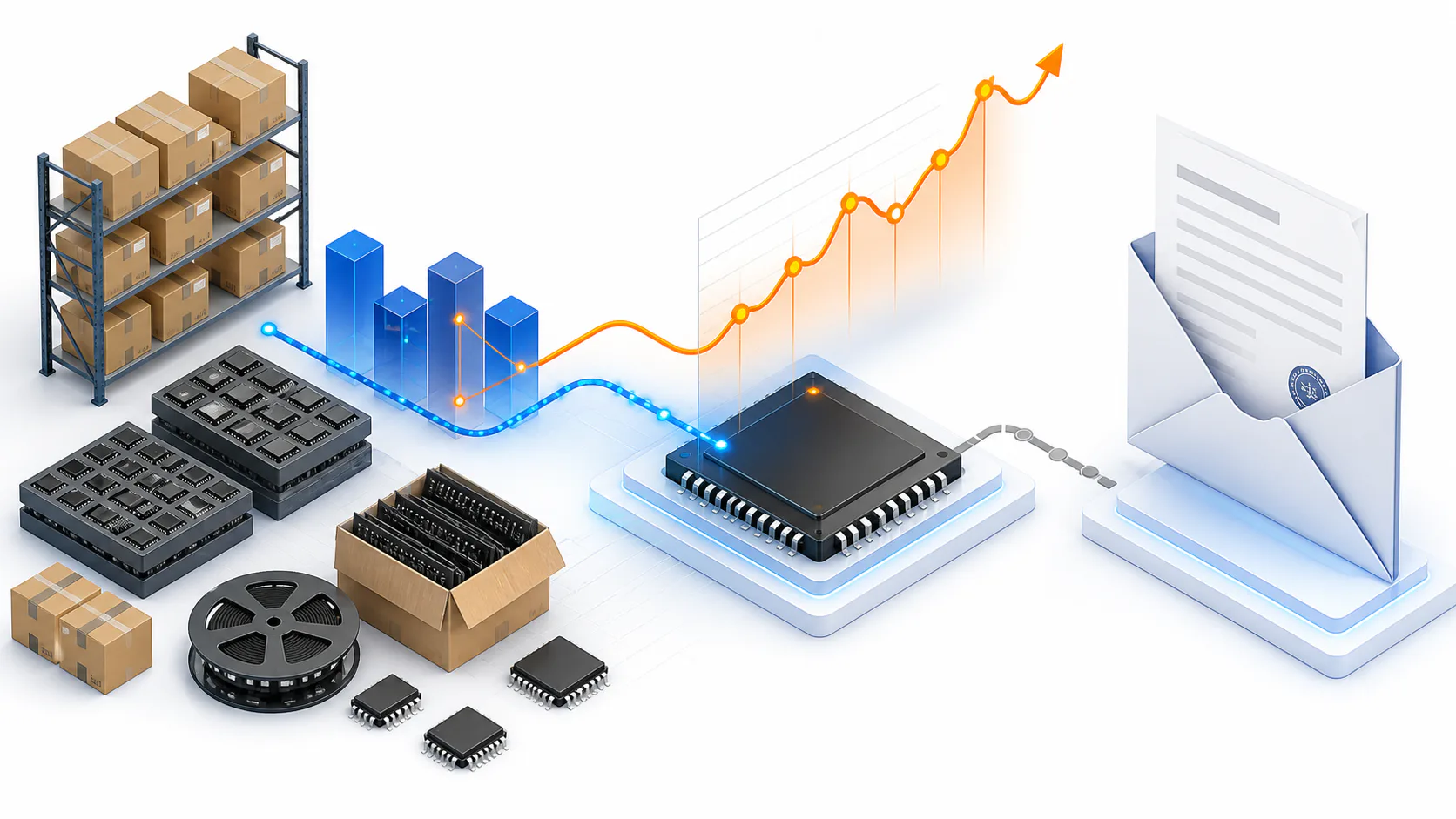
Supplier price actions are usually communicated with an effective date, yet channel data can begin moving earlier. Distributors anticipate replacement cost, old stock clears and brokers react to expected demand.
The April-to-May 2026 observations around selected Texas Instruments products illustrated this lead-lag effect. They also showed why a displayed price cannot be treated as a clean transaction series.
A listing price contains several variables
Quantity break, currency, location, inventory age, customer class and tax can change a displayed value. Marketplace data may duplicate one lot across sellers or leave a stale offer online.
Normalize exact MPN, date, quantity and channel before calculating change. Remove obvious outliers only with a documented rule; otherwise the analysis can be tuned to the desired conclusion.
Use medians and breadth across parts rather than one dramatic quote.
Timing can still be informative
If many authorized listings for the same product family rise before a supplier date, the channel may be repricing replacement inventory. If stock simultaneously declines and replenishment extends, the evidence is stronger.
If only brokers move while authorized supply remains normal, the signal may reflect urgency or speculation. Contract customers may see a different path entirely.
The goal is to identify commercial pressure, not to declare one universal percentage.
Separate portfolio action from shortage
A supplier can raise prices to improve returns on mature or low-volume products even without capacity scarcity. Conversely, a constrained part may be allocated rather than repriced.
Check lifecycle, product strategy, manufacturing process and demand. Mature analog and interface devices can have high redesign cost, giving suppliers pricing power even when wafer capacity exists.
Procurement should classify the reason because the response differs. A shortage needs coverage; a portfolio reset needs negotiation and migration.
Build an auditable watchlist
For each critical TI device, store capture date, authorized stock, lead time, price at a standard quantity, program demand and approved alternates. Compare with previous snapshots.
Flag weak data rather than filling gaps. A missing quote is not automatically a shortage. A price without available quantity is not an executable offer.
Use the same method for other suppliers so the comparison does not single out one portfolio unfairly.
Act on exposure, not the average
Secure high-risk parts with no released alternate and long qualification. For flexible positions, use the signal to accelerate samples and design portability. Avoid broad forward buying when the movement is concentrated.
Confirm changes directly with authorized suppliers and contract terms before revising customer forecasts.
The procurement conclusion
Channel data can reveal a price inflection before a formal supplier action reaches every customer. It can also exaggerate that inflection through stock and seller effects.
Buyers gain value when the data is normalized, dated and tied to exact BOM exposure. The signal should start a supplier conversation, not end the analysis.
The observations referenced here were captured in April and May 2026 and are not live quotes.