
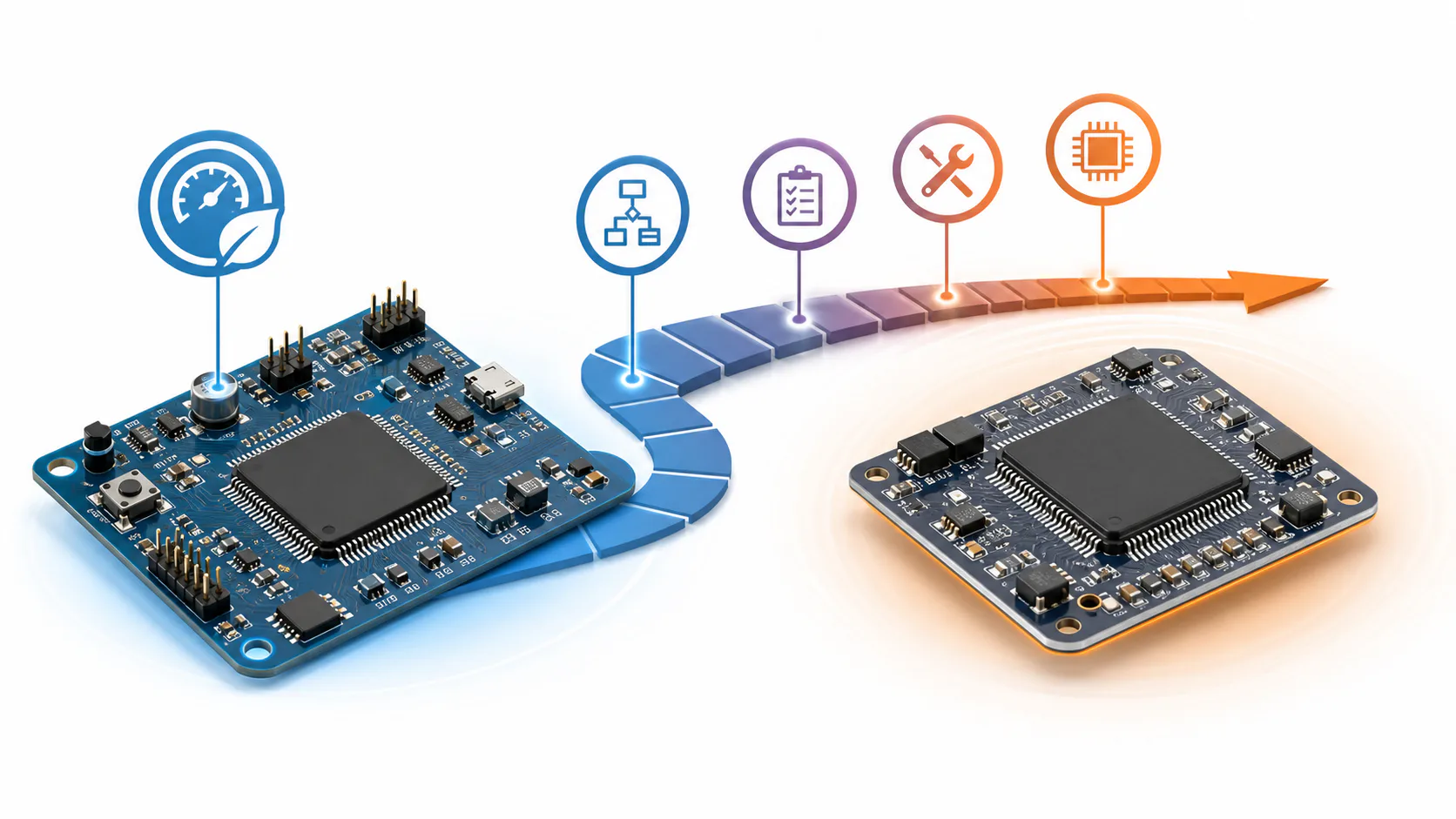
Many MSP430 products remained active and supported in July 2026. At the same time, Texas Instruments had published guidance for moving some customers toward its Arm-based MSPM0 platform. Those facts did not conflict.
A mature MCU can remain essential to installed equipment after it loses momentum in new designs.
Active does not mean strategically preferred
Active status means an orderable device has not entered an announced end-of-life process. It does not promise new derivatives, growing ecosystem investment or the lowest cost for a future product.
MSP430G2553, MSP430FR2355 and MSP430FR5994 still serve released designs. Their value includes known firmware, established test coverage and, for selected families, FRAM capability. Replacing them can cost far more than the MCU.
For a new platform, the decision should include roadmap direction and available engineering talent.
The competitive boundary moved
Low-cost 32-bit MCUs such as MSPM0C1104 and competing Cortex-M0+ products weakened the old assumption that a 16-bit architecture automatically wins on price or simplicity. Broader CMSIS, RTOS and tool ecosystems also reduce switching cost between Arm suppliers.
MSP430 remains differentiated in specific low-power and FRAM use cases. That is an application case, not a category-wide defense.
Compare the exact peripheral, memory and power requirement instead of debating instruction-set width.
Protect installed programs separately
For active production, map every MSP430 MPN to annual demand, remaining lifetime, authorized source and firmware ownership. Maintain an inventory policy tied to supplier lifecycle notices and customer service obligations.
Do not force a redesign merely because the platform is mature. A stable low-volume program may be safer on the validated device than on a technically newer MCU.
However, preserve build tools, compiler versions, programmers and source code. Toolchain loss can become an obsolescence event even while silicon remains available.
Give new designs an exit path
For new work, compare an MSP430 option with MSPM0, STM32C0, RL78, PIC24 and relevant China-based candidates where appropriate. Price the firmware port, analog behavior, timing, debug workflow and qualification effort.
If MSP430 still wins, document why and define a migration trigger. If another platform wins, prototype the difficult peripherals before freezing the BOM. Pin similarity and code examples are not complete migration evidence.
Supplier support, long-term availability and second-source strategy belong in the architecture review.
When the decision is made, record the reason at program level. Include the expected production lifetime, migration estimate, required peripherals, toolchain owner and the event that would reopen the choice. That record prevents a mature part from being removed by fashion and prevents a new design from inheriting an old architecture only because its first prototype was convenient.
The procurement conclusion
MSP430 had not disappeared in July 2026. It had become a platform that required different treatment for installed and new products.
Buyers should protect released BOMs without interpreting active status as an unlimited roadmap. New programs should select on system fit and ecosystem continuity, with a documented path for the next transition.
This lifecycle analysis reflects information available in July 2026; verify current product status with the manufacturer.