The same MCU can regulate airflow in a fan, follow position commands in a servo drive, or hold a power supply's output steady when the load changes. The end products look different, but the controller faces the same task: observe a change, calculate a response and deliver that response within a defined time window.
Motor control, servo drives and digital power are therefore not isolated markets. Together, they form the real-time control segment in which China-developed MCUs are investing heavily. The question is no longer whether these devices can run a control loop. It is why TI C2000 and STM32G4 platforms remain difficult to displace.
1. A higher clock rate does not help if the critical action arrives late
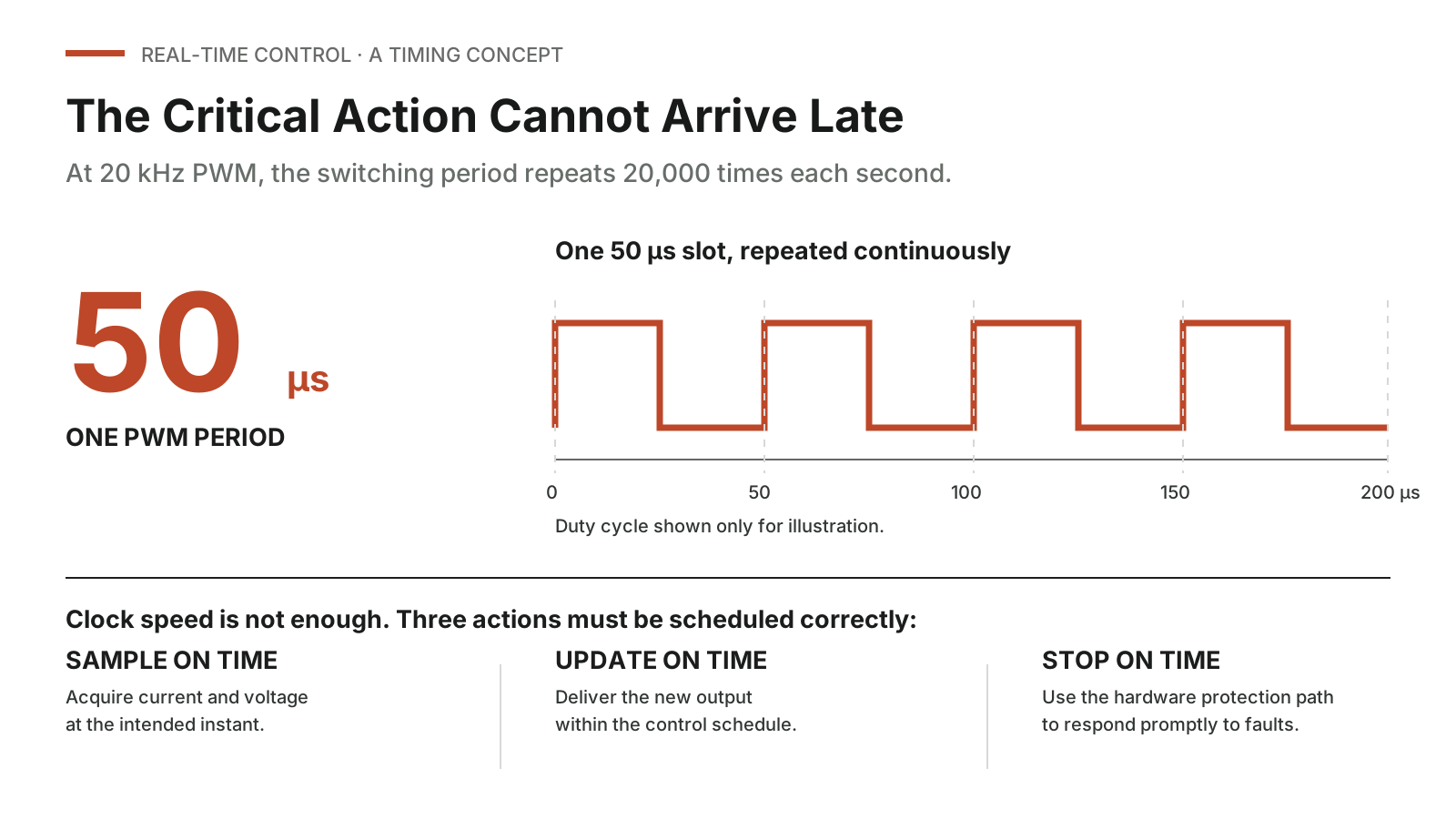
Consider a system using 20 kHz PWM. It repeats 20,000 switching periods every second, leaving only 50 microseconds per period. That number is not motor speed, and not every control algorithm runs at the PWM frequency, but it illustrates how tightly time must be budgeted on a control board.
The analog front end measures current and voltage, the processor calculates the correction, and the PWM hardware determines when the power switches change state. These actions must follow a defined sequence. If current is sampled at the wrong instant, even a very fast calculation may be acting on distorted information.
Protection follows the same principle. During an overcurrent event, a hardware comparator that can shut down an output promptly matters more than waiting for a busy CPU to finish unrelated work. Having such a path does not, by itself, make the complete system functionally safe.
Real-time control means sampling when required, updating when required and stopping when required. Clock frequency contributes to that result, but it is not the result.
That is why control-oriented MCUs increasingly emphasize the interaction among ADCs, timers, mathematical accelerators and protection peripherals. Engineers need coordinated hardware, not simply a fast CPU.
2. China has more than two or three options—and they do not all follow the same route
The China-based supplier landscape can no longer be summarized as “another high-clock-rate MCU.”
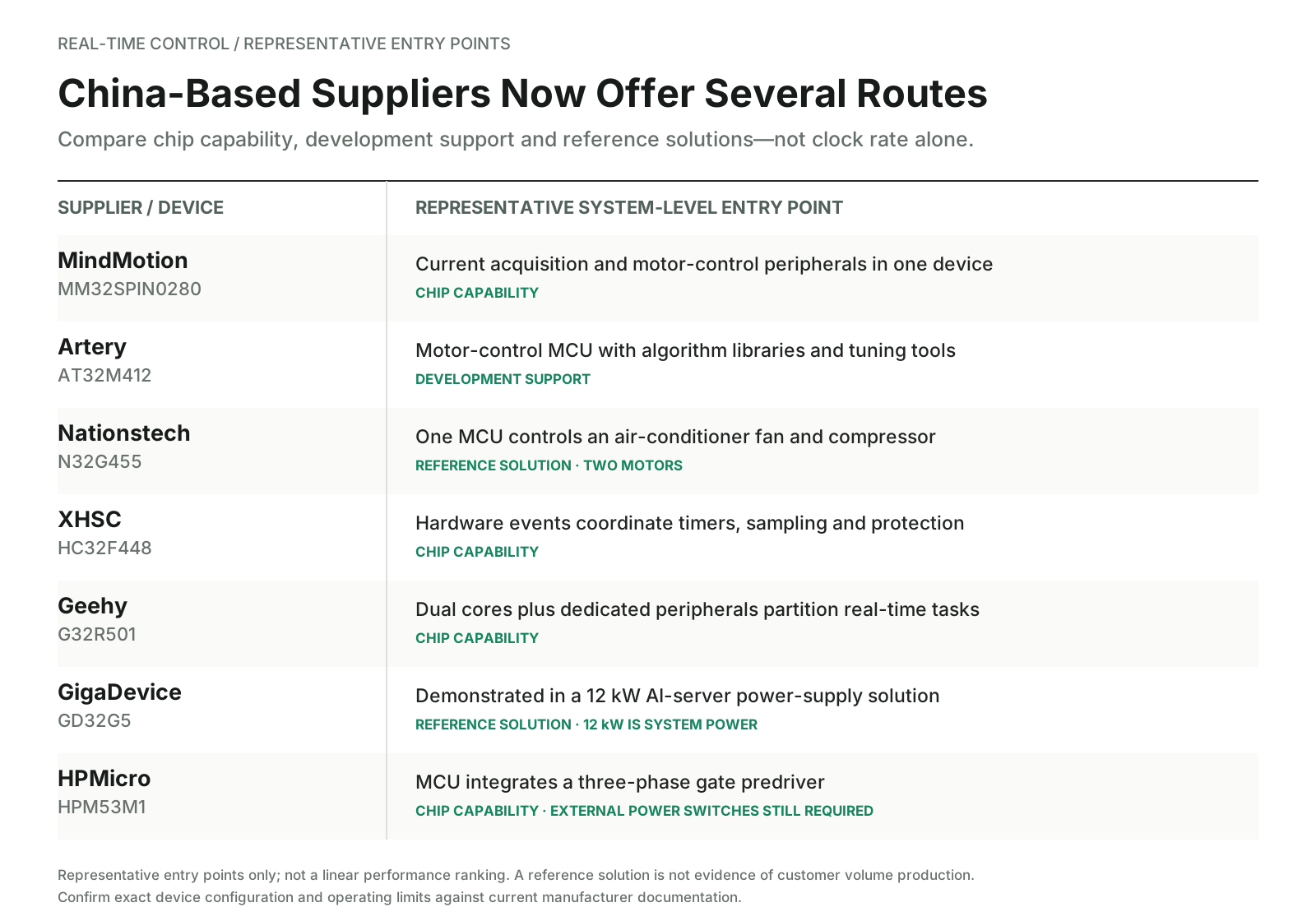
MindMotion's MM32SPIN0280 and Artery's AT32M412 combine dual ADCs, operational amplifiers, comparators and motor-control timers. The point is not the number of abbreviations. It is that current-signal amplification, acquisition and control output can be handled in a tighter hardware combination. Artery also supplies motor-control libraries and tuning tools, addressing development work beyond the silicon itself.
Nationstech's N32G455 provides a concrete system example: a manufacturer reference design uses one MCU to control both the fan and compressor in an air conditioner. Coordinating two motors with one controller says more about the workload it can carry than clock speed alone.
XHSC's HC32F448 focuses on hardware-event links among timers, sampling peripherals and other blocks. In practical terms, one hardware event can trigger the next operation without waiting for the CPU to issue every instruction.
For more complex control, Geehy's G32R501 uses two cores and dedicated control peripherals to create more room for task partitioning. GigaDevice's GD32G5 has appeared in a manufacturer-demonstrated 12 kW AI-server power-supply solution. The 12 kW figure describes the power system, not MCU power consumption, and it does not mean the MCU performs every power-conversion function by itself.
HPMicro's HPM53M1 integrates an MCU with a three-phase gate predriver, moving one step closer to the motor-drive power stage. An integrated predriver should not be confused with integrated power switches; external switching devices are still required.
These seven suppliers occupy different price ranges and system positions, so a simple numerical ranking would be misleading. Collectively, they show that China-developed MCUs now offer several credible real-time control approaches. Competition is shifting from “can it run?” to “which platform fits this system?”
3. TI and STM32 are hardest to replace in the second half of the engineering job
The advantage of established international platforms is more specific than the phrase “better ecosystem.” STM32G474, for example, combines analog peripherals, mathematical acceleration and a high-resolution timer. Motor developers also receive algorithm libraries, configuration tools and motor-identification support; digital-power users have evaluation boards and software examples. The product is a connected path from hardware setup to debugging, not just a microcontroller.
TI C2000 likewise spans motor control and digital power. Its software packages include low-level drivers, control algorithms, loop-tuning tools and reference projects. TI's TIDM-02010 reference design places compressor control, fan control and digital power-factor correction on one controller. PFC shapes input current and improves power factor.
Dual-motor control, precision PWM and hardware protection are therefore not exclusive selling points for China-developed devices. Established suppliers have already organized these capabilities into reusable solutions.
Chinese vendors are adding algorithms and debugging tools as well. The meaningful comparison is how far a toolchain covers the target motor, power stage and abnormal operating conditions, and how much of the resulting code can be reused.
The hardest asset to migrate is often the control software that a team has tuned on its incumbent platform. Startup vibration, response to a sudden load and false protection trips all depend on the interaction among the MCU, surrounding circuitry and software. A faster replacement does not inherit that knowledge automatically. To win such projects, a new platform must show not only that the algorithm runs, but that deadlines are still met with communications, monitoring and fault handling enabled—and that failures can be diagnosed quickly.
4. The next test is performance outside normal operating conditions
It is no longer accurate to treat every China-developed control MCU as a low-cost fallback. Dedicated motor-control products, dual-motor solutions, dual-core control platforms and server-power reference designs now cover work well beyond small general-purpose controllers.
The opposite claim is equally weak: a device with a higher clock rate or more peripherals does not automatically outperform C2000 or STM32G4 across every application. Different control tasks, code bases and power circuits cannot be reduced to one frequency table.
The next questions are concrete. Does the motor shake during loaded startup? Can a servo follow an abrupt reversal? Does the power supply remain stable when load steps sharply? The same tests must be repeated with communications and monitoring enabled. Running one algorithm in isolation and carrying the complete machine workload are different achievements.
For a new design, China-developed platforms can join this comparison from the start. For equipment already in stable production, the old code must be ported and startup, light-load, full-load and fault conditions must all be revalidated. The chip-price difference is a component-level calculation; revalidation is a system-level calculation.
The next meaningful milestone for Chinese MCU suppliers is therefore repeated customer validation and reuse in subsequent products. That is stronger evidence of market position than one isolated maximum specification.
Conclusion: the platform must carry the project, not only the task
Motors, servo drives and digital power are all assigning denser real-time workloads to the MCU. Chinese suppliers now compete through several technical routes. TI and STM32 retain an advantage because control hardware, development tools and reference projects have matured together over time.
The platform that keeps the system stable during startup, abrupt transitions and faults has the better chance of winning demanding programs. For China-developed MCUs, the goal is to turn capability on a data sheet into dependable actions in a customer's machine.
This article is intended for industry discussion only and is not a procurement or part-number recommendation. Confirm product capabilities and operating limits against manufacturer documentation and project-level validation.