
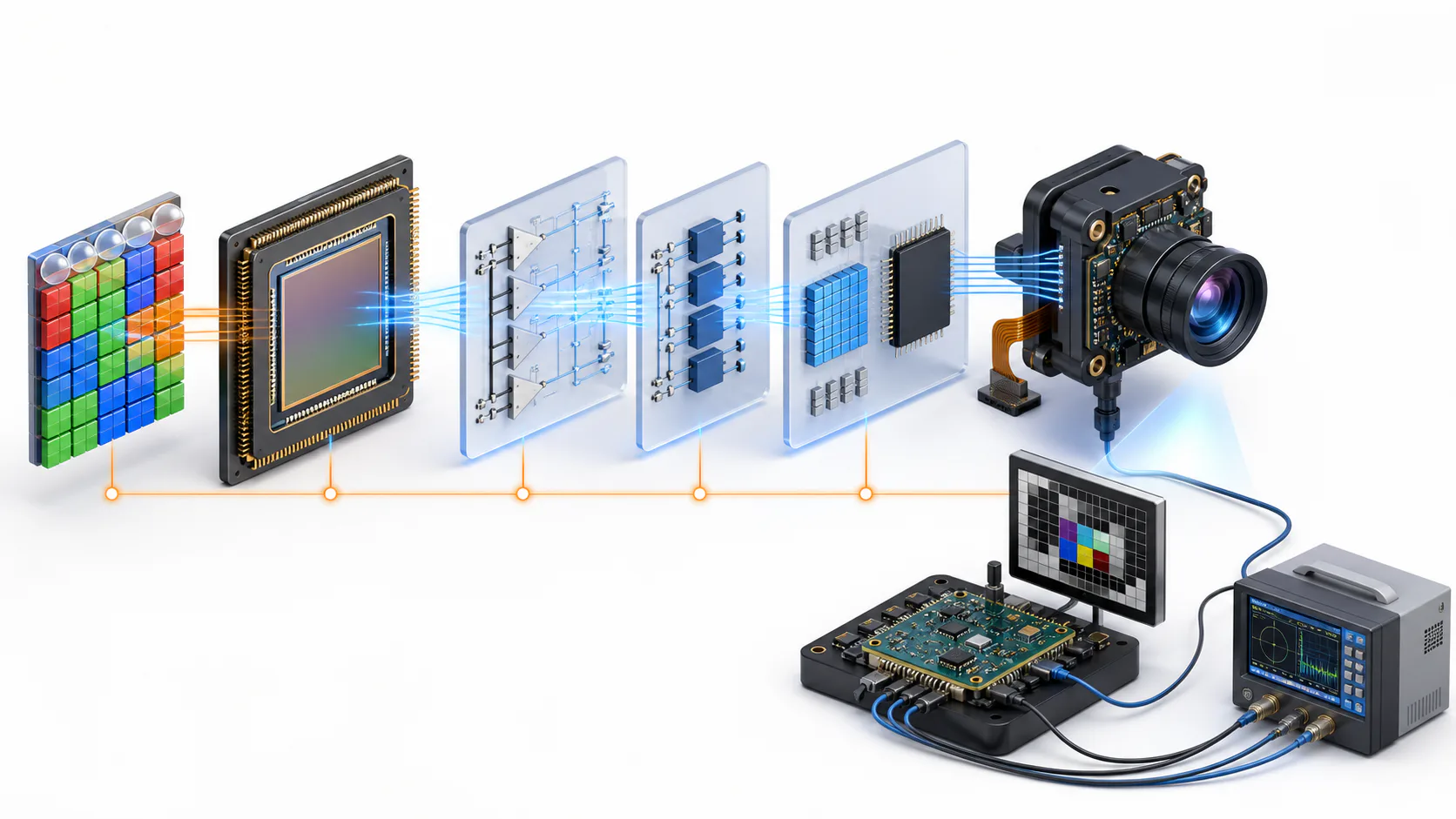
A CMOS image sensor converts light into charge, reads that charge through analog circuitry and delivers digital image data to an ISP. Its headline specifications are easy to compare. Its real behavior is tied to the complete camera system.
That is why image-sensor second sourcing is difficult. A candidate can match resolution and frame rate while producing different noise, color, artifacts or exposure behavior.
The pixel is only the beginning
Pixel architecture, photodiode performance, microlenses, color filters and analog readout determine sensitivity and noise. Smaller pixels can increase resolution in a fixed optical format, but they also collect less light and place more pressure on process control and signal processing.
Buyers should compare full-well capacity, read noise, dark current, dynamic range, conversion gain and defect behavior across temperature. Typical sample images are useful demonstrations, not qualification data.
Process consistency matters because a camera program may ship millions of units. Lot-to-lot variation and calibration yield can determine total cost more than the sensor price.
HDR is a system behavior
Automotive and security cameras must capture bright and dark regions at once. Suppliers implement HDR with different exposure schemes and readout timing. Those choices affect motion artifacts, LED flicker, latency and ISP requirements.
An alternate sensor can therefore require changes to exposure control, tuning and validation. Test moving objects, pulsed lighting, tunnels, night scenes and temperature extremes using the final lens and ISP pipeline.
Do not accept a dynamic-range number without understanding the mode, frame rate and artifact tradeoffs used to obtain it.
Interfaces do not guarantee compatibility
Two sensors may use the same general serial interface while differing in lane configuration, clocking, register map, startup sequence, embedded metadata and power rails. Package dimensions and chief-ray-angle requirements can affect the lens stack.
Firmware drivers, ISP tuning, defect correction and manufacturing calibration are part of the migration cost. A pin-compatible candidate can still require months of image-quality work.
Qualification evidence should follow the application
Smartphones prioritize size, power and computational photography. Automotive cameras add functional safety, long temperature exposure, lifecycle and traceability. Industrial vision values predictable trigger timing and consistency. Security cameras emphasize low-light performance and continuous operation.
Ask for application-specific qualification, reliability reports, PCN control, production-site information and support for tuning and failure analysis. A supplier strong in one market is not automatically qualified for another.
Build the second source early
Freeze optical, electrical and image-quality test scenes before comparing devices. Maintain raw image data and objective metrics alongside human review. Include manufacturing yield and calibration time.
If the alternate requires a new lens or ISP branch, record it as a second camera design rather than a drop-in sensor. That can still provide resilience if the work is completed before supply tightens.
The procurement conclusion
CMOS image-sensor competition is decided from the pixel through the analog readout, interface, optics and ISP. Resolution parity proves very little by itself.
A credible source qualifies image quality, production consistency and system integration together. Buyers should budget for that complete path when adding another sensor supplier.
Image performance depends on the final optical and processing system. Confirm claims through current documentation and controlled camera testing.