
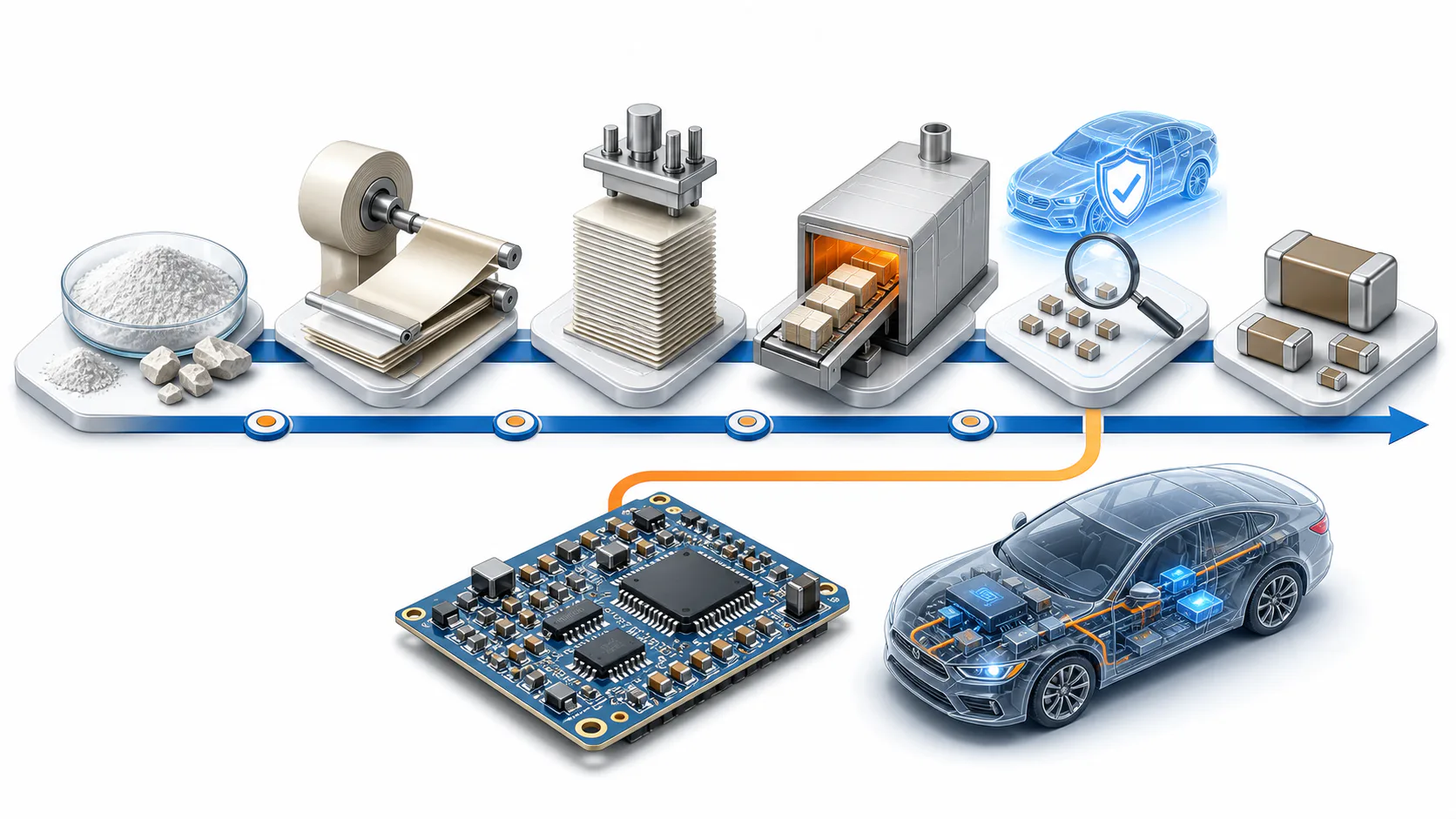
MLCC supply discussions usually begin with finished components and factory output. The harder capability sits upstream: ceramic powder, formulation, electrode materials, layer formation, sintering and process control.
Those steps determine whether a supplier can make small, high-capacitance and high-reliability devices consistently. For buyers evaluating another source, a product announcement is less useful than evidence that the complete process is stable.
High capacitance requires manufacturing control
An MLCC stacks many alternating ceramic and electrode layers. Increasing capacitance in a small case can require thinner dielectric layers and more of them. Defects, contamination, thickness variation and sintering behavior become increasingly important.
The ceramic formulation must produce the required dielectric behavior while controlling temperature characteristics, insulation resistance and reliability. Powder particle size and consistency affect the achievable layer structure.
This is why capacity for ordinary products cannot always be redirected to advanced devices. The equipment may look similar while the material and process window are different.
Automotive and server applications add separate gates
Automotive products need component qualification, long-duration reliability, traceability and strict change control. Server power delivery can require high effective capacitance, low impedance and compact placement under significant thermal and electrical stress.
Neither market is served by nominal capacitance alone. Buyers should review DC-bias behavior, temperature, flex and board stress, ripple current, insulation resistance and failure modes for the exact construction.
Suppliers such as Murata and Taiyo Yuden have accumulated process knowledge and application support over many product generations. A newer competitor does not need to copy their corporate history, but it does need comparable evidence for the requested device.
Localizing the value chain changes risk
A supplier may manufacture finished capacitors locally while depending on imported powder, electrode paste or equipment support. Another may control upstream material but have limited automotive qualification capacity.
Map the critical process and source for each family. Ask which materials are single-sourced, where formulation and firing occur, how lots are traced and what changes trigger customer notification.
This reveals whether two finished-component suppliers actually share one upstream bottleneck.
Qualify capability, not a sample lot
Initial samples can be selected from a strong lot. Production approval needs process-capability data, lot-to-lot results, reliability testing and yield behavior. Include multiple lots and manufacturing dates in validation.
Review how the supplier handles defects, root-cause analysis and containment. For a high-volume passive component, response speed and statistical control can matter as much as the first electrical result.
A practical sourcing strategy
Segment MLCCs by difficulty. Maintain broad competition for standard commercial grades. Start early qualification for high-capacitance, high-voltage, soft-termination and high-reliability series. Avoid forcing one supplier across every tier when its strongest process serves only part of the requirement.
Keep upstream material and site information in the risk record. Revisit it after PCNs, expansions or ownership changes.
The procurement conclusion
The defensible opportunity in MLCC supply is not simply adding another logo. It is developing suppliers that control the materials, thin-layer process and quality systems required for difficult products.
Buyers should measure that capability directly. Finished-part capacity is resilient only when the upstream process can reproduce it lot after lot.
Technical capability and qualification status vary by exact series and site. Confirm current evidence with the supplier.