
MLCC market analysis can easily be distorted by one part number with an extreme increase. When only a handful of units remain, a few quotation changes can produce a dramatic percentage that says little about actual supply and demand.
For this analysis of the ic.net capacitor dashboard, we excluded SKUs with single-digit inventory and retained only parts with more than 1,000 units in stock and complete continuous price and inventory records.
As of August 13, 2026, the dashboard covered 26,437 sample MLCC SKUs, including 1,065 X5R and 7,797 X7R parts. Two measurement definitions matter. At the category level, a price index measures relative movement in the center of sampled distributor quotations. A part's 7-day change is the movement in its average quotation within the sample database. Neither measure is equivalent to actual off-platform transaction prices across the entire market.
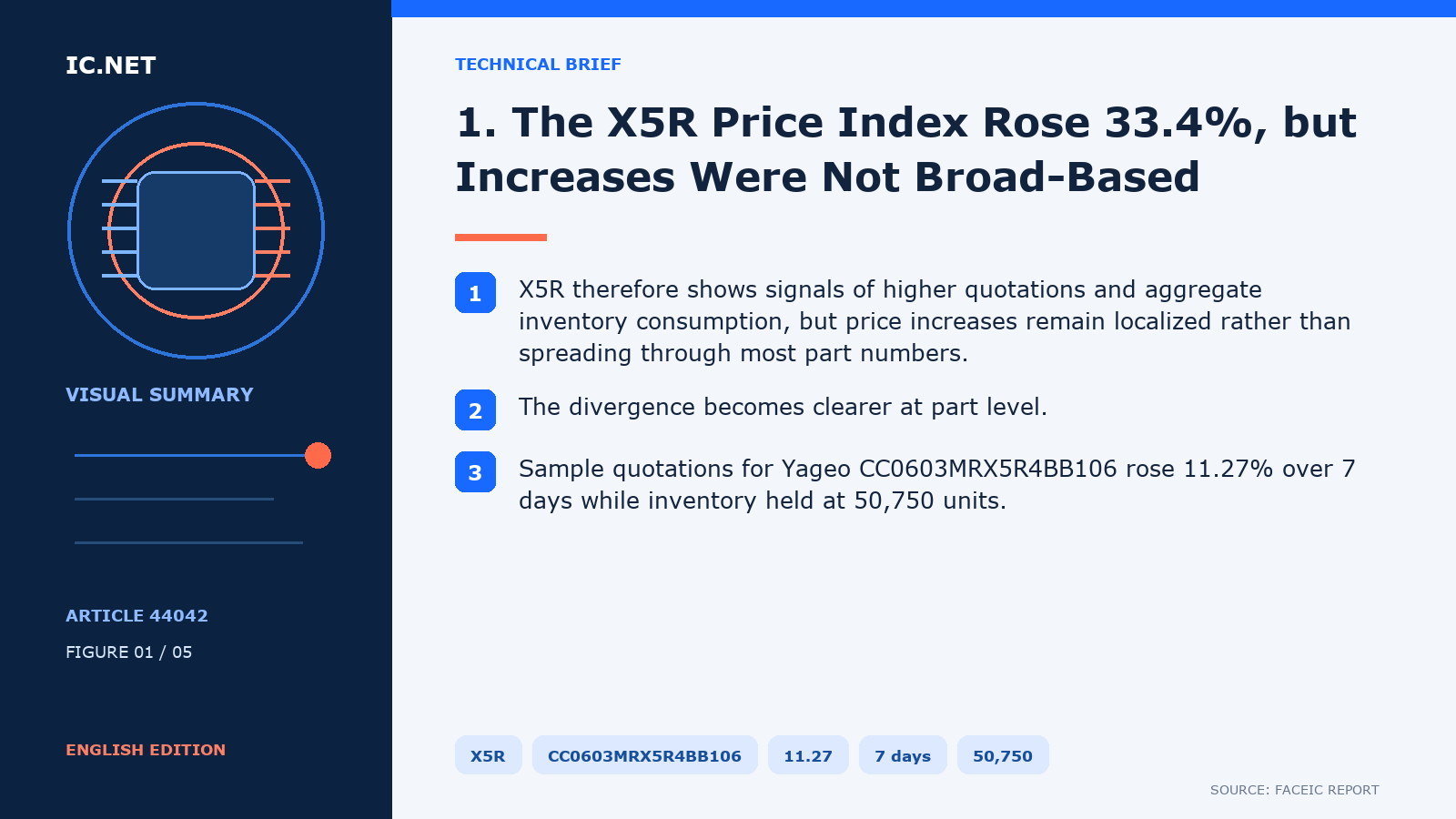
1. The X5R Price Index Rose 33.4%, but Increases Were Not Broad-Based
In the ic.net raw 30-day index, the X5R price index rose from 139.4 to 186.0, an increase of approximately 33.4%. The inventory index fell from 235.3 to 167.3, down 28.9%. Yet only 76 of the 1,065 sampled X5R parts recorded an increase or a large increase, a coverage rate of just 7.1%.
X5R therefore shows signals of higher quotations and aggregate inventory consumption, but price increases remain localized rather than spreading through most part numbers.
The divergence becomes clearer at part level. Sample quotations for Yageo CC0603MRX5R4BB106 rose 11.27% over 7 days while inventory held at 50,750 units. Murata GRM186R60G226ME15D rose 4.01% with 3,779 units still available. Both became more expensive without simultaneous inventory consumption, suggesting proactive channel repricing rather than demonstrated shortage.
Samsung CL31A226KOHNNNE presents a different pattern. Its quotation rose 2.56% over 7 days while inventory declined rapidly from 2,301 to 1,386 units, a reduction of nearly 40%. Among the current valid samples, it has the clearest combination of rising price and falling inventory. That pattern deserves closer monitoring than an isolated quotation spike.
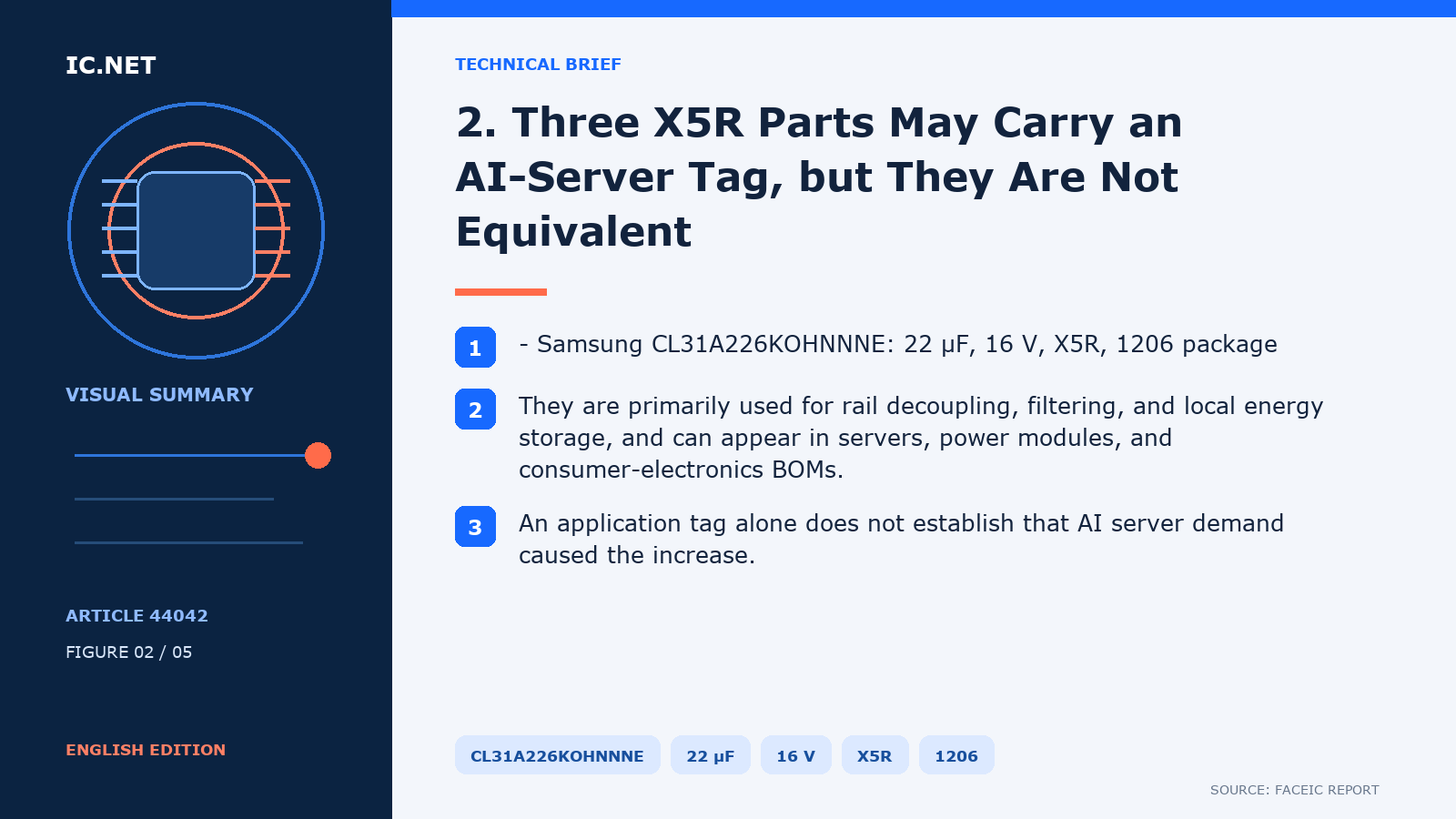
2. Three X5R Parts May Carry an AI-Server Tag, but They Are Not Equivalent
The ic.net application tags classify all three Yageo, Murata, and Samsung parts above under AI servers. Their manufacturer specifications show that they are general-purpose MLCCs, not components developed exclusively for AI servers.
- Yageo CC0603MRX5R4BB106: 10 μF, 4 V, X5R, 0603 package
- Murata GRM186R60G226ME15D: 22 μF, 4 V, X5R, 0603 package
- Samsung CL31A226KOHNNNE: 22 μF, 16 V, X5R, 1206 package
They are primarily used for rail decoupling, filtering, and local energy storage, and can appear in servers, power modules, and consumer-electronics BOMs. An application tag alone does not establish that AI server demand caused the increase.
Public channels show very different current static manufacturer lead times: 24 weeks for Yageo, 17 weeks for Murata, and 39 weeks for Samsung. These are point-in-time values. Because the dashboard lacks a continuous lead-time history, it cannot establish that lead times lengthened quarter over quarter. Falling inventory combined with a long static lead time gives the Samsung part the strongest tightness signal, but still does not prove a production adjustment or discontinuation at Samsung.
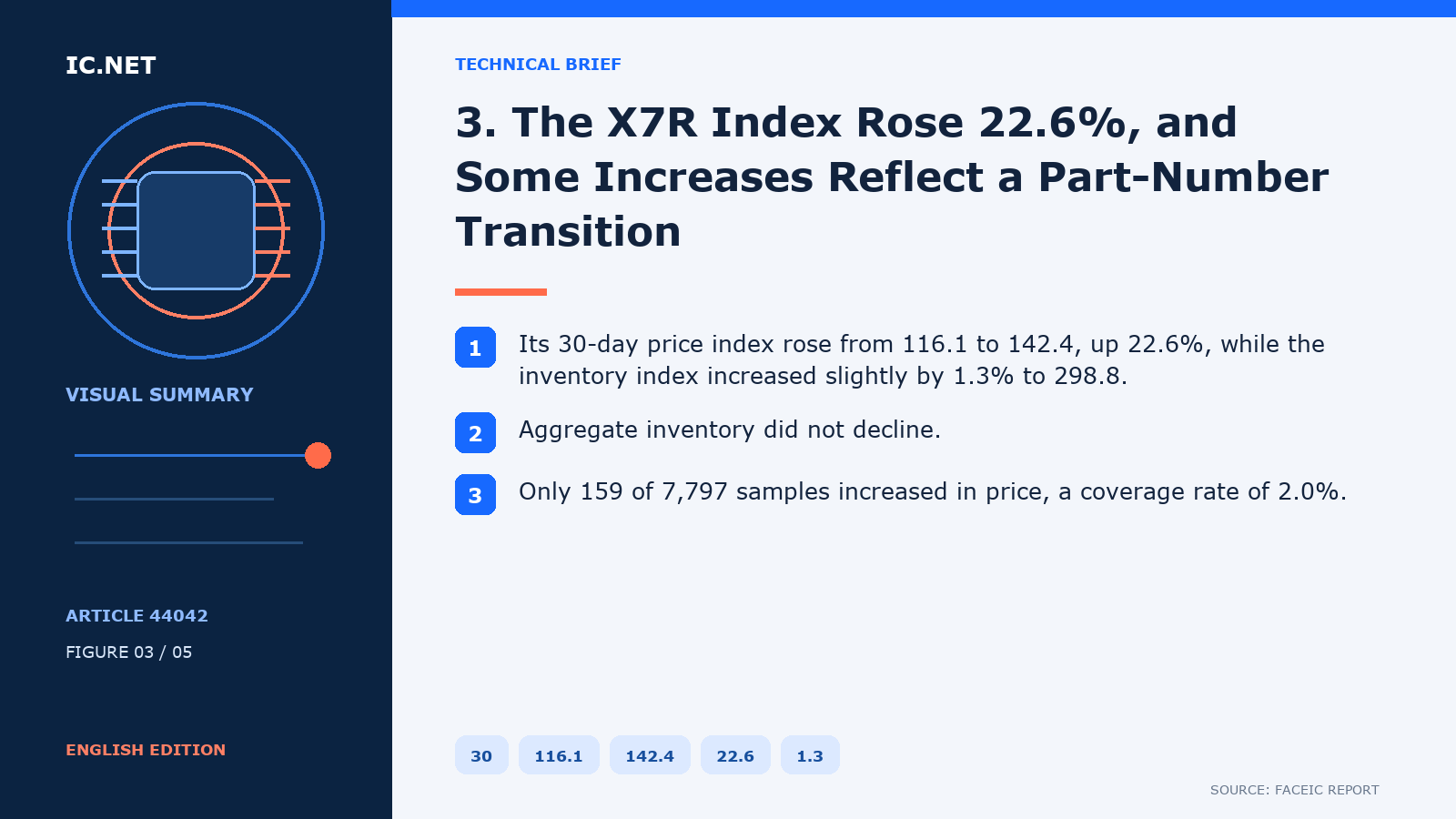
3. The X7R Index Rose 22.6%, and Some Increases Reflect a Part-Number Transition
X7R behaved differently. Its 30-day price index rose from 116.1 to 142.4, up 22.6%, while the inventory index increased slightly by 1.3% to 298.8. Aggregate inventory did not decline. Only 159 of 7,797 samples increased in price, a coverage rate of 2.0%.
Taiyo Yuden HMJ107BB7472KAHT rose 22.20% over 7 days while inventory remained stable at 2,022 units. Price alone suggests severe shortage, but manufacturer information identifies HMJ107BB7472KAHT as a legacy part approaching end of life. The replacement is MBJCH168BB7472KTPA01, specified at 4,700 pF, 100 V, X7R, 0603 with soft termination for communications infrastructure and industrial markets.
Public channels currently mark the old part as being in the final phase of discontinuation, with a static lead time of approximately 10 weeks. The new part is at 10-11 weeks. This increase is therefore better explained by end-of-life channel inventory repricing and a purchasing transition to the new part than by a sudden industrial or automotive demand gap. It is a typical combination of part migration and channel repricing.
4. Capacity Is Moving Upmarket, but Headlines Alone Do Not Describe the Market
According to TrendForce's July industry report, AI is strengthening demand for advanced MLCCs. Japanese and Korean producers are gradually moving capacity from consumer-grade X5R toward higher-specification X6S and X7R products, squeezing medium- and high-capacitance consumer MLCCs from 1 μF to 22 μF. At the same time, end demand for ordinary consumer electronics remains weak, creating a structural contradiction between subdued device demand and rising channel quotations.
That framework can explain the decline in the overall X5R inventory index and anticipatory repricing by channels. It does not establish that every higher-priced part was driven by AI servers. In the ic.net sample, Samsung CL31A226KOHNNNE combines price movement and inventory consumption; selected Yageo and Murata parts show higher price without lower inventory; and the Taiyo Yuden legacy part is driven by a lifecycle transition.
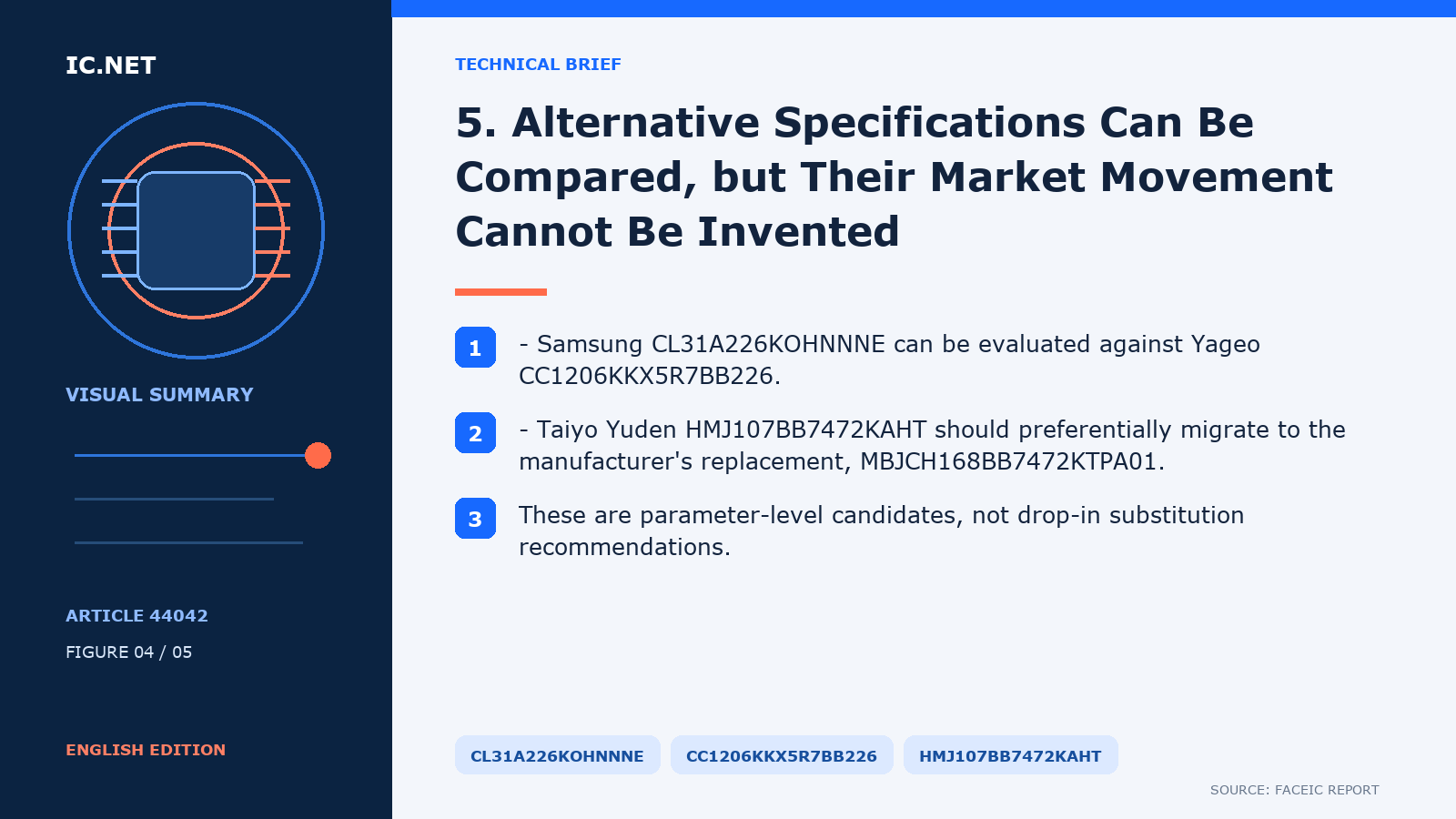
5. Alternative Specifications Can Be Compared, but Their Market Movement Cannot Be Invented
Potential parameter-level alternatives exist for the highlighted parts:
- For Yageo CC0603MRX5R4BB106, Murata GRM185R60G106ME15D is a candidate with the same 10 μF, 4 V, X5R, 0603 headline specification.
- Murata GRM186R60G226ME15D can be compared with Yageo CC0603MRX5R4BB226.
- Samsung CL31A226KOHNNNE can be evaluated against Yageo CC1206KKX5R7BB226.
- Taiyo Yuden HMJ107BB7472KAHT should preferentially migrate to the manufacturer's replacement, MBJCH168BB7472KTPA01.
These are parameter-level candidates, not drop-in substitution recommendations. Selection still needs thickness, effective capacitance under DC bias, ESR, soft-termination behavior, temperature range, automotive qualification, and internal customer validation. The historical sample also lacks continuous market series for the alternatives, so their price or inventory direction cannot be inferred. Future part-level analysis should require complete price and inventory histories for both the target and its alternatives.
Summary: Three Different Markets Are Overlapping in This MLCC Movement
The detailed data do not show a simple, market-wide MLCC shortage. Three effects are occurring together. First, the X5R category inventory index is falling and supply-chain buffer is genuinely shrinking. Second, some parts show higher quotations with unchanged inventory, consistent with anticipatory channel repricing. Third, some increases result entirely from end-of-life transitions between old and new part numbers.
For procurement, a part such as Samsung CL31A226KOHNNNE—with rising price, inventory consumption, and a long static lead time—deserves an immediate review of open orders and second-source progress. Yageo and Murata parts whose prices rise without inventory decline can be monitored for wider propagation rather than prompting panic buying. For discontinued Taiyo Yuden parts, the priority is completing the migration, not competing for aging inventory.
A single price spike does not confirm a supply-demand inflection. The stronger condition is the same part showing sustained inventory drawdown for 2-3 weeks and a longer lead time while its alternatives also rise in price and fall in inventory. Only when all three occur together is pressure likely to pass into the BOM.
The components discussed here have been organized as part data cards in the ic.net App. The figure below uses channel samples collected by the platform to show price, inventory, and period changes at individual-part level. It reflects the ic.net App sample only and is not equivalent to market-wide quotations, inventory, or transaction prices.
Disclaimer: This article uses ic.net distributor samples, public manufacturer information, and authorized-channel data for industry discussion only. It does not constitute a procurement decision, investment advice, or a direct part recommendation.