Bankruptcy review is not bankruptcy — but the supply question is already live
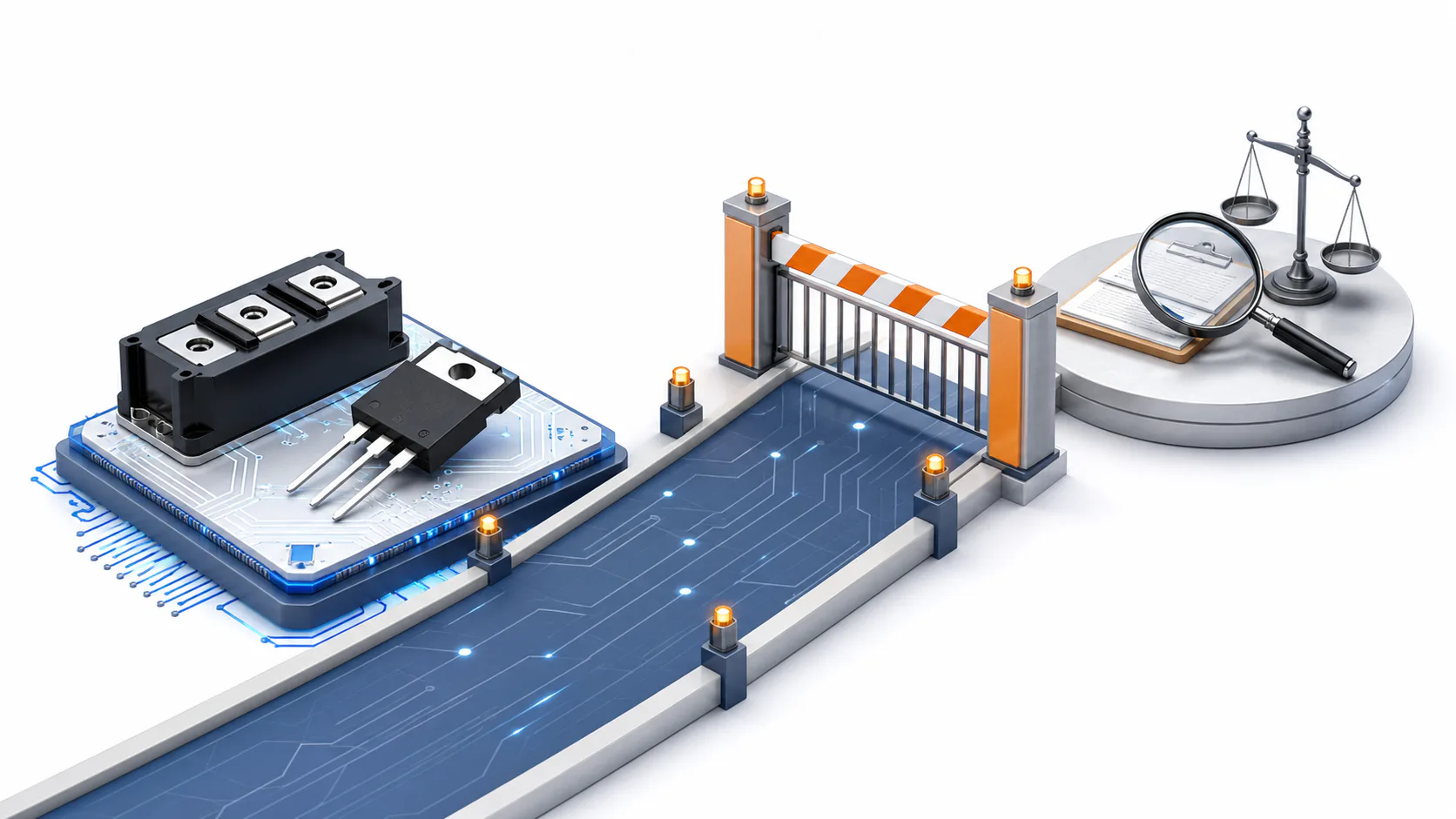
Tengrui Micro (founded 2021; IGBT design, discretes, third-gen semiconductor materials; one A-round) has a new bankruptcy-review case filed at Shenzhen Futian District Court. Important nuance: bankruptcy review is not a court declaration of bankruptcy — it may lead to liquidation, restructuring, settlement, or be dismissed.
But for procurement, supply chain and distributors, the moment the news breaks the question is no longer "how will the court rule," it's: can the parts still ship? Will a designed-in part number go end-of-supply? What happens to the inventory, orders and qualification data customers already hold?
Why a hot track can still run out of cash
IGBT is everywhere — EV traction, PV inverters, storage converters, industrial VFDs, appliance power. SiC MOSFET is the great hope for 800 V EVs, ultra-fast charging, PV/storage and high-end power. The track is right.
The trap is that power semis look like big-order, slow-cash businesses. A chip company pays first for R&D, tape-out, packaging, test and equipment — then waits for customer sampling, qualification, small-batch design-in, and only much later, stable volume. Automotive qualification can run in years. So payroll and equipment are due today; the batch orders and cash arrive far later.
You can plan a technology roadmap three years out, but cash flow often only covers a few months. Big market, real product — and a long river between "we made a sample" and "we make money."
IGBT second-sourcing is not "find a chip with matching numbers"
China's IGBT field isn't short of players — StarPower, Silan, CRRC Times Semiconductor, BYD Semiconductor all invest across die, discretes and modules.
| Role | Part / Supplier | Note |
|---|---|---|
| Incumbent / benchmark | Infineon IKW40N120H3 | 1200 V / 40 A IGBT, TO-247 — UPS, welders, high-frequency conversion |
| China-based alternative | StarPower · Silan · BYD Semi | Die, discretes and modules across the same voltage classes |
| Incumbent / benchmark | ST SCT040H120G3AG | 1200 V, 40 mΩ, 40 A auto-grade SiC MOSFET, H2PAK-7, in production |
| Incumbent / benchmark | Wolfspeed C3M0065090J | 900 V, 65 mΩ, 35 A — EV chargers, HV DC-DC, power |
| China-based alternative | Sanan · Basic Semi · Global Power | SiC material or device investment |
If procurement reads only "1200 V, 40 A, TO-247," a domestic alternative looks easy. Real engineering validation is not. You still confirm whether VCE(sat) is close, switching loss matches, short-circuit withstand time is enough, reverse-recovery affects system efficiency, junction temperature and thermal resistance change the heatsink design, and gate-drive parameters need re-tuning.
The same 1200 V IGBT behaves differently in a PV inverter, an industrial VFD and an EV main drive — frequency, load profile and temperature all differ. The datasheet can line up while the system temperature rise does not; a sample can pass while post-volume consistency does not. So IGBT second-sourcing is really about re-validating device + driver + thermal + control strategy.
Gate one: does it work. Gate two: does it work stably. Gate three: can the supplier keep working.
SiC is hotter — and tests endurance even harder
SiC's story is sexier: higher voltage, lower switching loss, higher efficiency, smaller and denser systems. But getting a SiC MOSFET into a system means re-adapting gate drive, switching speed, parasitic inductance, EMI, thermal and protection. Device price is only part of the cost — validation time, test equipment, failure analysis and customer certification all burn capital too.
The bigger the opportunity, the fiercer the competition — and as more entrants crowd one track, prices get pushed, and supplier cash-flow pressure can actually rise. SiC isn't "make it and sell it" — it's "burn cash a long time before you sell it."
The signal to watch: not "small supplier" but "status you can't pin down"
Supplier decks lean on words like taped out, sampling, customer sampling, in qualification, small-batch supply, in mass production. All upbeat, all very different in meaning. Sample = testable. Qualification = customer hasn't fully accepted. Small-batch = shipping, but capacity and consistency still unproven. Only stable mass production means genuine, sustained delivery capability.
- A domestic power-device quote dropping sharply → could be competition, could be a supplier dumping inventory.
- Lead time shifting from "schedulable" to "inquire" → line, material or funding change.
- Supplier count steadily shrinking → single-source risk rising.
None of these proves trouble — but each helps a buyer catch an anomaly early. The useful market analysis isn't today's price; it's whether you can still get this part number next month.
Bottom line
This case doesn't prove the IGBT/SiC direction is wrong, or that peers carry the same risk. It flags that China's power-device second-sourcing is now a combined contest of technology, capacity, customer and cash flow. To evaluate a supplier, check four things: can the product be used, can customers qualify it, can the firm reach volume, can the cash flow last until orders convert.
So don't keep only a "domestic-alternative part list" — keep a "supplier-delivery-risk list" beside it. In a real supply chain, the most expensive part is rarely the chip itself — it's the chip that was fully qualified and then suddenly couldn't ship.