
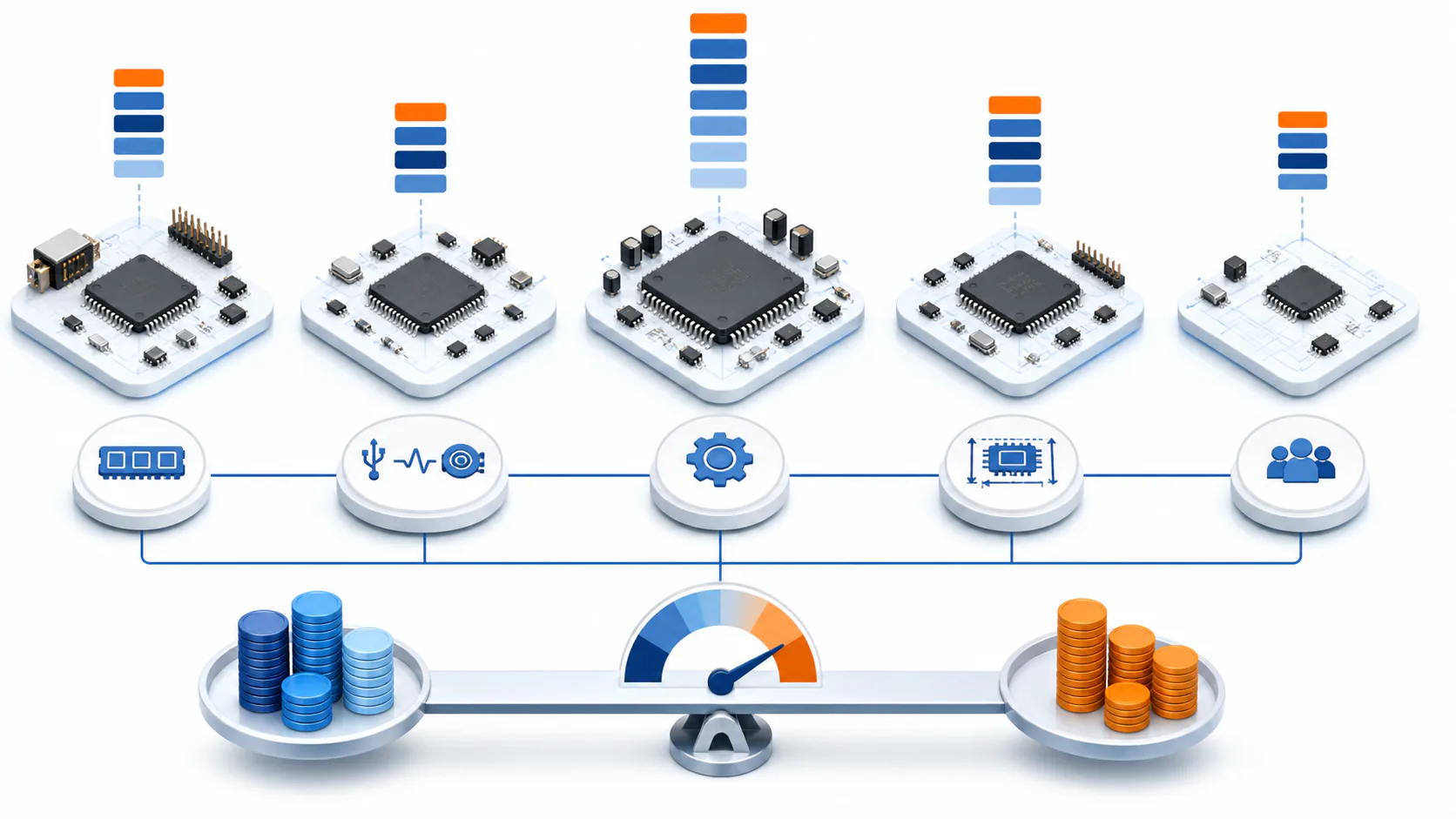
Five public one-piece listings captured on August 5, 2026 ranged from about $1.34 for STM32C011F6P6 to $24.19 for STM32N657X0H3Q. Those listings were not volume quotes, but they illustrated how misleading a single “STM32 price” can be.
The devices address different jobs. Paying more is rational only when the additional capability removes a system cost or a verified project risk.
Start with the workload
STM32C011F6P6 provides a small Cortex-M0+ platform for simple control, sensing and housekeeping. STM32G431CBT6 adds fast mixed-signal peripherals and motor-control resources. STM32U535VET6 emphasizes memory, low power and security, while STM32H743ZIT6 targets demanding real-time and interface workloads. STM32N657X0H3Q moves into edge-AI and graphics territory.
Clock frequency cannot express those differences. List control-loop deadlines, concurrent interfaces, signal-chain requirements, security functions and the measured Flash and RAM footprint before choosing a family.
Expensive silicon can enlarge the BOM
A higher-end MCU may require a larger package, more power rails, additional decoupling, a more complex clock tree, high-speed routing and a larger software stack. An N6-class design can also need external nonvolatile memory and more demanding thermal planning.
Those costs belong in the comparison. A device that looks like generous headroom can quietly increase PCB area, validation scope and firmware complexity without removing any peripheral component.
Ask exactly which converter, accelerator, memory device or development month the upgrade eliminates.
A small MCU can also become expensive
Choosing too little memory or too few interfaces can force external Flash, protocol compromises and repeated board revisions. OTA updates, diagnostics and communication buffers often consume the margin that looked comfortable in an early spreadsheet.
Use production compiler output and worst-case runtime measurements. Include bootloader, update image, stack peaks and future functions that have an approved requirement. A vague possibility is not a sizing input, but a released roadmap is.
Compare two complete implementations
Build one candidate around the smallest device that meets the requirement and another with justified margin. Price the MCU, external components, PCB, power, software migration, test effort and inventory transition for both.
Then prototype the difficult operating conditions. Verify pin multiplexing, ADC timing, simultaneous peripherals, thermal behavior and fault recovery. Check the exact package and suffix because members of one STM32 family are not automatically pin- or software-compatible.
Lifecycle status, authorized availability and toolchain support should be reviewed with the technical fit.
The procurement conclusion
The August price spread did not rank five MCUs from worst to best. It priced several distinct system roles through a noisy retail lens.
The right device is the lowest total-cost implementation with measured margin and an acceptable supply path. Every step upward should remove a named constraint; every step downward should survive a real resource and validation test.
Prices cited here are dated one-piece public listings, not current or volume quotations.