
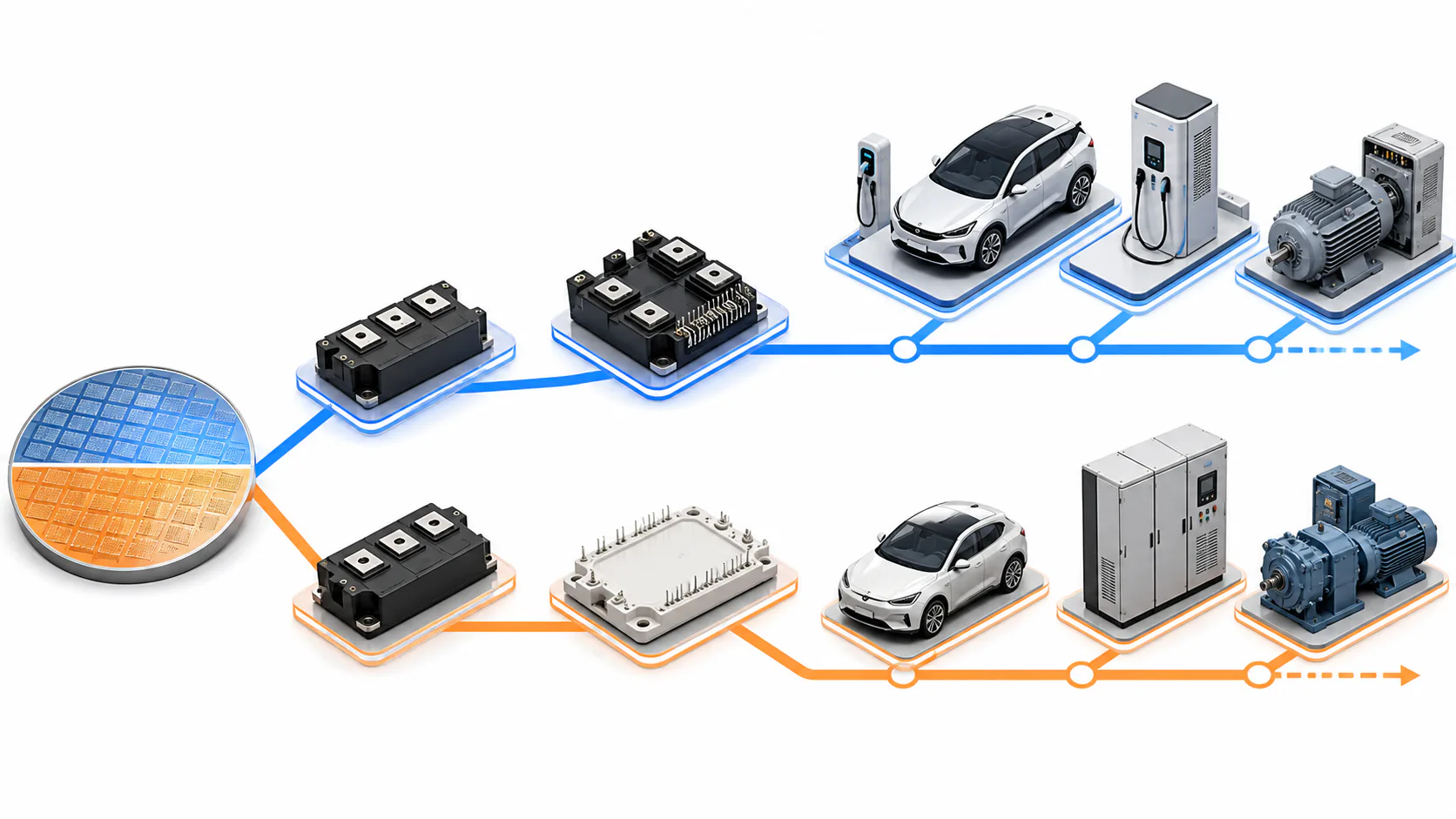
Silicon carbide was gaining ground in high-voltage vehicle traction and other efficiency-sensitive systems in April 2026. That did not make every IGBT obsolete. Channel observations for established IGBT products remained broadly stable, which was consistent with a market in transition rather than a market completing one.
For procurement teams, the important question was never whether SiC would grow. It was where its system benefit justified a new cost, control scheme and qualification path.
Replacement happens at the application level
A semiconductor technology does not replace another across every converter at once. Switching frequency, bus voltage, load profile, cooling, acoustic limits and efficiency targets change the answer.
SiC can reduce switching losses and enable smaller passive or thermal systems in suitable high-voltage designs. A mature IGBT can still be the lower-risk choice in cost-sensitive motor drives, appliances, UPS equipment and industrial converters whose operating point does not reward the same switching performance.
The comparison therefore belongs at inverter or power-stage level, not in a generic price-per-device table.
Stable supply is useful evidence, not a lifetime guarantee
The April snapshot showed no broad collapse in the observed IGBT channel. Stable prices and available offers suggested continued demand, but they could not prove that every part had a secure future.
Buyers should examine lifecycle status, factory commitment, package availability and the concentration behind each approved MPN. Mature technology can remain economically healthy while individual products become exposed to line transfers, wafer reallocation or package discontinuation.
A category average hides precisely the long-tail parts that create production stops.
Compare complete design paths
Moving from IGBT to SiC can change the gate driver, isolation, protection thresholds, PCB layout, electromagnetic behavior and thermal interface. It may also require a different module footprint and supplier service model.
The engineering review should measure switching and conduction loss over the real mission profile. It should include short-circuit behavior, gate transients, thermal cycling, EMI and fault response. A better data-sheet headline is not an approved replacement.
Commercial analysis should include system savings and requalification expense alongside semiconductor cost. That prevents an expensive device from being rejected when it reduces total system cost, and prevents an fashionable technology from being adopted where it adds little value.
Build two risk maps
Maintain one roadmap for performance-driven adoption and another for continuity. The first identifies platforms where SiC creates measurable value. The second identifies IGBT designs with long production lives, single-source modules or limited redesign windows.
For each path, track the actual die technology, module or discrete package, gate-driver dependency, alternate sources and customer approval status. A second logo is not meaningful if it depends on the same bottleneck or requires a board redesign.
STARPOWER and other IGBT suppliers should be assessed on the relevant family and application evidence, not on a broad nationality or technology label.
The procurement conclusion
The April 2026 data supported coexistence: SiC was advancing in applications that paid for its performance, while IGBT continued to serve large mature markets. Neither observation justified a blanket inventory decision.
Buyers should protect exposed IGBT programs, qualify SiC where the system case is real and review both roadmaps on product-specific evidence. Technology transitions are schedules made of many BOMs, not one industry deadline.
This analysis reflects an April 2026 market snapshot and is not a current availability or design recommendation.