
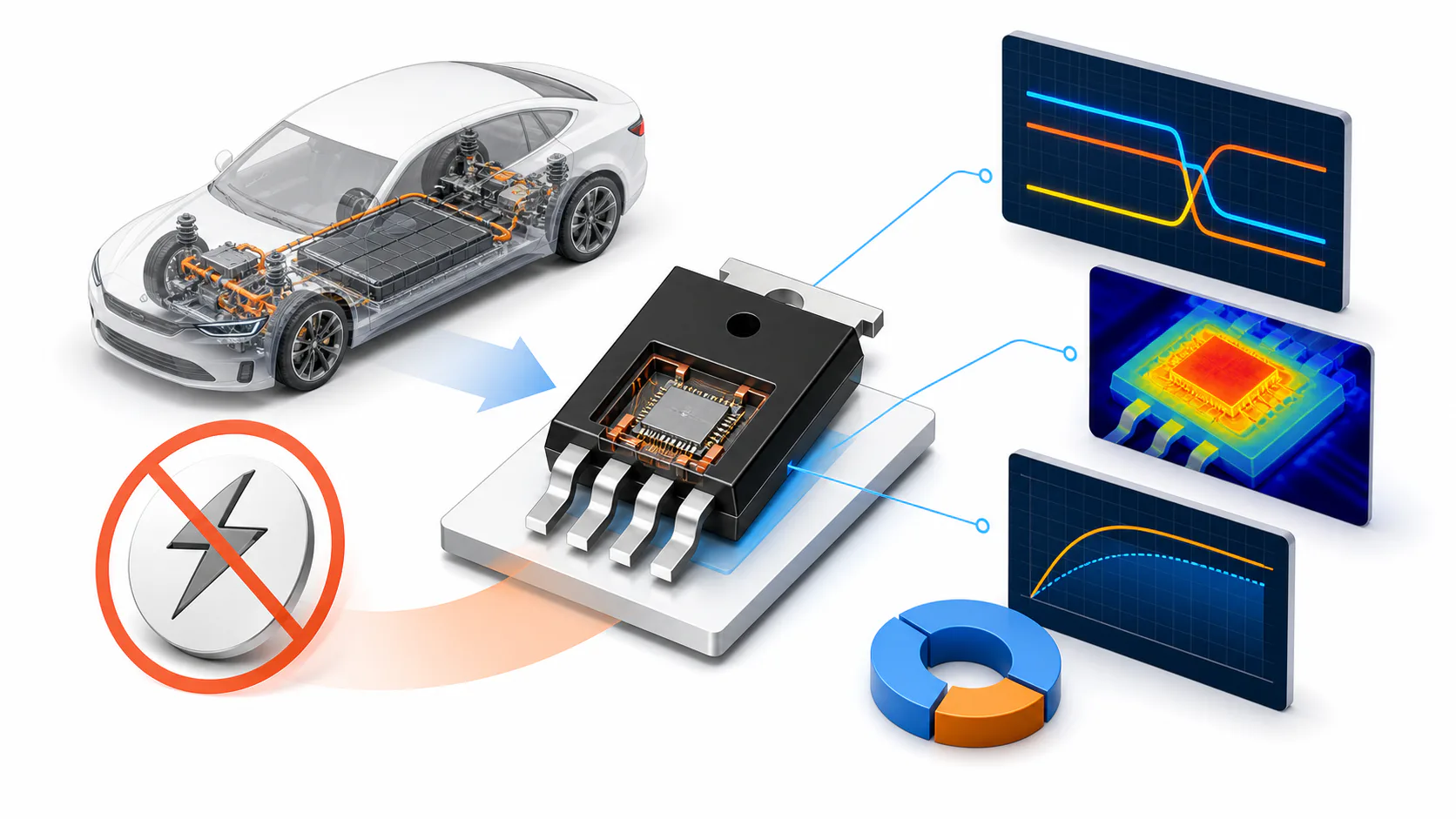
High-voltage MOSFET opportunities are often described by one number: 650 V, 750 V or 800 V. That number is important, but it does not define performance in an on-board charger, DC-DC converter, compressor or auxiliary inverter.
The device operates inside a switching loop with a gate driver, package, busbar, magnetics, cooling and control algorithm. A credible second source must be qualified in that loop.
Choose technology for the operating point
Silicon superjunction MOSFETs, SiC MOSFETs and other power devices offer different tradeoffs in switching frequency, conduction loss, reverse recovery, gate drive and cost.
Compare losses across the real voltage, current, temperature and switching pattern. A lower room-temperature on-resistance can be offset by switching energy or higher hot resistance.
Do not infer application fit from voltage class alone.
Package parasitics become circuit behavior
Lead inductance, source connection, thermal path and isolation affect overshoot, ringing and switching speed. A device in a nominally similar package may require different gate resistance or layout.
Review creepage, clearance, mounting torque, interface material and cooling. Test the final power loop with realistic bus inductance and current.
If the alternate needs a board or busbar change, classify it as a second design rather than a drop-in part.
Gate drive needs revalidation
Threshold voltage does not define drive requirements. Compare recommended gate voltage, negative bias, gate charge, Miller behavior, short-circuit withstand and driver protection.
Fast edges can improve efficiency while worsening EMI and overshoot. Tune the driver with the candidate device and repeat emissions, immunity and thermal tests.
Protection thresholds and desaturation timing may also change. A reused setting can trip unnecessarily or respond too slowly.
Reliability is application-specific
Review automotive qualification for the exact product and site, along with power cycling, temperature cycling, humidity, gate-oxide and avalanche evidence. Understand which failure mechanisms the supplier monitors in production.
Mission profile matters. Repeated thermal cycling in a traction or compressor application differs from steady operation in a charger. Convert vehicle duty cycle into junction-temperature and switching stress before comparing lifetime data.
Build supplier readiness into the AVL
Request controlled data, models, lot traceability, PCN terms, capacity information and failure-analysis support. Evaluate wafer, assembly and test dependencies. Two device brands can still share one foundry or package bottleneck.
Qualify samples from multiple lots and production dates. Record switching waveforms, efficiency, thermal images, EMI and fault results for incumbent and candidate.
The procurement conclusion
The high-voltage MOSFET market can support more sourcing choices, but safe substitution requires evidence at the switching-system level. Voltage rating creates a shortlist; dynamic behavior and reliability create approval.
Buyers should fund that qualification before allocation. A second source is valuable only when the converter can use it without consuming hidden electrical or thermal margin.
Confirm device limits and automotive qualification in current supplier documentation and application testing.