
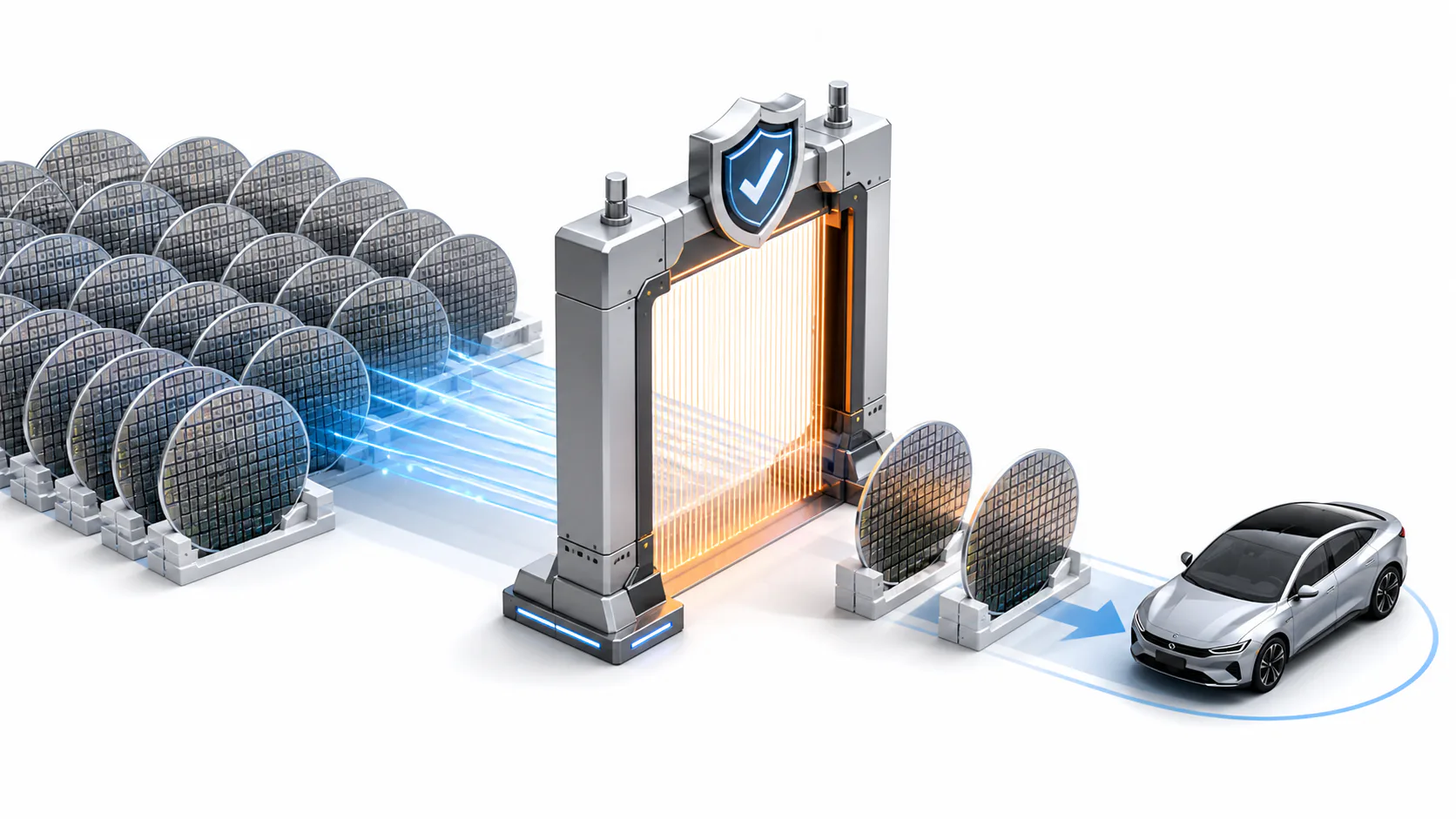
The SiC market in July 2026 carried both oversupply language and large investment plans. The source described Bosch committing about $2 billion to convert its Roseville site for 200 mm SiC production, alongside potential US support.
The apparent contradiction disappears when capacity is separated by stage and qualification.
Wafer diameter is not the final metric
Moving from 150 mm to 200 mm can improve die economics if crystal quality, epitaxy, device processing and yield transfer successfully. A larger wafer with poor yield does not create competitive device supply.
Buyers should ask for qualified die output, not nominal wafer starts. Track defect density, parametric distribution and learning-curve progress for the relevant voltage and resistance class.
The useful denominator is accepted automotive devices per month.
Oversupply can exist upstream
Substrate prices can fall while automotive MOSFETs or modules remain constrained by epitaxy, device yield, package capacity or customer qualification. Commodity products and application-specific products do not share one market clearing price.
An AEC-Q101 result also does not establish approval for a traction inverter. The OEM and Tier 1 still validate switching, short-circuit behavior, thermal cycling and mission-profile reliability.
Category inventory should therefore be segmented by process, package and released program.
Bosch is building a system position
Bosch participates in vehicle electronics beyond the bare die. Combining device manufacturing with module, driver and automotive integration knowledge can shorten feedback between failure data and process improvement.
That systems advantage does not guarantee cost or yield leadership, but it changes the qualification proposition. A customer may value one accountable chain for silicon, packaging and application support.
Competing suppliers need comparable evidence and response capability, not only a lower MOSFET quote.
Audit the real dependency map
For each SiC BOM position, identify substrate, epitaxy, wafer fab, package site, module assembly and qualified alternative. Two brands can share a hidden upstream dependency.
Review capacity by exact product family and approved factory. Require PCN terms, traceability and a plan for process transfer. A new 200 mm line should be treated as a new manufacturing source until its qualification is complete.
For planning, maintain separate dates for equipment readiness, internal device qualification, module qualification and customer production approval. Attach expected yield and package capacity to each milestone. This avoids counting the same future output several times and shows whether the constraint has moved from wafer fabrication into assembly, testing or vehicle validation.
The procurement conclusion
SiC could be oversupplied in one part of the chain and scarce in automotive-qualified output at the same time. Bosch's investment was a long-term manufacturing and integration decision, not proof that every SiC segment was tight.
Buyers should manage the qualified supply pool that reaches their inverter or charger. Nominal gigawatts, wafer starts and subsidy headlines become actionable only after yield, package and customer approval are connected.
This analysis reflects investment information available in July 2026 and is not a current capacity forecast.