
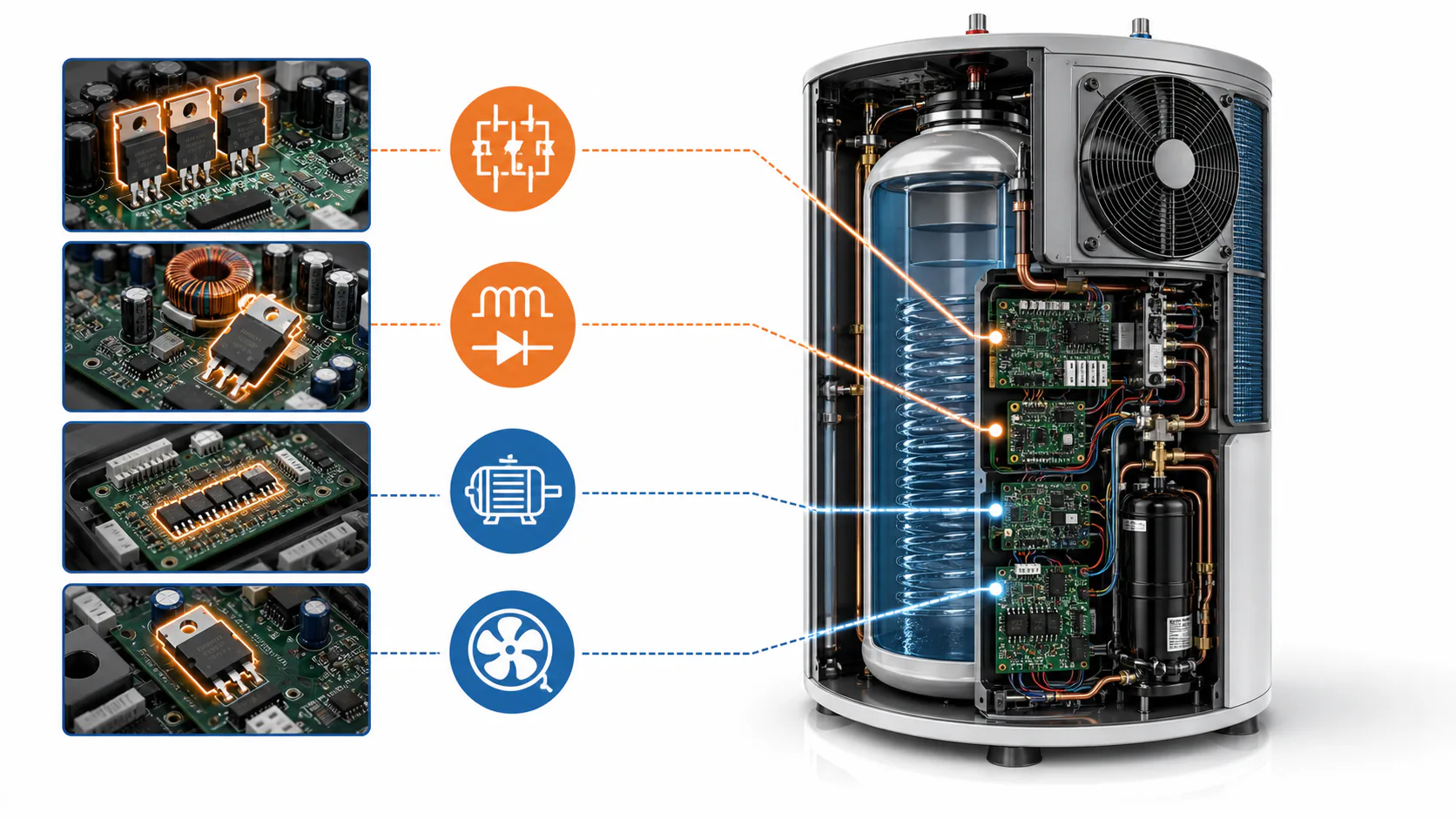
Why heat pumps put IGBT into a water heater
Traditional electric water heaters heat by resistance; gas units revolve around valve control, fan, ignition and sensing. Power-semiconductor content is low in both. What brought IGBT into the supply chain is the air-source heat-pump water heater and its inverter variants.
A heat-pump water heater is closer to a small heat-pump air conditioner: it moves heat with a compressor rather than converting electricity straight into heat. So whether the compressor runs efficiently, quietly and across a wide operating window directly determines system COP, low-temperature heating capability, start-up inrush, service life and user experience.
In that architecture IGBT stops being a switch and becomes the device behind compressor inversion, PFC power-factor correction, fan and pump drive, and overall efficiency. Read this category through "heat-pump, inverter, system-integrated" — not through the conventional storage-tank electric heater.
The China-based bench, mapped to this application
| Supplier | Where it fits |
|---|---|
| Silan | The most established white-goods IPM base |
| BYD Semiconductor | Automotive-grade background spilling into appliance IPM |
| China Resources Micro | IDM platform; IPM and RC-IGBT worth tracking |
| StarPower | Strong module capability; mid-to-high power |
| Macmic | Complete IGBT module matrix; better matched to commercial heat pumps |
| Yangjie · NCE Power | Discrete power platforms filling the periphery |
The practical selection rule: domestic heat pumps run on 600 V three-phase IPM; commercial upgrades move to IGBT / PIM modules; the PFC front end pairs a 650 V IGBT with a driver IC.
The channel matters as much as the die
Appliance markets split their sourcing. Leading OEMs bring parts in jointly with the die maker, the solution house and the control-board manufacturer. Smaller brands lean on agents, distributors, design houses and e-commerce.
For a water-heater maker the distribution layer is not just where you buy — it delivers three things: alternative selection, prototype bring-up, and failure analysis. An IGBT/IPM swap is never a straight BOM substitution. Package and pin-out, protection logic, VCE(sat), switching loss, thermal resistance, short-circuit withstand and EMI behaviour can each affect system certification and field reliability.
The real threshold: cost-sensitive and reliability-sensitive at once
Water heaters are a market where the OEM looks past the datasheet at long-term supply, batch consistency, field failure rate, EMI-rework capability, and whether the control-board house is comfortable using the part. That combination — not headline specs — is what gates adoption.
Bottom line
Water heaters are not IGBT's largest market, but they are a good vantage point on China's power devices moving from industrial and new-energy applications deeper into appliances. Inverter-driven air-source heat pumps pull 600 V/650 V IPM, PFC IGBT, RC-IGBT and small motor-drive parts onto the same control board. Silan, BYD Semiconductor and China Resources Micro sit closest to the appliance IPM mainstream; StarPower and Macmic suit mid-to-high power and commercial units; Yangjie and NCE Power fill the periphery through discretes and channel reach. The opportunity is not single-part substitution — it is the combination of system efficiency upgrade + domestic supply-chain adoption + distribution support reaching down-market.