
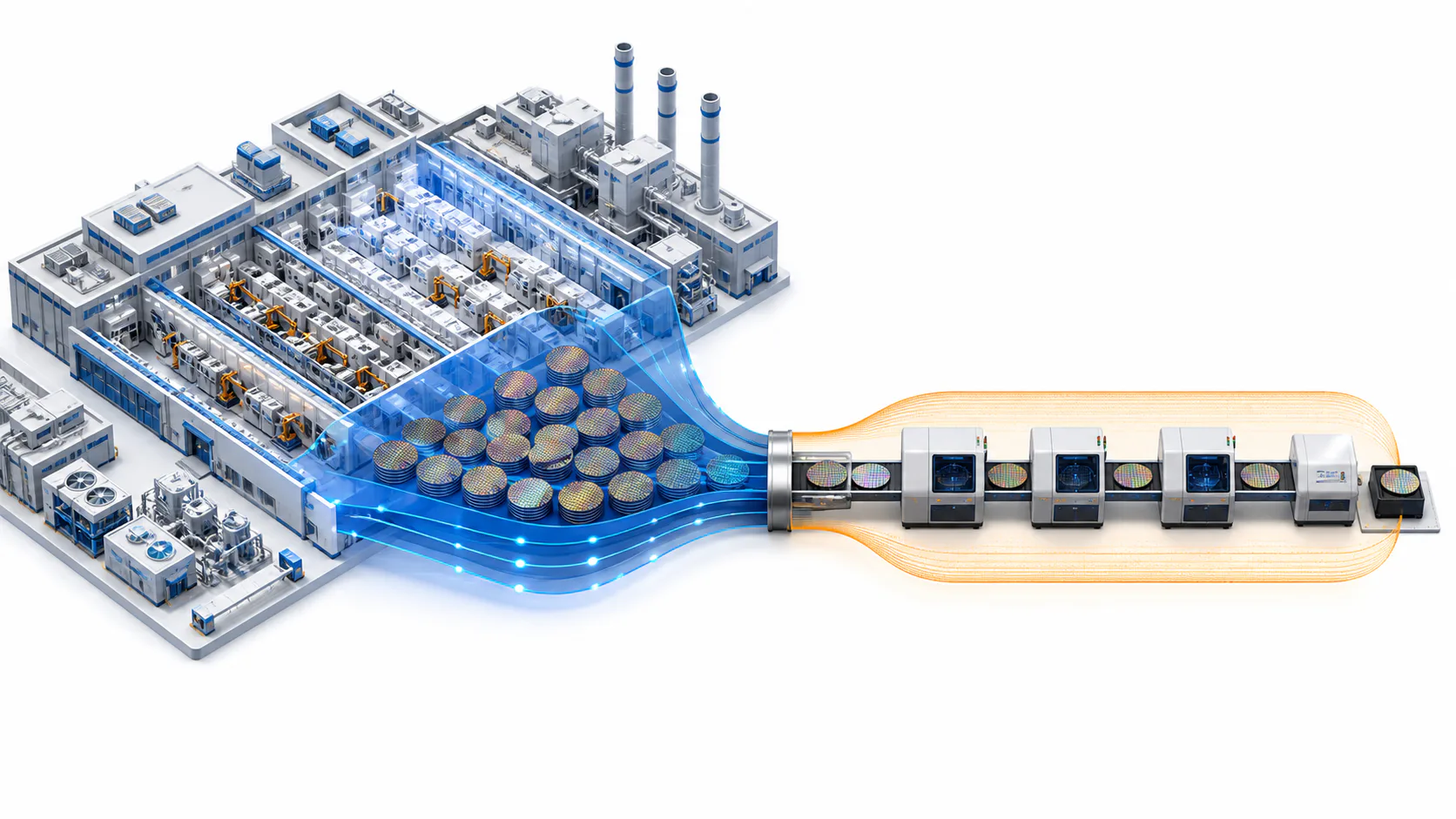
The July 2026 source described Nanya Technology planning a 69% capacity expansion over three years while industry participants expected DRAM tightness to persist. The numbers addressed different clocks.
A fab plan concerns future output. A released BOM needs qualified devices and confirmed deliveries now.
AI demand reallocates more than HBM
AI infrastructure directly consumes HBM and server DRAM, while manufacturer capital and engineering attention move toward higher-value products. That can affect commodity and mature DRAM supply even when those devices are not installed beside an accelerator.
The result is segmentation by generation, density and customer. A company-wide capacity number cannot describe every DDR4 and DDR5 product.
Buyers should map the exact device family to its production process.
Capacity arrives through several gates
Fab construction is followed by equipment installation, process qualification, yield ramp, package and test readiness and customer approval. Each stage consumes time.
Nominal wafer starts are not saleable devices. Track the announced milestone, qualified product mix and expected accepted output separately. A delay or mix change can leave total capacity on plan while a named MPN remains tight.
Near-term coverage should not assume future wafers.
Nanya occupies a different product position
Nanya is not the leading HBM supplier, but it can benefit when broader DRAM supply and demand tighten. Products such as NT5AD512M16C4 and NT5AD1024M8C3 illustrate why DDR4 remains relevant to industrial and embedded platforms.
Those designs often have long lifetimes and slow qualification. Falling industry attention to a mature generation can increase product-specific risk even if total demand declines.
Use a program-level memory map
For every released platform, record generation, density, package, speed, temperature grade, approved manufacturers and firmware or timing dependencies. Add current coverage, authorized lead time and alternate validation duration.
Separate contract, spot and retail observations. Require executable quantity and date before treating a quote as market evidence. Define triggers for additional coverage, alternate approval and inventory reduction.
Review the map monthly with engineering and planning. For each exception, preserve the supplier confirmation, lot scope, consumption forecast and exit condition. If a substitute requires BIOS, timing or board changes, put those tasks on the same schedule as purchasing coverage. This prevents inventory from masking a qualification project until the last approved lot is nearly consumed. Report schedule risk separately from the temporary cost of additional coverage.
The procurement conclusion
Nanya's expansion could improve medium-term DRAM supply without fixing a 2026 shortage immediately. The scarce resource between announcement and usable output was time for factory ramp and customer qualification.
Buyers should protect exposed MPNs with confirmed coverage and accelerate technically credible alternatives. Capacity headlines are context; supply resilience is built at the exact device and program level.
This article reflects July 2026 plans and observations and is not a current capacity or price forecast.