
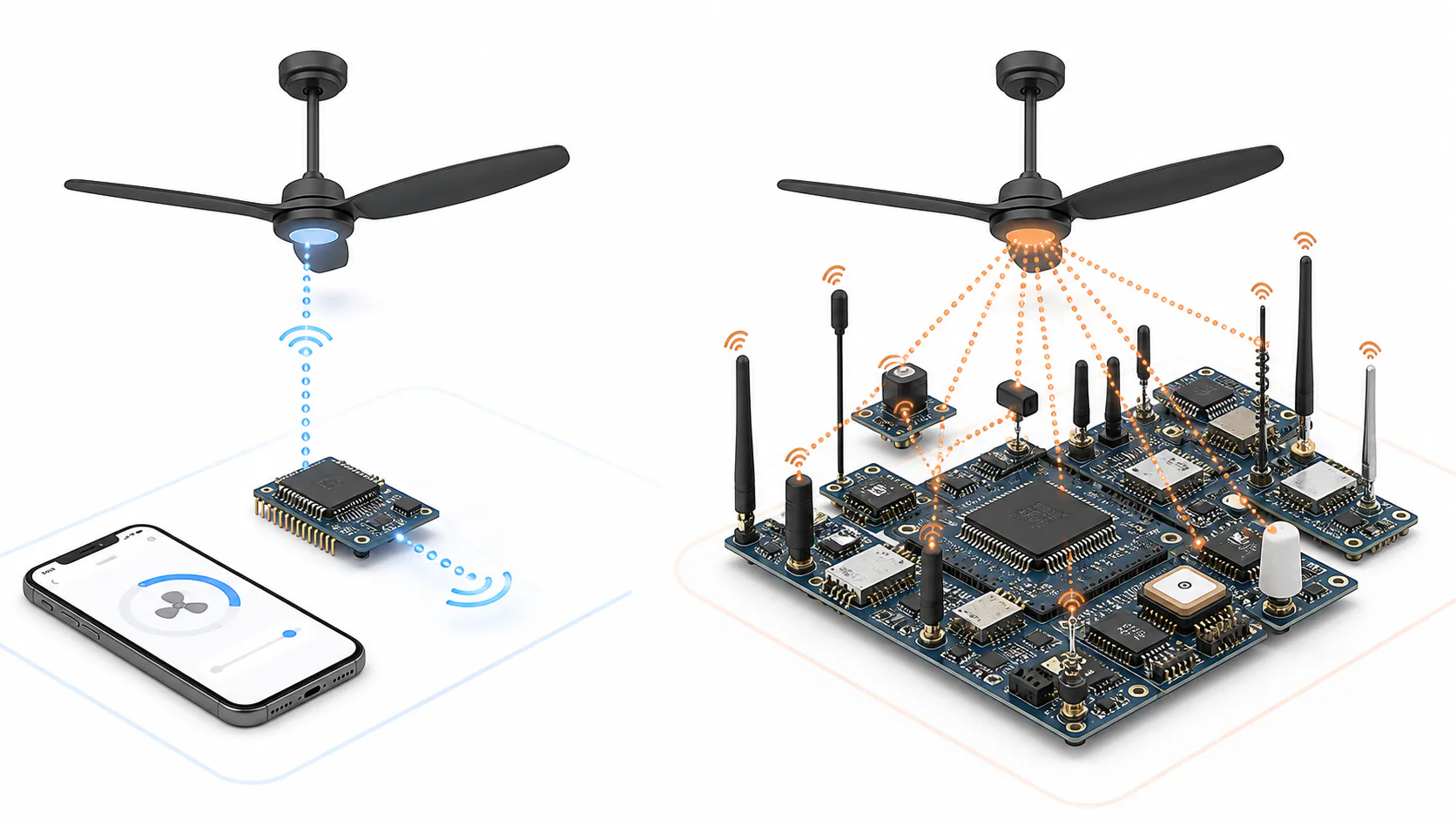
Connected circulation fans are often marketed through a list of controls: Wi-Fi, Bluetooth, voice assistants, mobile apps and remote scheduling. The feature count is easy to increase. The durable user value is harder to prove.
For product and procurement teams, the right starting point is the use case. Connectivity should solve setup, automation or accessibility problems without turning a simple appliance into an unsupported software platform.
Give each radio a job
Bluetooth can simplify local commissioning and control without requiring a cloud account. Wi-Fi enables remote access, schedules and integration with home platforms. Voice control usually depends on an ecosystem and internet service.
A design may need both radios, but duplication should be intentional. Define what works when the router, phone or cloud is unavailable. Core fan speed and safety functions should remain local.
The architecture determines whether to use a wireless module, a combo SoC or separate devices.
Standby power becomes a product requirement
An appliance that waits for network commands remains partially active. Measure module sleep current, wake behavior, regulator loss and cloud keep-alive traffic across the full product state.
A lower-cost module with poor sleep support can consume more energy over the product life. Power design should include the MCU, radio, indicator LEDs, sensors and voice subsystem, not only the motor.
Verify behavior after brownouts and network reconnection. An appliance should not enter an unsafe state or require repeated manual setup.
Software creates the long tail
Wireless hardware depends on firmware, mobile operating systems, cloud APIs and security updates. Buyers should request a support period, vulnerability process, signed-update mechanism and ownership of the application code.
If the module supplier ends a software branch, the appliance maker may inherit maintenance. Record firmware versions in the BOM and qualify update and rollback paths before launch.
Privacy review is also needed when voice or cloud services collect account and usage data.
Motor control still defines the appliance
Airflow, noise, efficiency and reliability remain the core product. Motor driver, power stage, position sensing and control algorithm need stable operation across speed range and supply conditions.
Connectivity can schedule or command the motor, but it cannot compensate for poor acoustics or control. Keep safety interlocks and thermal protection independent of a network connection.
Suppliers such as STMicroelectronics, GigaDevice and many module vendors offer building blocks, but exact choice depends on motor architecture, certification and software resources.
Qualify the failure modes
Test lost Wi-Fi, changed passwords, account transfer, cloud outage, corrupted update and radio interference. Confirm that physical controls remain clear and functional. Include factory reset and secure deletion of credentials.
For a second-source module, repeat RF, regulatory, security and ecosystem testing. Similar AT commands do not guarantee identical behavior.
The procurement conclusion
A useful connected fan is an appliance with carefully chosen connectivity, not a radio demonstration attached to a motor. Wi-Fi, Bluetooth and voice deserve BOM cost only when they support a maintained user flow.
Buyers should source the software lifecycle with the module and preserve local safety and control. The real feature is dependable operation after the launch campaign ends.
Certification, security and ecosystem requirements should be confirmed for the final product and markets.