The automotive MCU market offers more credible choices than it did during the last supply crisis. GigaDevice's GD32A7 family, NXP's S32K3, Texas Instruments' AM263x and AM263Px-Q1 products, and STMicroelectronics' SPC5 and Stellar portfolios illustrate the range now available for body, chassis, domain-control and real-time applications.
That does not make them interchangeable. A sourcing comparison based on CPU architecture, clock frequency, flash and peripheral counts can find candidates, but it cannot establish a second source. In a vehicle program, the MCU sits inside a safety case, a software platform, a cybersecurity process, a network design and a production test system.
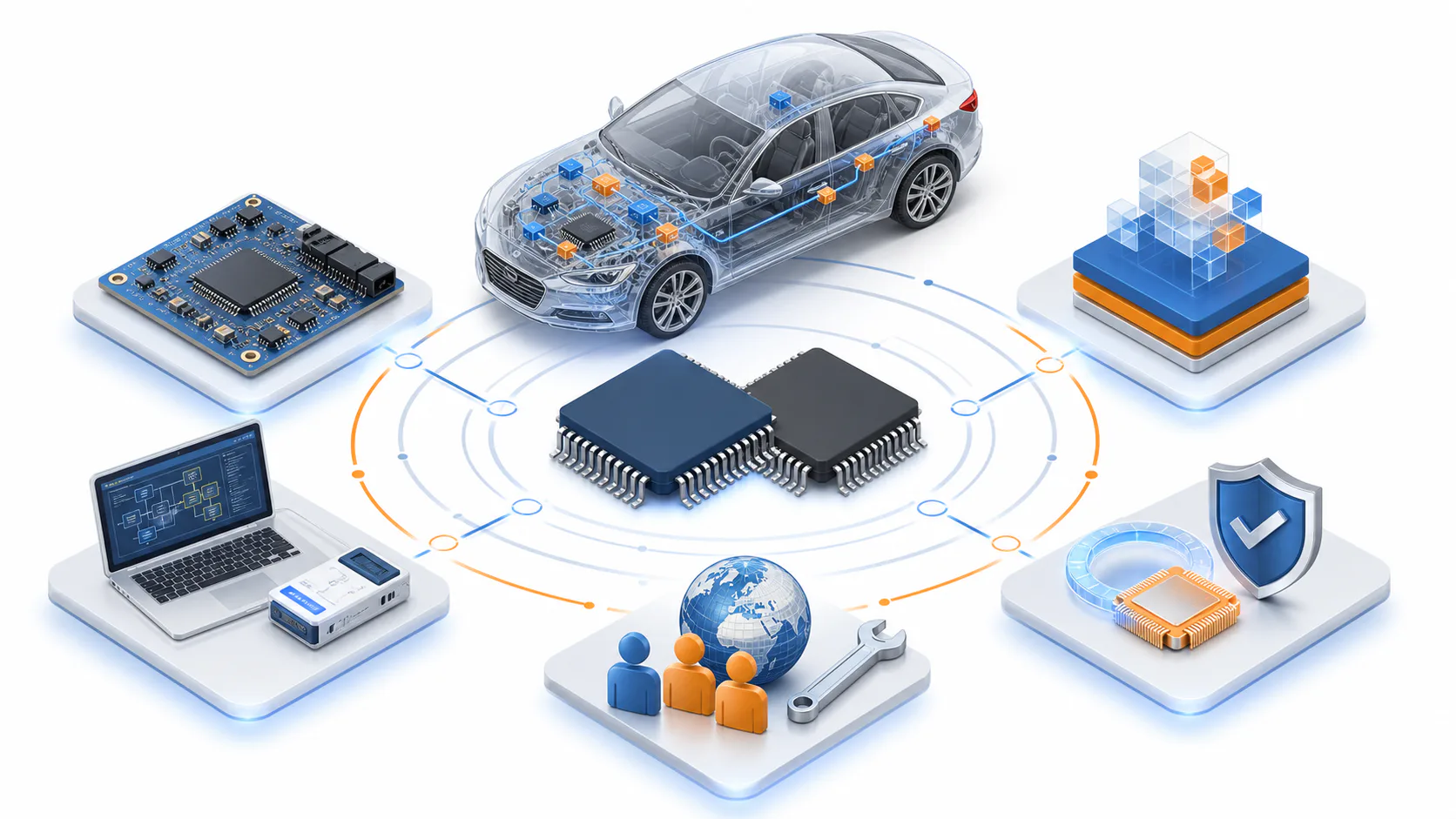
The real qualification unit is that ecosystem.
Start with the function, not the incumbent part number
Automotive MCU families span very different control problems. A body controller prioritizes deterministic I/O, low-power modes and LIN or CAN connectivity. A traction or chassis function may require faster real-time control, motor-control peripherals and tighter safety mechanisms. A zonal controller adds gateway traffic, security and mixed high-side or low-side I/O requirements.
Before searching for an alternate, freeze the function-level requirements: worst-case CPU load, memory margin, interrupt latency, timing channels, analog accuracy, network traffic, boot time, power states and environmental limits. Then identify which incumbent features are truly required and which are unused artifacts of the current design.
This avoids two common errors: rejecting a viable device because it lacks an unused peripheral, or accepting a similar-looking device that misses one timing or safety behavior the application depends on.
Functional safety cannot be added at the end
An automotive safety claim is more than a hardware feature list. Buyers and engineering teams need the supplier's safety manual, failure-mode data, diagnostic assumptions, development evidence and tool support for the exact product and intended safety goal.
The alternate may use a different lockstep architecture, memory protection scheme, clock monitor or fault-reporting path. Those differences can change diagnostic coverage and require updates to the system safety analysis. A family-level statement about functional-safety readiness is not a substitute for reviewing the exact device, revision and documentation package.
Procurement should treat access to safety collateral and supplier application support as deliverables, not optional technical extras.
Cybersecurity and boot flow create another lock-in layer
Secure boot, hardware security modules, key storage, debug authorization and firmware-update mechanisms are implemented differently across MCU platforms. Switching devices may change the provisioning station, certificate flow, recovery procedure and responsibilities between the Tier 1, vehicle maker and semiconductor supplier.
The comparison should include secure lifecycle states, cryptographic services, key-injection support, vulnerability response, software-update compatibility and the supplier's long-term security process. If production keys or field-update logic are tied to the incumbent implementation, the migration plan needs a security workstream from the first sample build.
Software determines the schedule
Register-level drivers are only one piece of the software cost. An automotive program may depend on AUTOSAR MCAL, complex device drivers, a real-time operating system, network stacks, calibration tools, flash programming, trace and debug, model-based development, and years of application code built around the incumbent.
Ask whether production-quality software exists for the exact device and peripheral set, which versions are qualified, who maintains it and what the license permits. Review known errata and the workaround's impact on timing and memory. A low unit price can be overwhelmed by a delayed software baseline or a toolchain that the validation team has not used before.
For GigaDevice, NXP, TI and ST candidates, the useful comparison is therefore not “Which data sheet has the most features?” It is “Which platform can enter our current build, debug, calibration and release process with a controlled amount of change?”
Network behavior must be tested under load
CAN FD, LIN, Ethernet and SENT labels do not guarantee identical behavior. Message RAM organization, DMA paths, timestamping, wake-up handling, transceiver diagnostics and error recovery can differ. Gateway and zonal applications should be tested at worst-case bus load while safety and application tasks are running.
Pin compatibility is helpful but rare at the system level. Even when package dimensions align, pin multiplexing, power sequencing, oscillator requirements, external flash and debug connections can force a board spin. Build the cost and schedule of that spin into the sourcing decision rather than hiding it behind the word “alternate.”
Qualify in gates
A disciplined second-source program can be divided into four gates:
- Paper fit: function, package, temperature, qualification status, lifecycle and documentation access.
- Engineering fit: board, startup, drivers, timing, network load, diagnostics and performance margin.
- Assurance fit: functional safety, cybersecurity, manufacturing test, traceability and change control.
- Production fit: yield, field monitoring, supplier capacity, quality response and long-term support.
Do not promise a production alternate at gate one. Record the maturity of each candidate so purchasing, engineering and program management see the same risk.
The procurement conclusion
Automotive MCU resilience is created before a shortage, not during one. The strongest second source is not the device whose headline specifications most closely resemble the incumbent. It is the platform whose hardware, software, safety evidence, security process and supplier support can be qualified within the program's real constraints.
That makes ecosystem readiness a sourcing attribute. Buyers who measure it early can negotiate with more than one credible path. Buyers who record only an alternate MPN may discover that the second source exists on paper but not in the vehicle.
Product capabilities and qualification status vary by exact orderable device and revision. Confirm current supplier documentation and complete application-level safety, security and performance validation before selection.