
A chip can already be installed in production vehicles and still require more testing, design changes and yield improvement. That is not necessarily a contradiction. In automotive semiconductors, "in production" is a milestone, not the end of engineering work.
One point needs to be stated precisely. Motorcomm's regulatory response refers to improving the production yield of specific SerDes port configurations at particular data rates. It does not say that the entire YT99 device cannot be manufactured, and it does not support a conclusion that the whole family has a quality problem. YT99 devices are already used in production vehicles, while several configurations, tests and project close-out items remain unfinished.
1. YT99 is on the road. Why is the development project still open?
Motorcomm has publicly confirmed that the YT99 family has entered vehicle production, including GAC Aion's Hyper GT Ascend Edition. Public material also says the family has been introduced at more than ten automakers and supports over 60 projects.
Those statements must not be collapsed into a single adoption number. A narrower regulatory disclosure says the 8- and 11-port TSN-switch program had nominations covering nine automakers and Tier 1 suppliers and 30 vehicle programs. The nine organizations are not all automakers, a nomination is not the same as a vehicle already in serial production, and "more than 60 supported projects" does not mean 60 production vehicle models.
Revenue gives another useful boundary. Motorcomm reported RMB 550,600 in 2025 revenue from automotive Ethernet switch chips, while its 8- and 11-port products generated RMB 567,900 in the first quarter of 2026. Commercialization has begun, but those figures do not yet demonstrate large market share. A production vehicle, a program nomination, recognized revenue and stable volume across every configuration are four different scorecards.
In an August 2026 response, Motorcomm moved the target date for the related investment project from July to December. It cited unfinished testing, selected functional-design improvements and the need to raise yield for certain SerDes-port rates. In practical terms, YT99 has passed the "can it get into a car?" test. The next question is whether that result can be repeated across more configurations, customers and production lots.
2. Eight or eleven ports do not mean eight or eleven identical T1 PHY lanes
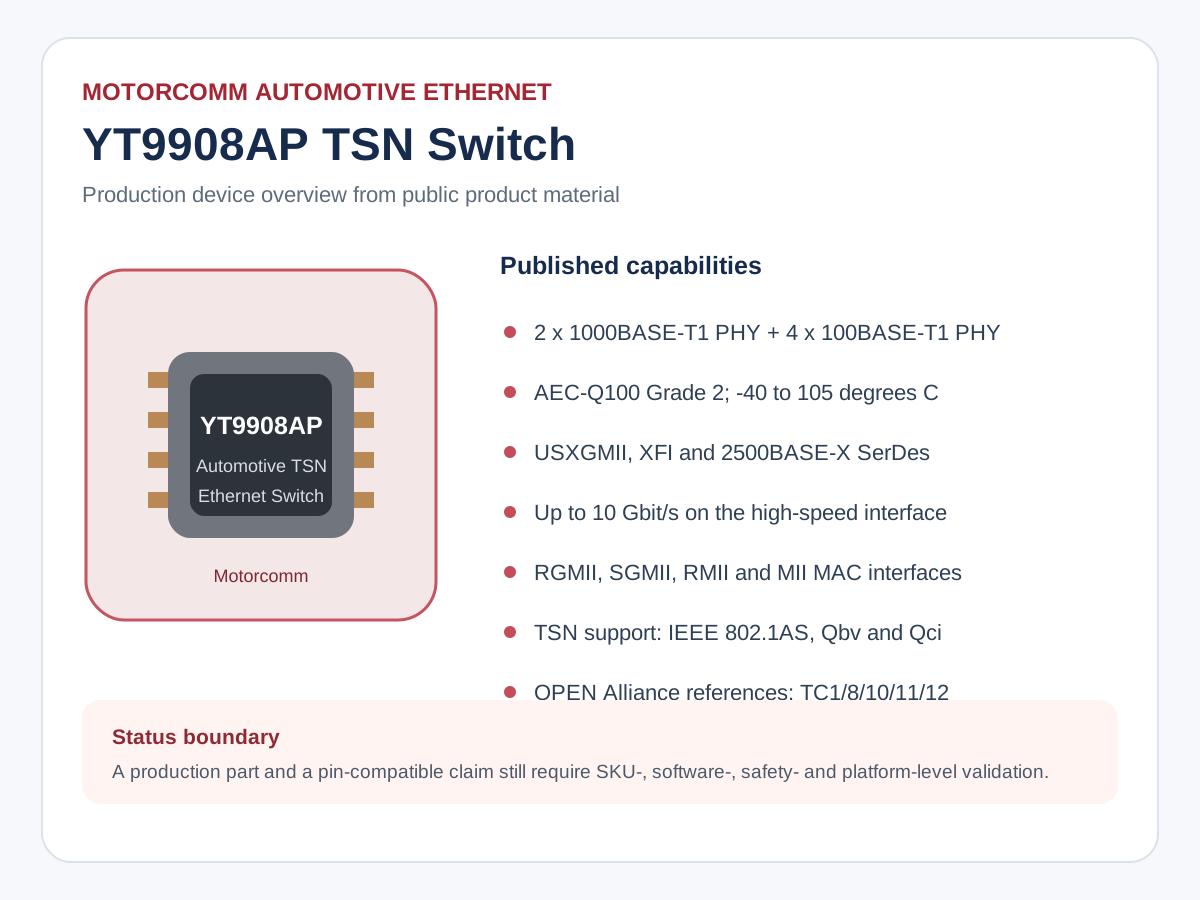
YT99 is a family rather than a single part number. Public products include the eight-port YT9908AP and YT9908CP, plus the eleven-port YT9911CP and YT9911CL. The YT9911CP uses BGA packaging and supports PCIe; the YT9911CL uses QFP and does not support PCIe. Packaging, host interfaces and surrounding circuitry therefore matter as much as the headline port count.
Motorcomm says the family integrates 100/1000BASE-T1 PHY capability. Host-side options may include SGMII, HSGMII, USXGMII, XFI and PCIe 3.0, with uplinks as fast as 10 Gbit/s and aggregate switching capacity above 25 Gbit/s. However, the eight- and eleven-port labels describe the product's overall port architecture. They should not be interpreted as eight or eleven integrated T1 PHYs. Public documents do not provide a complete PHY count and port-multiplexing matrix for every SKU.
In a vehicle BOM, a domain or zonal controller SoC may connect to the TSN switch through PCIe, xMII or high-speed SerDes. The switch then reaches single-pair Ethernet through on-chip T1 PHYs or external multi-gigabit PHYs. The surrounding design can also include a PMIC, QSPI flash, clocks, reset circuitry, coupling networks and ESD protection. Changing the switch supplier can trigger fresh validation of software, PCB layout, EMC behavior and network configuration; matching pads alone is not enough.
Security claims also need to be checked feature by feature. YT99 literature lists secure boot, port isolation, DoS protection and Chinese commercial-cryptography support. Public evidence is not yet sufficient to establish that every production YT99 configuration includes MACsec; Motorcomm describes MACsec and post-quantum cryptography as areas for further enhancement. AEC-Q100, meanwhile, is a device-reliability qualification. It is not the same as ISO 26262 ASIL-D certification for the complete product.
3. Infineon and NXP sell more than a switch IC
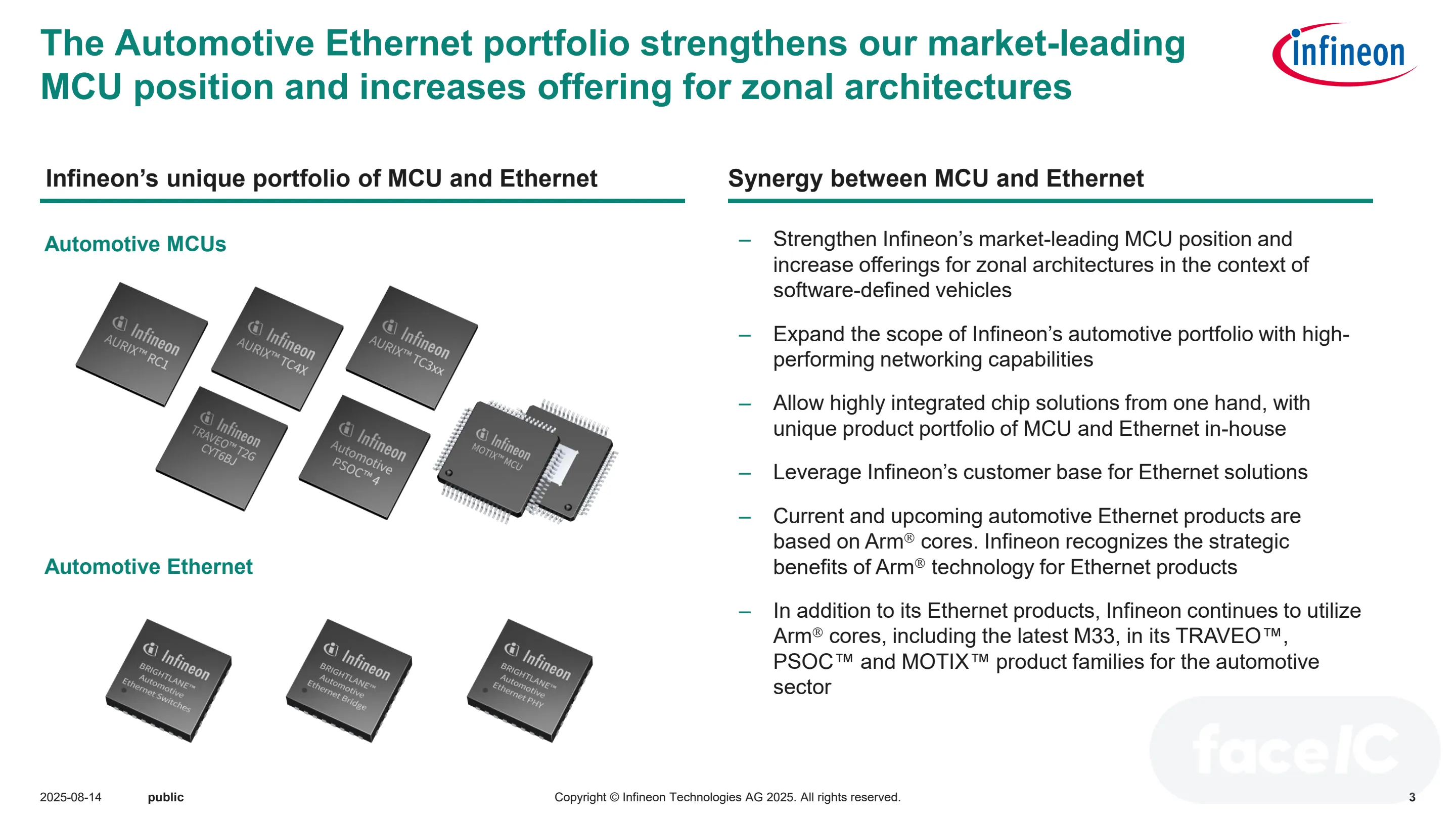
After acquiring Marvell's automotive Ethernet business in 2025, Infineon added the BRIGHTLANE portfolio to its automotive platform. The 88Q5152 is a nine-port switch with six integrated PHYs, two 10G SerDes links, PCIe Gen3, dual lockstep Cortex-R52 cores, MACsec and an embedded HSM. The 88Q5192 expands to 16 ports and 12 integrated PHYs, with additional 10G, 2.5G and PCIe resources.
Those numbers cannot be used as a direct winner-versus-loser comparison with YT99: the devices have different PHY integration, interface multiplexing and target architectures. They do show how the market has moved beyond basic packet switching. High-speed interfaces, cybersecurity, functional-safety evidence, software tools and platform integration are now part of the product.
NXP's SJA1110 is an active product with integrated 100BASE-T1/TX PHYs, a Cortex-M7 and supporting TSN, AUTOSAR drivers and development tools. The higher-end S32J100 pushes switching throughput beyond 80 Gbit/s and adds dual Cortex-R52 cores, MACsec, a hardware security engine and PCIe Gen4. Its official status is still preproduction, so it should be treated as a next-generation architecture reference rather than a broadly available production rival.
The mature-supplier playbook is clear: the switch is the entry point, followed by MCUs, PHYs, SDKs, safety documentation and an automotive validation environment.
4. The most expensive part of a China-based alternative is often not the chip
An automaker or Tier 1 evaluating YT99 should separate the work into at least six checklists: the simultaneously usable port matrix; SerDes eye diagrams, BER and full-temperature behavior; TSN scheduling, buffering, TCAM and time synchronization; safety manuals, FMEDA and diagnostic coverage; AEC-Q100, PPAP, PCN and lot traceability; and finally the full system cost, including external PHYs, storage, power, thermal design and software migration.
The team should also ask which interfaces and rates are covered by the current yield-improvement work, how production configurations differ from configurations still under test, how performance varies across lots, and whether SDK, AUTOSAR-driver and errata support will last for the vehicle's service life. These questions are closer to procurement risk than the port number printed on a product brief.
Comparable public information on volume price, stock and lead time is not available, so it would be premature to claim that a YT99 solution is cheaper than one based on 88Q5152, 88Q5192 or SJA1110. Replacing an imported device with a China-developed alternative should not be presented as a drop-in chip swap. It is an engineering program involving new-platform validation, second-source architecture, software migration and production ramp.
Conclusion
YT99 has taken a China-developed automotive TSN switch past the important threshold of appearing in a production vehicle. Its long-term competitiveness will be decided by whether that success can be repeated across more data rates, configurations, customers and lots.
"Already in a vehicle" and "still improving test coverage and yield" can both be true. The first statement proves that the product has entered the market. The second is a reminder that the hardest part of an automotive chip is not producing the first unit, but making the millionth behave like the first.
For procurement teams, the safest evaluation table records four states separately: in serial production, nominated, under customer validation, and still being optimized in a specific configuration. Omitting one status label can create an expensive misunderstanding.
Disclaimer: This article is an industry and technical analysis. It is not investment advice, a part recommendation, or confirmation of a specific supply relationship.