
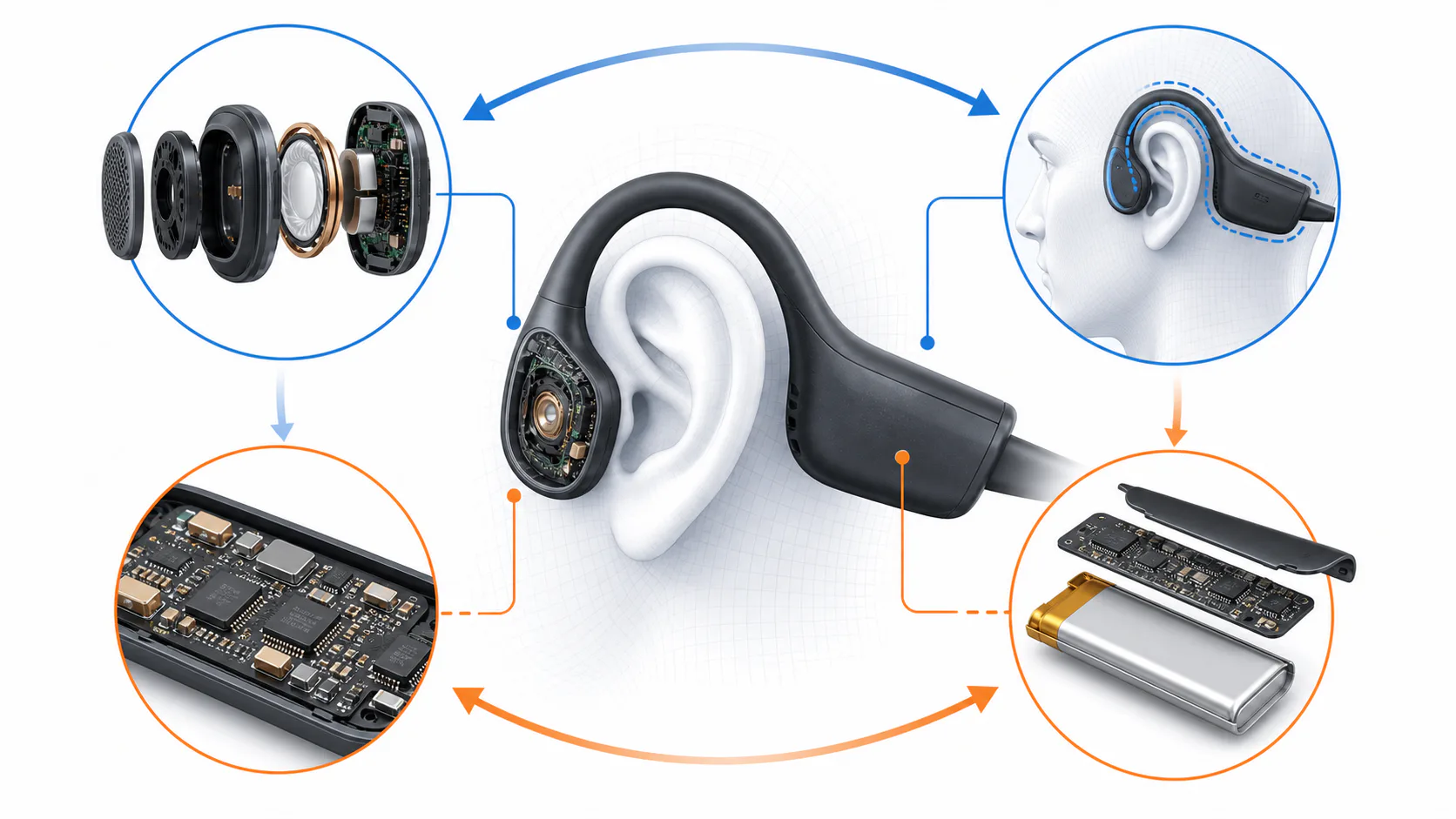
Open-ear and air-conduction headsets appeal to runners because they preserve environmental awareness and avoid sealing the ear canal. That user benefit changes the electronic design.
The transducer sits farther from the eardrum, acoustic leakage increases and outdoor noise becomes harder to manage. Fit, amplifier power, microphones, sensors, wireless audio and battery life become tightly coupled.
Acoustics begin with mechanics
An open-ear product must direct sound toward the ear while limiting what others can hear. Driver position, enclosure volume, acoustic ports and the flexibility of the wearing structure all matter.
A transducer with a similar diameter is not automatically interchangeable. Compare frequency response in the actual fixture, distortion, sensitivity, excursion and unit-to-unit consistency. Mechanical tolerances can move the sound field enough to change perceived bass and speech clarity.
Suppliers should provide samples across production lots, not only a tuned demonstration unit.
More output consumes the power budget
Overcoming leakage and outdoor noise can require more amplifier output. The audio amplifier, boost or buck converter, battery and thermal path need to be designed together.
Measure efficiency at realistic music and voice profiles rather than one sine-wave point. Check clipping, battery-voltage droop, idle consumption and heat near the skin. An alternate amplifier with higher headline power may shorten runtime or create audible switching noise.
Charging IC, protection, cell quality and connector durability determine whether the claimed runtime remains usable after months of exercise and sweat exposure.
Microphones and sensors carry more work
Calls and voice assistants need microphones that tolerate wind and movement. Multiple microphones and signal processing can improve pickup, but placement and mechanical isolation are critical.
Wear detection, motion sensing and touch controls add sensors and calibration. False touches from sweat or rain and unstable wear detection can dominate the user experience even when audio quality is good.
Qualify the microphones, MEMS sensors and algorithms in running, cycling and traffic conditions, not only indoors.
Wireless performance is part of fit
The head and body absorb RF energy, and the antenna sits in a small moving structure. Test range, dropouts and coexistence with a phone, smartwatch and crowded 2.4 GHz environment.
Bluetooth SoC or module changes can affect codec support, latency, multipoint behavior, power and firmware maintenance. A hardware alternate may require a new software branch and certification work.
Source the complete wearable
Review transducers, amplifiers, PMICs, batteries, microphones, sensors, RF and mechanical suppliers as one program. Define sweat, drop, bend, UV and temperature tests. Include repairability and battery aging.
For second sources, freeze acoustic and power metrics before comparing unit cost. A cheaper driver that requires more amplifier and battery can raise total BOM and weight.
The procurement conclusion
Open-ear headsets create a genuine component opportunity, but the value comes from coordinated acoustics, power, sensing and RF performance. The product cannot be qualified by copying an in-ear BOM into a different shell.
Buyers should measure the complete wearing experience and lifecycle. Fit is the architecture, and every component operates inside it.
Performance depends on the final mechanical, acoustic and software design.