
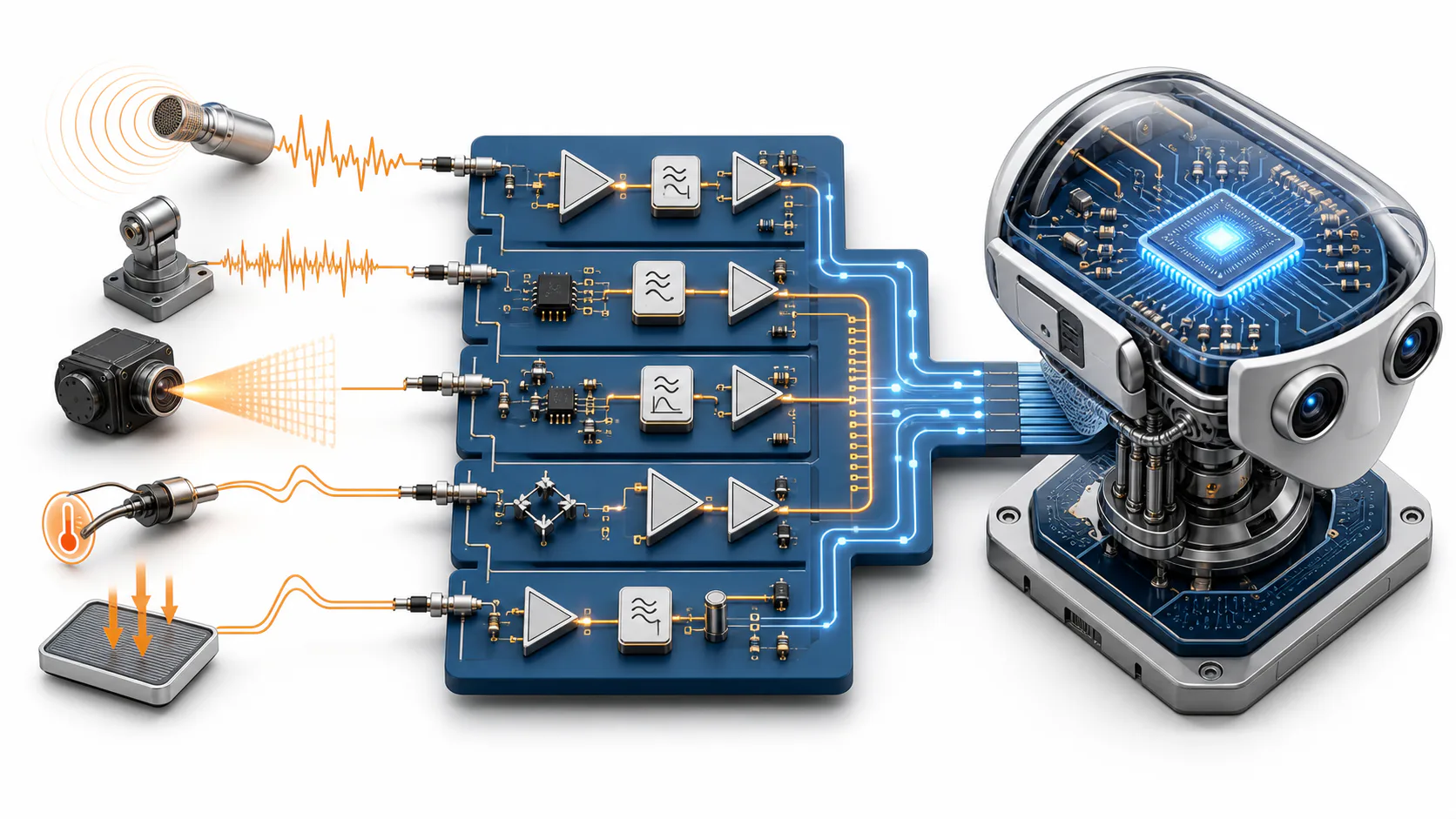
Digital processors receive most of the attention in electronic systems, but they do not directly understand temperature, current, pressure, sound or light. Those quantities are continuous and noisy. An analog signal chain has to sense, condition, convert and protect them before software can make a useful decision.
That makes analog and mixed-signal components part of the system specification, not interchangeable support parts. A faster MCU cannot recover accuracy that was lost in a noisy amplifier, saturated ADC or unstable power rail.
From physical quantity to digital decision
A typical measurement path starts with a sensor or shunt. Its output may be small, offset and exposed to common-mode voltage or interference. An amplifier scales the signal, a filter limits unwanted bandwidth and an ADC converts it into codes for an MCU, DSP or SoC.
Each step contributes error. Offset, gain error, noise, drift, reference accuracy, input bias and conversion nonlinearity combine. The relevant specification is the total error across the operating environment, not the best typical number in one data-sheet table.
For motor control, battery management and industrial automation, timing matters as well. Bandwidth, settling time, sampling synchronization and propagation delay can change a control loop or protection response.
Power and isolation are part of the signal path
An analog front end depends on clean power and grounding. Regulator ripple can enter a measurement. Poor sequencing can leave a sensor or converter in an undefined state. A weak reference can make a high-resolution ADC deliver high-resolution error.
High-voltage systems add isolation. Digital isolators, isolated amplifiers or isolated ADCs must meet working-voltage, transient and lifetime requirements while preserving timing and accuracy. Creepage, clearance, barrier technology and system grounding cannot be reduced to a pin-count comparison.
Buyers should qualify the signal path together with the power tree, reference and isolation architecture.
Why pin compatibility is not functional compatibility
Two amplifiers may share a package and nominal supply range while differing in input common-mode behavior, output swing, stability with capacitive loads or recovery from saturation. Two ADCs may have the same resolution but different reference interfaces, latency, digital timing and missing-code behavior.
These differences appear in the final board, often under temperature or electromagnetic stress. A replacement test should use the real sensor, source impedance, filter, PCB and firmware. Bench tests need worst-case input and power conditions, not only a room-temperature nominal signal.
Source the chain, not isolated line items
Map which components jointly determine each measurement or actuator function. Record the sensor, amplifier, reference, converter, isolator, regulator and processor interface. If one part changes, identify which error-budget and timing assumptions need to be repeated.
For a second source, request characterization data, models, errata, qualification reports, PCN terms and application support. Confirm that the supplier can debug system behavior rather than only deliver samples.
This is especially important for automotive, industrial and medical equipment, where a small analog deviation can create a large diagnostic or control consequence.
The procurement conclusion
Digital silicon decides, but analog circuitry determines what the system is allowed to know and how reliably it can act. The most expensive processor cannot compensate for a signal chain that clips, drifts or imports noise.
Procurement teams should treat analog performance as a system budget. Qualify alternatives against the complete measurement or drive path, and keep the evidence that shows where accuracy, timing and protection margin come from.
This article is technical supply-chain analysis. Final component selection requires current supplier documentation and application-level validation.