
What's actually moving, and why it matters
X5R isn't exotic — it's the most common temperature class of MLCC. A part like 0603, 10 µF, 10 V, X5R lives everywhere in decoupling, bypass and filtering. The equivalent pool spans every major vendor:
- Samsung CL10A106KP8NNNC · Murata GRM188R61A106KE69D · TDK C1608X5R1A106K080AC
- YAGEO CC0603KRX5R6BB106 · Walsin 0603X106K100CT
- Weirong V106K0603X5R100NKT · CCTC TCC0603X5R106K100CT · Fenghua 0603X106M100NT
Low unit price, enormous volume. When it moves, BOM cost creeps up like water seeping through a floor.
The novel angle: AI didn't make X5R fancy — it re-ordered the queue
This isn't "consumer X5R suddenly went premium." It's that high-end AI parts changed the production priority. TrendForce puts the end-June 2026 book-to-bill at Murata 1.30, Samsung EM 1.31, Taiyo Yuden 1.25 (industry 1.04). Japanese and Korean makers are prioritizing AI-grade MLCC orders, so mid-to-high-capacitance consumer X5R demand spills over to YAGEO, Walsin and Weirong.
Translated for procurement: ordinary X5R didn't get more attractive — the top fabs just got less willing to queue it.
Where the BOM "hot spots" are
Watch three specific pools, not all MLCCs:
- 0603 10 µF 10 V X5R — MCU, Wi-Fi/BT modules, sensors, PMIC periphery, SSD daughter-boards, camera modules.
- 0603 22 µF 6.3 V X5R — low-voltage rails, high-transient decoupling. (Murata GRM188R60J226MEA0J, Samsung CL10A226MQ8NRNC, YAGEO CC0603MRX5R5BB226.)
- 0805 / 1206 22 µF & 47 µF X5R — high-cap parts tighten first and swing hardest on price (e.g. Murata GRM31CR61A476ME15L, 1206 47 µF 10 V).
Why is a 0603 10 µF so sensitive? It's the engineer's handiest band-aid: rail unstable, add a few; module noisy, add a few; PMIC ripple ugly, add a few more. Not the star of the board, but a screw you can't be short one of. For buyers it's the worst kind of part — too cheap to watch, too high-volume to ignore when it moves.
The second-source opening
This is precisely where China-based MLCC makers get in. Fenghua, CCTC and Weirong don't need to challenge Murata's or Samsung's top AI-server parts head-on. The realistic opening is the overflow — mid-to-high-cap consumer X5R.
| Role | Supplier | Note |
|---|---|---|
| Incumbent / benchmark | Murata · Samsung EM · TDK · Taiyo Yuden | Prioritizing AI-grade orders; consumer X5R deprioritized |
| Overflow taker | YAGEO · Walsin | First stop for spillover demand |
| China-based alternative | Weirong | 0201–1210, high-cap to 220 µF, ~700bn units/yr capacity |
| China-based alternative | CCTC · Fenghua | Standard MLCC plus auto/industrial lines |
If a BOM today holds only Murata / Samsung / TDK, the move is to add these to the qualification pool — starting from non-critical rails, general decoupling and consumer projects.
The qualification trap: 10 µF nameplate ≠ 10 µF on the board
X5R is a Class-II ceramic, strongly affected by DC bias. The same 10 µF 0603 10 V X5R on a 5 V rail can lose a big chunk of effective capacitance; drop 10 V to 6.3 V to save cost and the board won't blow up immediately, but ripple, transient response, EMI and cold-start can all bite back later.
An MLCC swap is not "package, capacitance, voltage fields match, done" — it's DC bias, ESR/ESL, aging, leakage, batch consistency and reflow reliability.
Bottom line
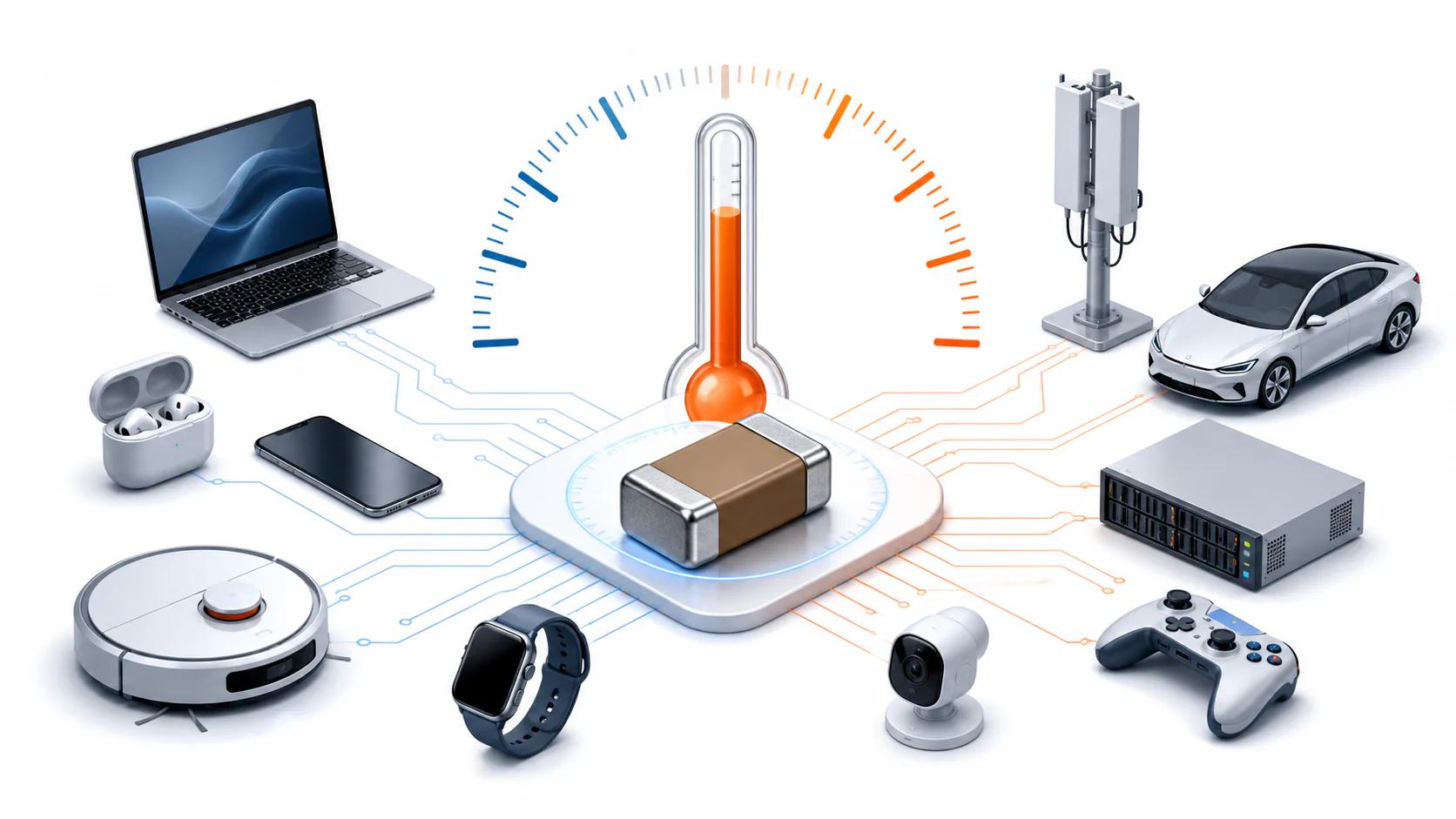
X5R commodity pricing is the first waterline of the AI-server shortage reaching ordinary BOMs. The old habit was watching whether Murata / Taiyo Yuden / Samsung raised premium auto parts; now you also watch inventory, lead time and quotes for these 0603/0805 high-cap X5R parts across HuaqiangBei, LCSC, DigiKey and Mouser. When even the plainest X5R climbs, the shortage has stopped being "AI parts only." Don't underestimate the 0603 10 µF — it's not a star part, it's the thermometer for BOM cost. When the thermometer spikes, the supply chain is genuinely running a fever.