
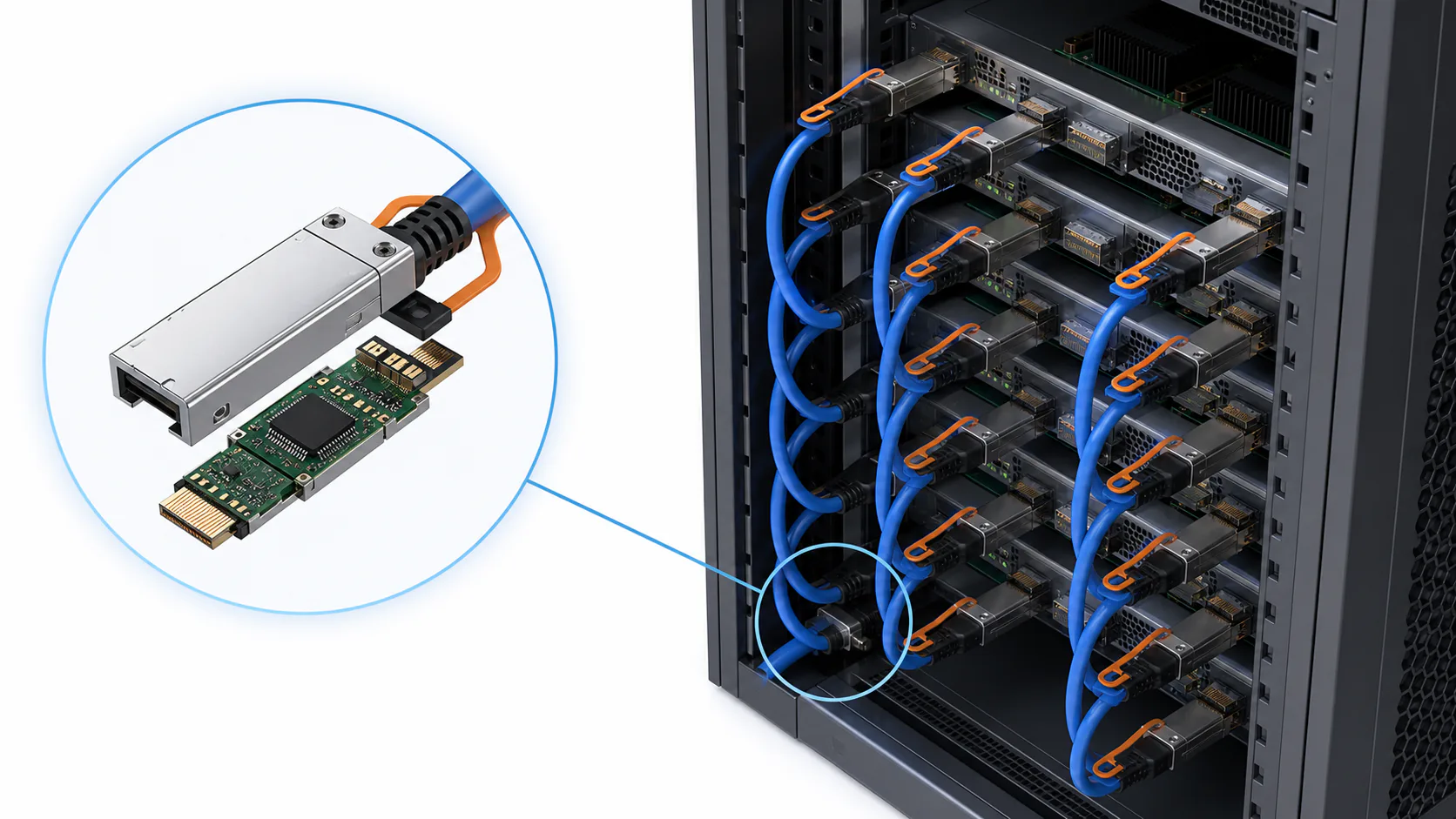
Optical modules dominated AI-network headlines, while active electrical cables were gaining attention for shorter in-rack and adjacent-rack links in July 2026. The two technologies address different reach, power and serviceability tradeoffs.
An AEC is not ordinary copper cable with a new label. It is an active link subsystem.
Reach creates the technology boundary
Passive copper is attractive at very short distances because it is simple and low power. As data rate and distance rise, insertion loss and signal integrity reduce its useful range.
AEC adds signal-conditioning electronics to extend copper into an intermediate reach, often discussed around several meters. Optics remains important when reach, density, routing or electrical isolation favors fiber.
The correct comparison uses the actual rack topology and thermal budget.
The assembly includes silicon
Retimers or related conditioning devices, firmware, connectors, twinax construction and manufacturing calibration determine link behavior. QSFP form factor alone does not establish interoperability.
Review data rate, lane mapping, management interface, forward-error-correction assumptions and host compatibility. Confirm whether both cable ends are identical and how inventory is identified.
Treat the cable as a serialized electronic component.
Power savings must be measured at the rack
AEC may use less power than an optical link for an appropriate short reach, but exact consumption depends on speed, silicon and operating mode. Copper diameter and routing can also affect airflow and installation.
Compare link power, cooling, port density, bend radius, service time and failure replacement. A lower transceiver wattage does not guarantee a lower rack-level cost if cabling blocks airflow or complicates maintenance.
Revenue signals need product evidence
Credo's business performance was cited as evidence that AEC had moved beyond a laboratory concept. Financial growth cannot identify which cable, customer or architecture a buyer should qualify.
Require shipping MPNs, interoperability results, production sites and capacity. Distinguish connector or cable suppliers from vendors that own the active silicon and firmware.
For deployment, build a port-to-port cable matrix that records host, switch, length, routing, firmware, temperature and error history. Include insertion cycles and service handling. Qualify more than one length because electrical margin and thermal behavior change across the family. A visually identical assembly should not enter inventory under the approved code without traceable test and firmware identity. Maintain spare strategy by exact link position, because a cable that passes one host-to-switch combination may not be released for another. Field returns should preserve both endpoints and management logs so the supplier can reproduce intermittent errors.
The procurement conclusion
AEC fills a useful short-reach space between passive copper and optics in AI infrastructure. It complements rather than eliminates either technology.
Buyers should qualify the complete active assembly with the intended switch, accelerator and thermal environment. The supply chain includes silicon, cable, connectors, firmware and test; resilience requires visibility into all five.
This analysis reflects July 2026 market observations and is not a current demand forecast.