
CXMT’s move into the public market is important to DRAM buyers for a reason that has little to do with the first trading day. The company is trying to turn a domestic memory option into a broader manufacturing and product platform.
The Shanghai Stock Exchange confirmed CXMT’s Science and Technology Innovation Board listing in July 2026. Public company and exchange materials describe investment in manufacturing upgrades, DRAM technology and forward research. For procurement teams, the question is how quickly that capital becomes qualified output rather than nominal capacity.
Capacity has four gates
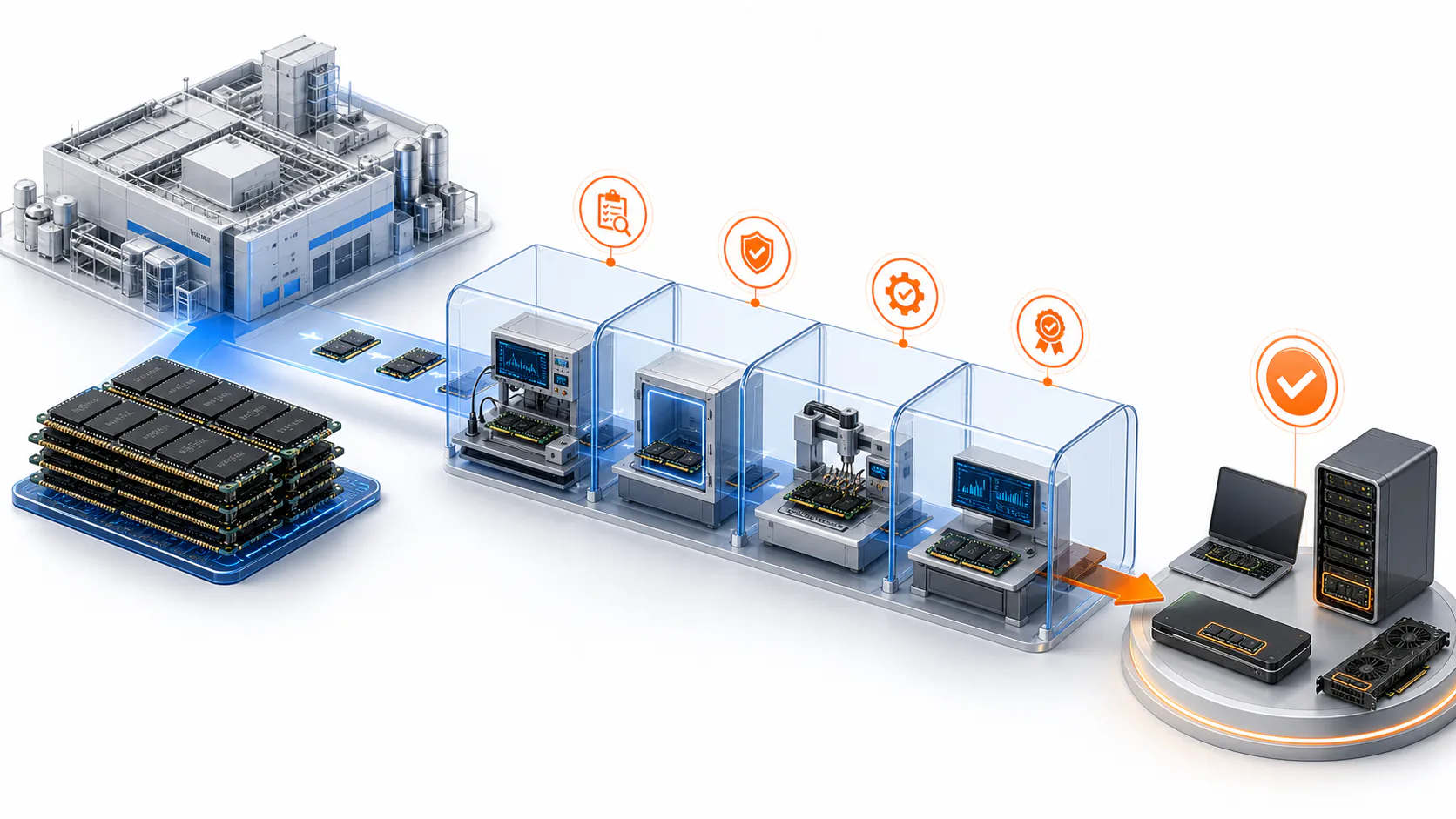
A new wafer line does not immediately create customer supply. Equipment must be installed and qualified, processes must reach stable yield, products must pass internal reliability work, and customer platforms must complete validation.
Each gate can move on a different schedule. A supplier may report more wafer starts while the density, speed or package required by a server program remains in qualification. Buyers should ask for output by product class, not one factory-wide capacity number.
The useful measures are yield maturity, committed customer output, qualification status and change-control discipline. Capacity without those measures is a future possibility, not current resilience.
Product mix matters more than wafer count
CXMT’s published portfolio now extends beyond DDR4. Its official product materials describe DDR5 devices up to 8000 Mbps with 16 Gb and 24 Gb densities, along with several module formats. The company also lists LPDDR5X products in 12 Gb and 16 Gb densities and speeds up to 10667 Mbps, with different stages of production and customer sampling.
Those capabilities open several markets, but they do not collapse them into one. A PC UDIMM, a server RDIMM and a soldered mobile-memory package have different electrical, thermal, firmware and validation requirements. Server adoption adds platform qualification, error behavior, module design and long-duration workload testing. Mobile adoption adds package, processor-interface and power-management constraints.
A buyer should therefore build a matrix of exact density, speed, package, module type, validation platform and production status. “DDR5 available” is not enough to release an order.
The first benefit may be negotiating leverage
Additional qualified supply does not guarantee an immediate price decline. DRAM remains cyclical, and new capacity can arrive while product mix is changing. The earlier benefit is a credible alternative during allocation and contract negotiations.
That benefit appears only after engineering has done the work. Memory substitution can affect timing parameters, firmware training, PCB design, PMIC behavior, SPD devices, thermal limits and system error rates. Samples need to be tested across the same platform and workload envelope as the incumbent.
Procurement should fund this qualification before the incumbent becomes constrained. A supplier in an evaluation database is useful; a supplier with approved devices, forecast visibility and a failure-analysis path is much more useful.
What to request from the supplier
Ask for exact production status, site and process information, qualification reports, revision control, PCN terms, lifecycle expectations and escalation support. For modules, separate responsibility for the DRAM die, PCB, PMIC, SPD hub and module assembly.
Also ask how capacity will be allocated between consumer, mobile and server products. High headline output can provide little protection if a buyer’s device sits at the edge of the supplier’s strategic mix.
The procurement conclusion
CXMT’s expansion can broaden the global DRAM supply base, particularly for customers willing to qualify another platform. The durable milestone is not a market valuation or a single speed claim. It is repeatable yield, customer-approved products, technical support and delivery through the cycle.
Buyers should treat the listing as a reason to start a structured qualification program, not as proof that every DRAM shortage or price risk has already been solved.
Product performance and production status vary by exact device and date. Confirm current documentation, samples and commercial commitments directly with the supplier.