
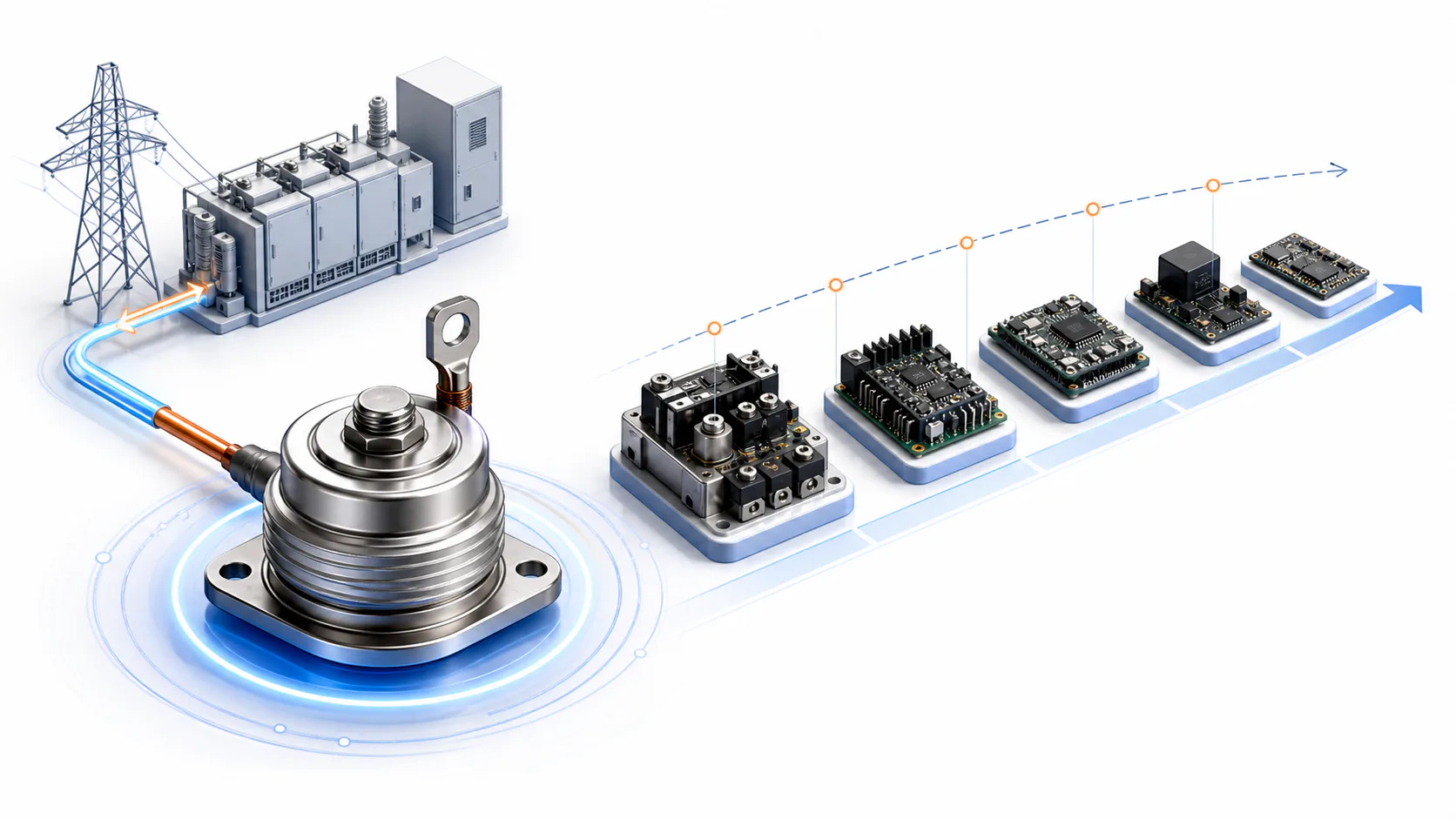
IGBTs and MOSFETs advanced through several generations, yet STMicroelectronics BTW69-1200RG still appeared in active industrial designs in July 2026. Its survival was not evidence that technology stopped. It reflected an application that valued rugged surge behavior, simple control and an already-qualified circuit.
Mature devices persist when the replacement does not repay system change.
The useful rating is the surge profile
The 1,200 V label establishes a blocking class, but surge current, repetitive current, holding current, gate trigger and thermal conditions determine whether the thyristor fits.
Industrial heaters, soft starts and mains control can expose devices to brief high-energy events. A thyristor's latching behavior and surge tolerance may be advantageous where turn-off follows the line current zero.
Compare the complete current waveform, not two headline ratings.
Fifty amperes can mean different things
Catalog current values may describe RMS, average, surge or case-temperature conditions. Package cooling and mounting determine continuous capability.
An IGBT or MOSFET with a similar voltage and current label can require an isolated driver, different protection, controlled turn-off and EMI work. It may deliver benefits, but it is not the same circuit.
The data-sheet conditions must be translated into the actual heatsink and duty cycle.
Stable availability still needs monitoring
The source did not show a broad shortage for BTW69-1200RG. Mature parts can nevertheless become exposed through low-volume package lines, factory transfers or shrinking authorized stock.
Track lifecycle notices, supplier count, lead time and exact suffix. Preserve traceability for broker material because long-lived industrial products attract reclaimed or mixed lots.
An active product is safer than an obsolete one, not risk-free.
Replacement cost protects the incumbent
Changing the switch can affect gate control, snubber, thermal design, EMC, safety certification and firmware. In a low-volume product, that engineering cost may exceed years of component spending.
If continuity risk rises, evaluate a qualified same-function alternate first. A technology migration should be justified through efficiency, controllability, size or lifecycle value and tested as a new power stage.
Preserve a golden unit and the original commutation, surge and thermal waveforms. Any replacement program should reproduce the worst mains phase, load transient, heatsink tolerance and protection behavior. Document which safety and EMC approvals must be repeated. This evidence distinguishes a manageable component substitution from a redesign whose schedule is longer than the remaining inventory. Review the trigger annually while the original expertise and laboratory setup still exist.
The procurement conclusion
BTW69-1200RG remained relevant because it solved a specific energy-control problem inside validated equipment. Newer transistor technologies did not erase that fit.
Buyers should protect mature BOMs with lifecycle evidence and traceable supply, while maintaining a redesign trigger. “Old” and “replaceable” are different judgments; the second requires system-level proof.
This analysis reflects July 2026 lifecycle observations and is not a current availability statement.