
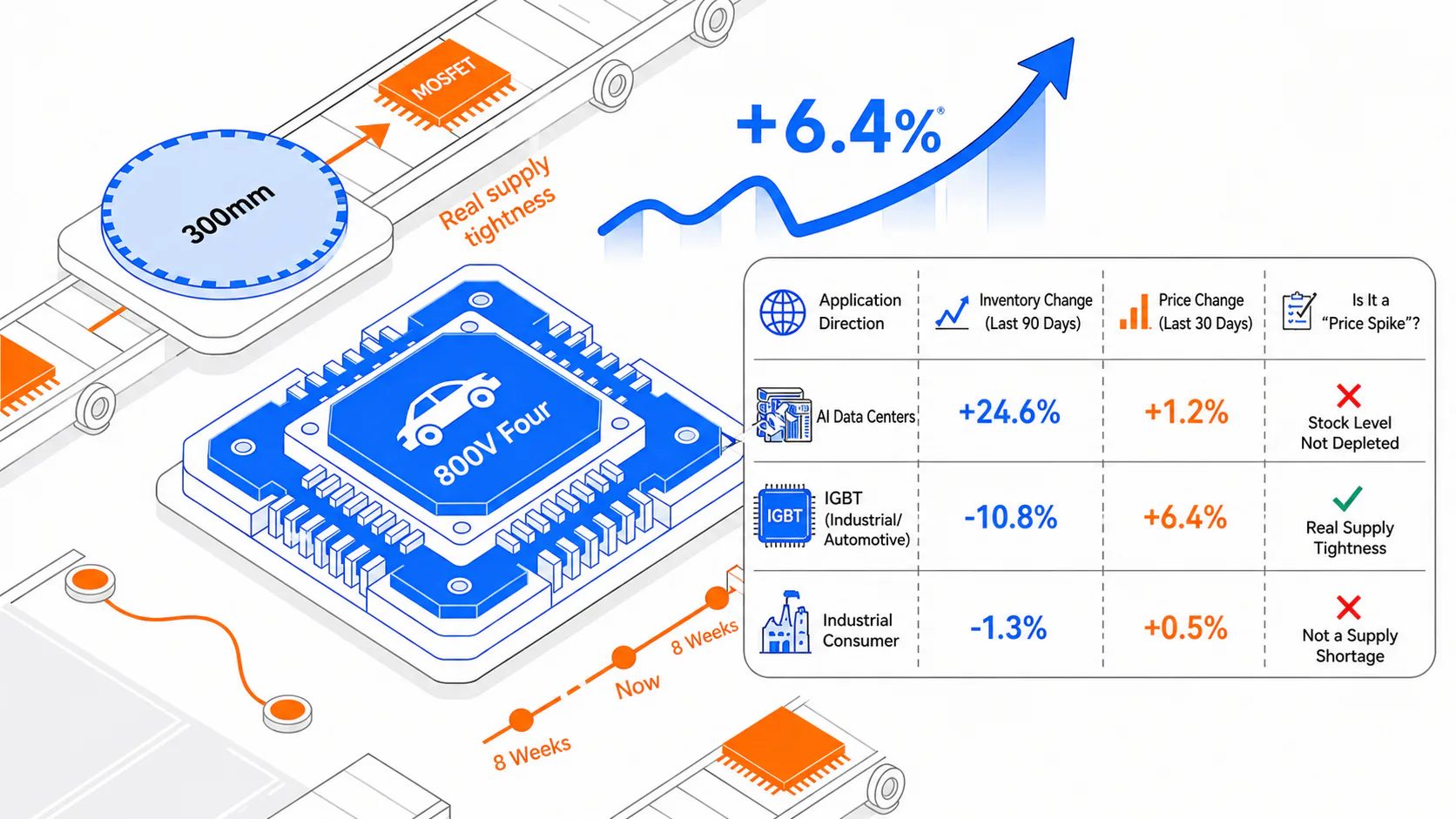
Claims that AI had absorbed power-semiconductor supply sounded plausible in early May 2026. Data centers consume power conversion at several levels. Yet the ic.net channel snapshot showed normal or weak conditions across many listed power devices.
The apparent conflict disappears when the category is segmented.
AI demand is architecture-specific
Accelerator power delivery uses high-current regulators, power stages and passive components near the board. Racks and facilities use additional conversion, backup and cooling equipment.
That demand does not automatically consume every automotive IGBT, industrial module or commodity MOSFET. Voltage, current, package, process and qualification prevent capacity from moving freely.
A supplier such as Infineon can see strong AI-related demand in selected products while other portfolio areas remain available.
Inventory and utilization can disagree
Distributor inventory reflects previous orders and channel decisions. Factory utilization reflects production mix. A supplier can operate constrained advanced lines and still have excess mature products in distribution.
Track exact product families, not company-wide language. Ask which factories and packages are affected and whether lead times actually extend.
Stock should be verified for ownership, location and date code.
News language needs a BOM translation
“Power devices are tight” should be converted into a list of MPNs, applications and evidence. If the statement cannot identify the product class, it should not trigger a buy.
Compare supplier confirmation, authorized lead time, allocation, bookings and end-program releases. Use channel price only as one dated input.
The May ic.net observation was a counter-signal, not proof that no AI bottleneck existed anywhere.
Avoid the wrong hedge
Buying broad power-semiconductor inventory after an AI headline can lock cash into products unrelated to the constrained segment. It can also obscure lifecycle and authenticity risks.
Protect devices with confirmed allocation, single sourcing or long qualification. For normal products, maintain forecasts and alternatives without speculative stock.
Review whether two approved sources share a foundry, substrate or package dependency.
Qualify power devices dynamically
An alternate needs switching loss, gate drive, EMI, thermal and fault testing in the real converter. Similar voltage and current ratings create only a shortlist.
Supplier models, quality evidence, PCN terms and failure-analysis support belong in the AVL decision.
Demand scenarios should be translated into rack shipments, converter counts and semiconductor content before they reach the purchasing forecast. That bridge exposes double counting between accelerator, server and data-center estimates. It also shows which power stages scale with deployment and which remain constrained by architecture, efficiency targets or customer qualification.
The procurement conclusion
AI can create meaningful power-component demand without producing a universal shortage. The supply effect follows exact architectures and capacity pools.
Buyers should challenge both bullish headlines and reassuring inventory snapshots. Connect each signal to an MPN, real program and confirmed delivery before acting.
This article analyzes a May 2026 channel snapshot and is not a current availability statement.