
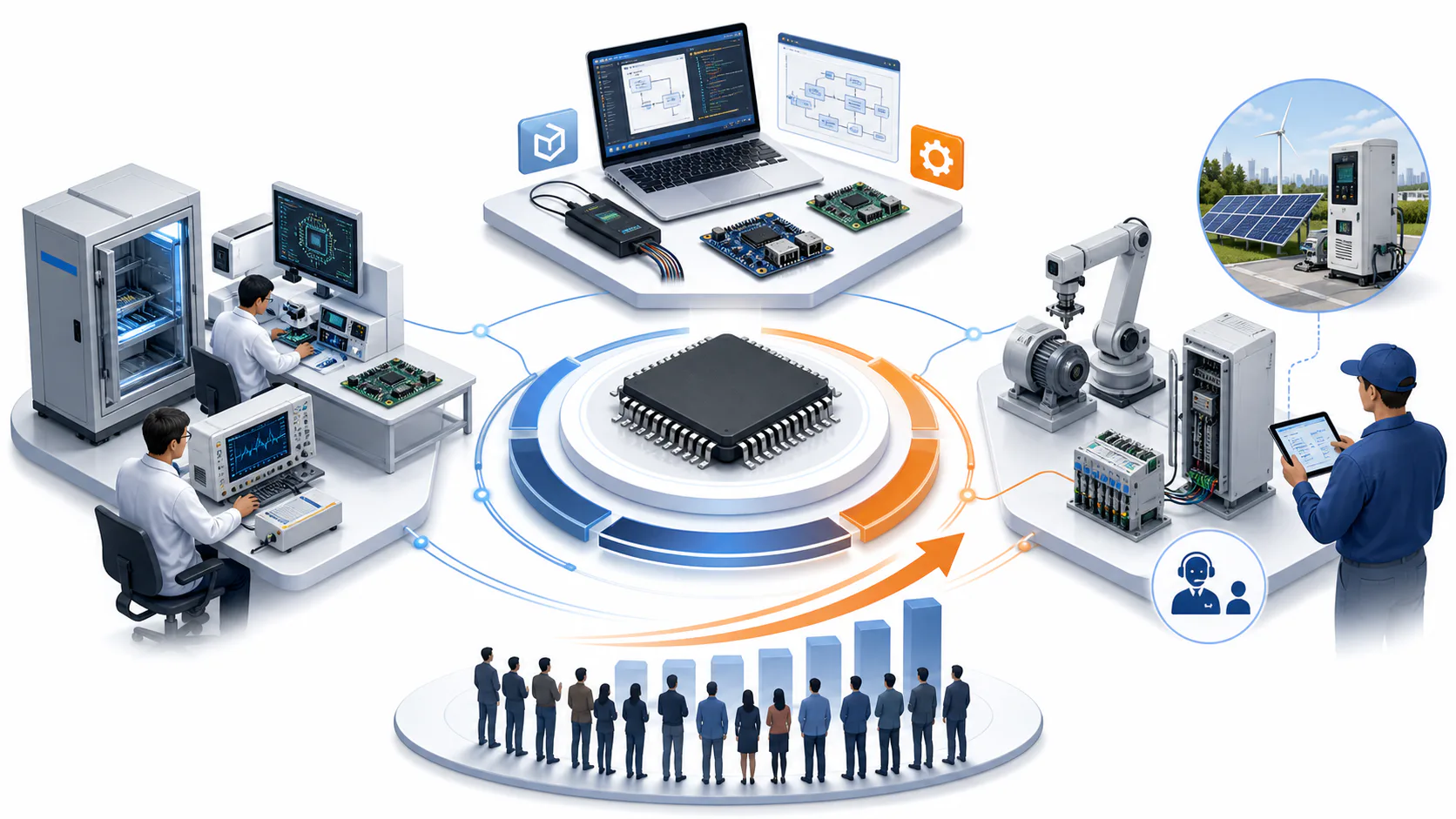
By July 2026, many China-based MCU suppliers could present credible devices for motor control, wireless products and automotive electronics. ADCs, advanced timers, connectivity and qualification claims were no longer rare.
That expanded the candidate pool, but a candidate list was still not an approved BOM.
Validation cost defines the real market
Moving an MCU affects clocking, analog behavior, peripheral drivers, boot flow, programming, EMC and production test. The customer pays that cost even when the replacement device is cheaper.
A supplier that provides working reference code, migration tools and timely application support can reduce total program cost more than another supplier with a slightly stronger parameter table.
Procurement should price the engineering work explicitly instead of hiding it in a unit-price comparison.
Integrated peripherals increase switching cost
Motor-control MCUs combine timers, ADCs, comparators and amplifiers into a tightly timed chain. Integration can reduce the external BOM, but it also ties algorithms and calibration to device-specific behavior.
The alternate must reproduce sampling timing, PWM protection, noise performance and fault response. A shared Cortex core does not make those peripherals equivalent.
Test the actual control loop and power stage, not only a development board.
Wireless and automotive add organizational gates
Wireless products need protocol maintenance, security updates and radio coexistence support. Automotive programs add AEC-Q100 evidence, quality processes, MCAL, functional-safety work products and long failure-analysis timelines.
A supplier may meet a published standard while lacking the support capacity to carry a customer through integration. Ask which artifacts are available now, which are roadmap items and who owns delivery.
“Sampling” and “mass-production approved” must remain separate statuses.
Channel responsibility must be visible
Small and mid-sized customers often buy through distributors. Before selection, define whether the distributor or original manufacturer handles firmware questions, returns and root-cause analysis.
Record escalation contacts, response targets, programming support and PCN flow. A low-cost device with ambiguous support ownership can create a stranded project after the first abnormal lot.
GigaDevice, Artery, MindMotion and other suppliers should be evaluated at the exact family and support team level.
Run a paid pilot rather than an open-ended sample exercise. Give each candidate the same board, firmware scope, defect list and response deadline. Track engineering hours on both customer and supplier sides, along with unresolved issues and production-test changes. The result exposes the real migration cost and the support capacity available after the initial sales attention fades.
The procurement conclusion
The 2026 MCU market was no longer constrained mainly by missing functions. It was constrained by the ability to move a customer from sample to repeatable production.
Buyers should qualify the support system alongside the silicon. The strongest second source is the vendor that can prove electrical fit, migration effort, production consistency and field accountability for the named program.
This article is a procurement framework, not a claim that all devices or suppliers have equivalent maturity.