
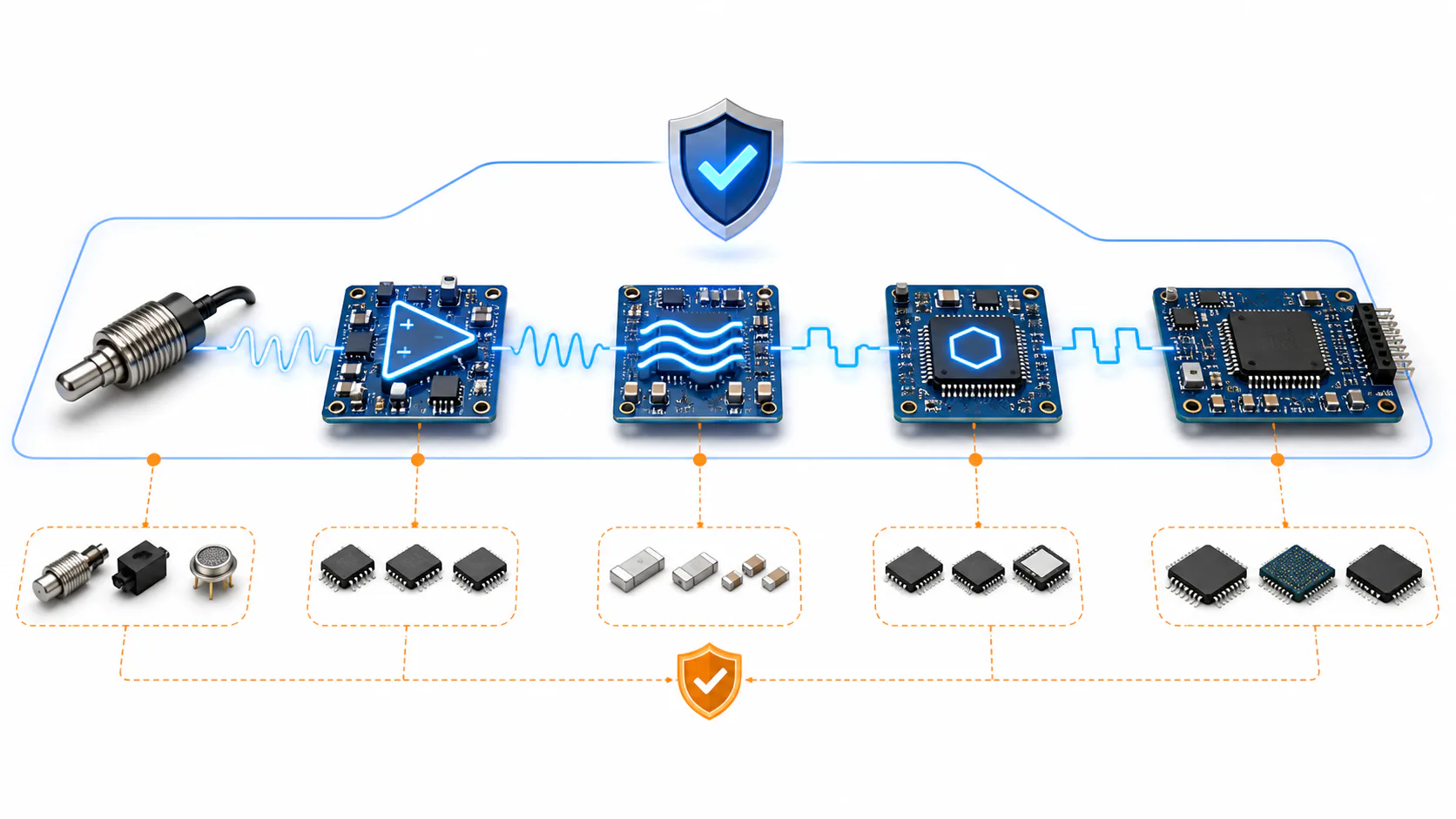
Analog sourcing projects often begin with a spreadsheet: incumbent MPN, candidate MPN, package, supply voltage and price. That is a useful screen, but it can create false confidence. Analog components operate inside feedback loops, filters, references and protection networks. Small differences can propagate through the complete signal chain.
The practical unit of second sourcing is therefore the function, not the individual line item.
Map the chain before searching
For each critical function, draw the path from physical input to digital code or from digital command to physical output. Include sensors, amplifiers, references, converters, isolation, drivers, regulators and protection.
Record the system requirement beside the path: total error, bandwidth, latency, fault response, output drive and environmental limits. This shows which component specifications are coupled.
Without that map, a buyer may qualify an op amp by itself while missing that its output cannot settle into the incumbent ADC input network.
Pinout is a mechanical convenience
Pin compatibility can reduce layout work, but it does not prove functional compatibility. Compare common-mode range, output swing, bias current, noise, offset drift, capacitive-load stability, overload recovery and phase reversal.
For converters, compare reference drive, input sampling behavior, digital timing, latency and calibration. For regulators, compare startup, compensation, current limit, transient response and discharge behavior. Typical data-sheet numbers should not replace worst-case analysis.
An alternate can pass a room-temperature bench test and fail only at cold start, high source impedance or after a large overload. Those corners belong in the original qualification plan.
Software and production can be affected
Changing an analog component may require new calibration constants, filtering, diagnostic thresholds or timing. Production testers may need different limits. Field diagnostics may interpret the new fault signature incorrectly.
Procurement should ask engineering to identify these dependencies before commercial approval. The total change cost includes firmware, fixtures, validation time and documentation, not only PCB rework.
Build a chain-level comparison
Measure the incumbent and candidate in the final circuit across supply, temperature and load. Use realistic interference, transients and source conditions. Track total error and stability rather than comparing isolated specifications one by one.
If several components are being localized or second-sourced together, test combinations. Two individually acceptable alternates can consume the same margin and fail when combined. A reference with higher noise and an ADC with lower effective resolution may be safe separately but unacceptable as a pair.
Supplier support is part of readiness
Established analog suppliers often provide models, application notes, characterization and failure-analysis support. A newer supplier can still be a strong second source if it supplies equivalent evidence and responds during debugging.
Request controlled data sheets, errata, reliability reports, PCN commitments, simulation models and named technical support. Treat missing evidence as qualification work, not as proof of failure or success.
The procurement conclusion
Single-chip substitution is easy to count and hard to trust. Chain-level qualification is slower, but it reveals the actual system margin and prevents multiple small changes from creating one large failure.
Define alternates around the measurement, power or drive function. Then purchasing can negotiate with more suppliers while engineering knows exactly what has been preserved.
Component changes require application-level verification. This article is supply-chain guidance, not a selection approval.