
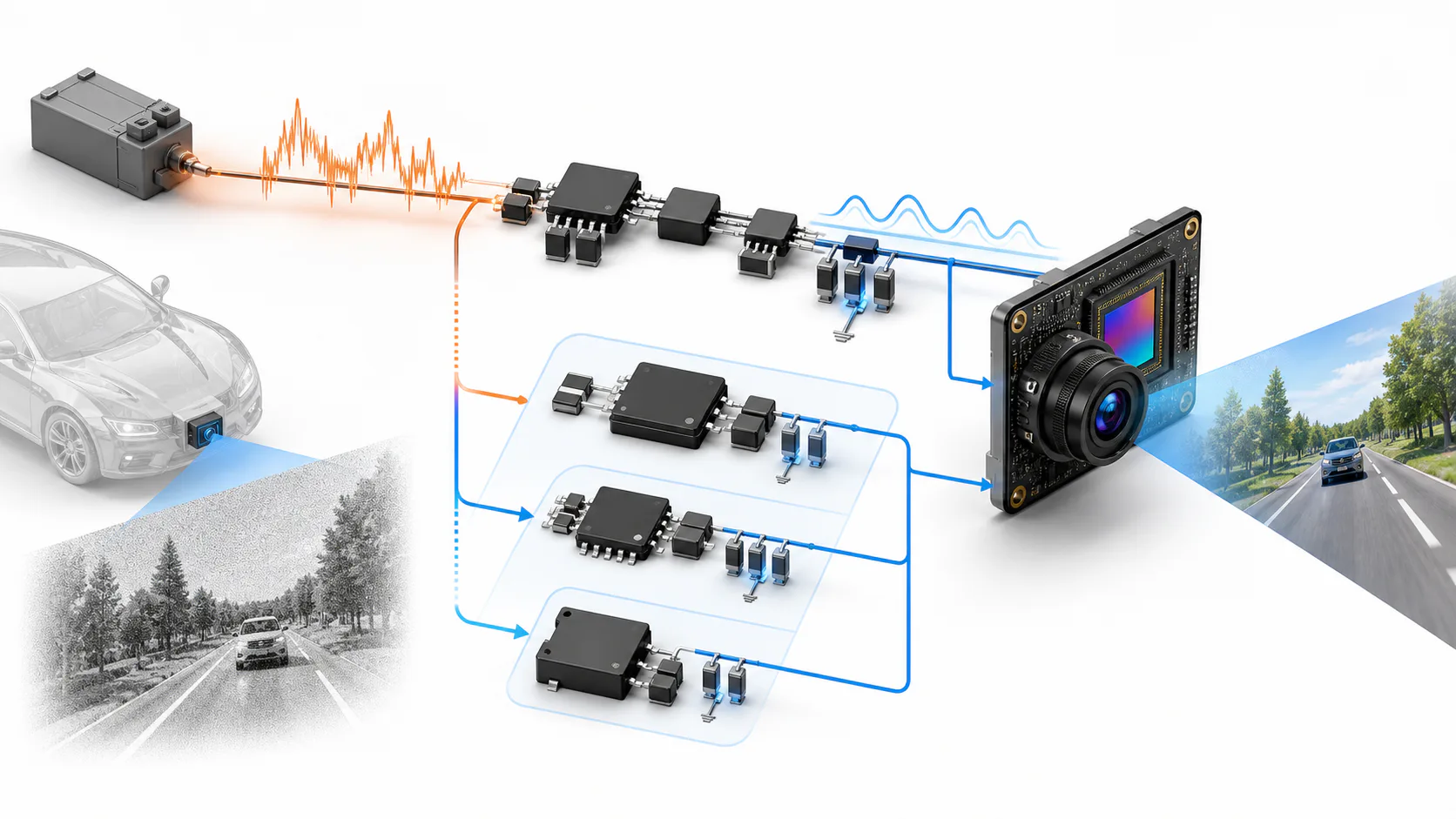
One camera, many rails
A camera module is not a lens plus a sensor; it is a small electronic system. The image sensor, the serialiser, the logic and the analogue front end all need power — at different voltages, with different noise tolerance, and often with strict start-up ordering. Some rails want efficient step-down; some want a low-noise LDO; some are fussy about sequence.
Automotive makes it harder. Cameras are frequently fed over coax via Power-over-Coax, so the cable is long and the environment is hostile — motors, radar, displays and comms modules all operating nearby. The PMIC has to convert one input into several outputs while controlling noise, optimising EMI, holding efficiency, and providing over-voltage, under-voltage, over-current and over-temperature protection. Small job, no room for error.
What "feeding the image dirty" actually means
Power quality becomes image quality. An image sensor is sensitive; supply noise and ripple can enter the imaging result through the analogue chain. You think the rail is merely a little unsteady — downstream, the algorithm is having doubts about whether it is looking at a lane marking, a shadow, or noise.
This matters more in assisted driving, because the image is not for human appreciation — it is machine input. A person shrugs at a few noise specks. A detector confronted with abnormal texture, interference banding or brightness fluctuation may produce a different result for object detection, lane recognition and scene interpretation.
Hence the emphasis in this category on low-noise LDOs, high PSRR, fixed-frequency PWM, spread spectrum, phase shifting, EMI optimisation, power-up sequencing and protection. Translated: the power must be quiet, the switching must be orderly, and a fault must contain itself rather than take the module down.
Where China-based parts have landed
This segment was long dominated by international suppliers with mature automotive power-management portfolios. What has changed is that domestic vendors have stopped pitching "automotive-grade power management" as a concept and started shipping parts aimed at this specific module.
| Role | Part | Note |
|---|---|---|
| Incumbent / benchmark | TI · Renesas · Analog Devices · Silicon Labs | Established automotive camera power solutions |
| China-based alternative | Southchip SC6201Q | Camera-module PMIC; supports PoC input; integrates one high-voltage buck, two low-voltage bucks and an LDO in a single chip |
| China-based alternative | Southchip SC6205Q | Automotive camera modules; 2.2 MHz fixed-frequency PWM, noise immunity and load-transient performance |
| China-based alternative | SCT61240Q | Four-channel automotive camera-module PMIC; small size, low noise, high PSRR, flexible configuration and EMI optimisation; handles PoC supply; integrates input over-voltage, output over/under-voltage, over-current and thermal protection |
The appeal of the integrated approach is direct: fewer external components, less PCB area, easier module miniaturisation — which is exactly what a camera crammed into a mirror housing needs.
The qualification bar
The point is not to find a chip that "more or less powers it" and swap it in. A camera PMIC has to clear noise, EMI, thermal design, sequencing, protection, package, automotive reliability and actual imaging performance together. OEMs and Tier 1s are not buying an alternative that exists in a slide deck; they are buying one that runs stably for years in a production vehicle.
Bottom line
The camera PMIC is easy to underrate. It does not capture the picture and it does not run the algorithm, but it determines whether the module works cleanly and reliably. As camera counts rise and modules shrink, the demands on supply quality rise with them. Parts like the SC620x family and SCT61240Q show that China-based alternatives have moved from generic power chips into specific, demanding automotive scenarios. Put simply: the job is not getting power to the car's eyes — it is not making them short-sighted.