
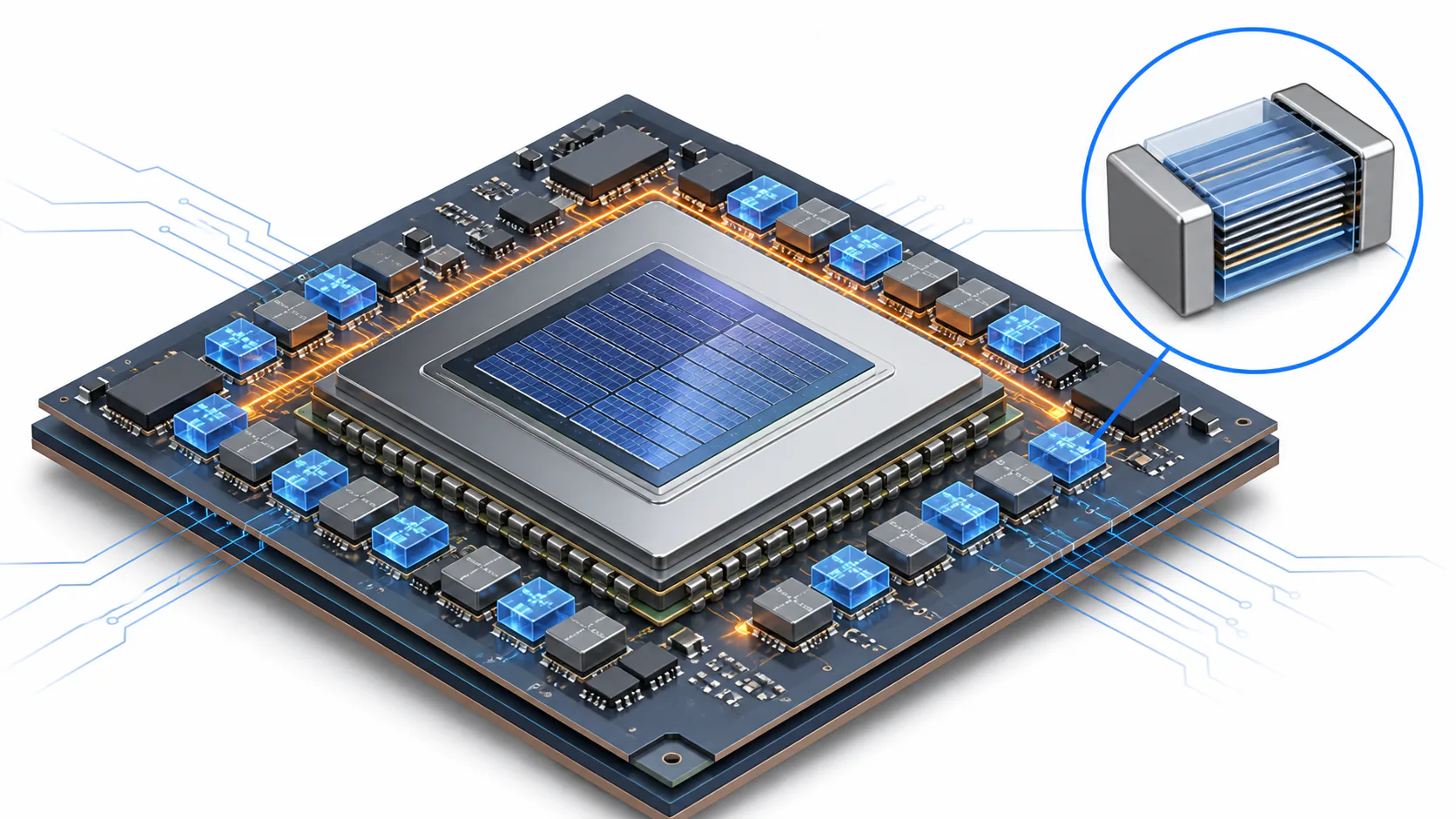
AI accelerators have made power delivery a packaging problem. As current changes become faster and power rails less forgiving, a capacitor several centimeters away on the board cannot do the same job as one placed beside the die or embedded in the substrate. That is the opening for silicon capacitors.
The sourcing mistake would be to treat this as another broad capacitor substitution cycle. Silicon capacitors are not simply thinner MLCCs, and a family that works in an optical module may not be interchangeable with one designed for package-level decoupling. Buyers need to qualify the electrical role, assembly route and supplier capacity together.
Why proximity changes the component choice
An MLCC remains the economical workhorse for bulk and board-level decoupling. It is mature, available in enormous volume and supported by a wide supplier base. Its limitation is not that it suddenly became a poor capacitor. The limitation is the interconnect between the capacitor and a fast, high-current load.
Every trace, via and package connection adds parasitic inductance. At the edge rates seen around GPUs, ASICs, HBM and high-speed optical engines, that path can prevent a board-level capacitor from responding quickly enough. Silicon capacitors use semiconductor-style structures to provide low parasitics, tight dimensional control and very thin form factors. They can be mounted on the land side, placed close to the package or designed into a substrate.
That makes them a precision layer in the power-delivery network. It does not make them the default answer for every capacitance position.
Three markets are being discussed as if they were one
The first market is package-level power integrity for AI and high-performance computing. Empower Semiconductor's ECAP products illustrate this direction: the component is positioned as last-inch decoupling close to a high-current processor, with newer devices designed for substrate embedding. In this market, the buyer is qualifying a component together with a package and power-delivery architecture.
The second market is high-frequency and optical equipment. Murata's silicon-capacitor families and ROHM's very small silicon-capacitor products address positions where stable RF behavior, small size and low parasitics matter more than large board-level capacitance. TOSA/ROSA assemblies, optical modules and compact wireless products have different qualification priorities from an AI package.
The third market is an emerging packaging ecosystem. Samsung Electro-Mechanics, AP Memory and newer China-based suppliers are positioning silicon capacitors alongside substrates, advanced packaging or high-speed module design. The opportunity is real, but a supplier's presence in one of these markets does not prove readiness in the other two.
What can actually be second-sourced
Capacitance and voltage rating are only the beginning. A credible comparison should include impedance over the relevant frequency range, ESR and ESL, DC-bias behavior, temperature stability, thickness tolerance, termination or bump structure and the mechanical rules of the assembly process.
Package location is especially important. A top-side component, a land-side component and an embedded substrate component can require different handling, inspection and rework strategies. If the capacitor is co-designed into a package, changing supplier late may force substrate or power-integrity revalidation rather than a simple AVL update.
For optical and RF applications, the test plan should include the actual signal path and fixture. A headline frequency claim is not a substitute for S-parameters, mounting guidance and performance in the customer's layout.
The capacity question is more complicated than a new product launch
Supplier announcements show that silicon capacitors are moving beyond laboratory samples. They do not, by themselves, establish qualified capacity for a specific geometry and assembly route. Buyers should ask where wafers are processed, where thinning and back-end work occur, which steps are single-sourced and whether quoted capacity refers to wafers, finished devices or committed customer output.
The qualification burden also changes the risk model. A small supplier may have an attractive electrical design but limited ability to support package co-development, automotive-grade documentation or a long product lifecycle. A large passive-component supplier may offer stronger quality systems but a product optimized for a different application. Neither profile is automatically better; the program requirement decides.
A practical buyer checklist
Before adding a silicon capacitor to an approved-vendor list, ask:
- Where in the power or signal network will the device sit, and what failure is it meant to prevent?
- Is the comparison based on impedance across the operating band, not just nominal capacitance?
- Does the alternate support the same assembly, inspection and rework process?
- Which reliability data apply to the exact construction being quoted?
- Is supply capacity qualified for the required thickness and package, or only for the broader family?
- Can the design retain MLCCs or another capacitor layer as a fallback if package-level supply tightens?
The procurement conclusion
Silicon capacitors will not erase the MLCC content of an AI server. They will take the positions where being closer to the silicon creates enough system value to justify a more specialized component and a deeper qualification process.
For buyers, the opportunity is not a cheap one-for-one replacement. It is a chance to build a second source into the package power-delivery plan before the capacitor becomes physically and contractually locked into the design.
This article is for supply-chain analysis, not a component-selection decision. Electrical limits and qualification status must be confirmed in current supplier documentation and in the final assembly.