
A serious crash involving driver assistance raises urgent questions, but a public account rarely provides enough evidence to assign a component cause. The responsible engineering response is to examine the complete fault chain.
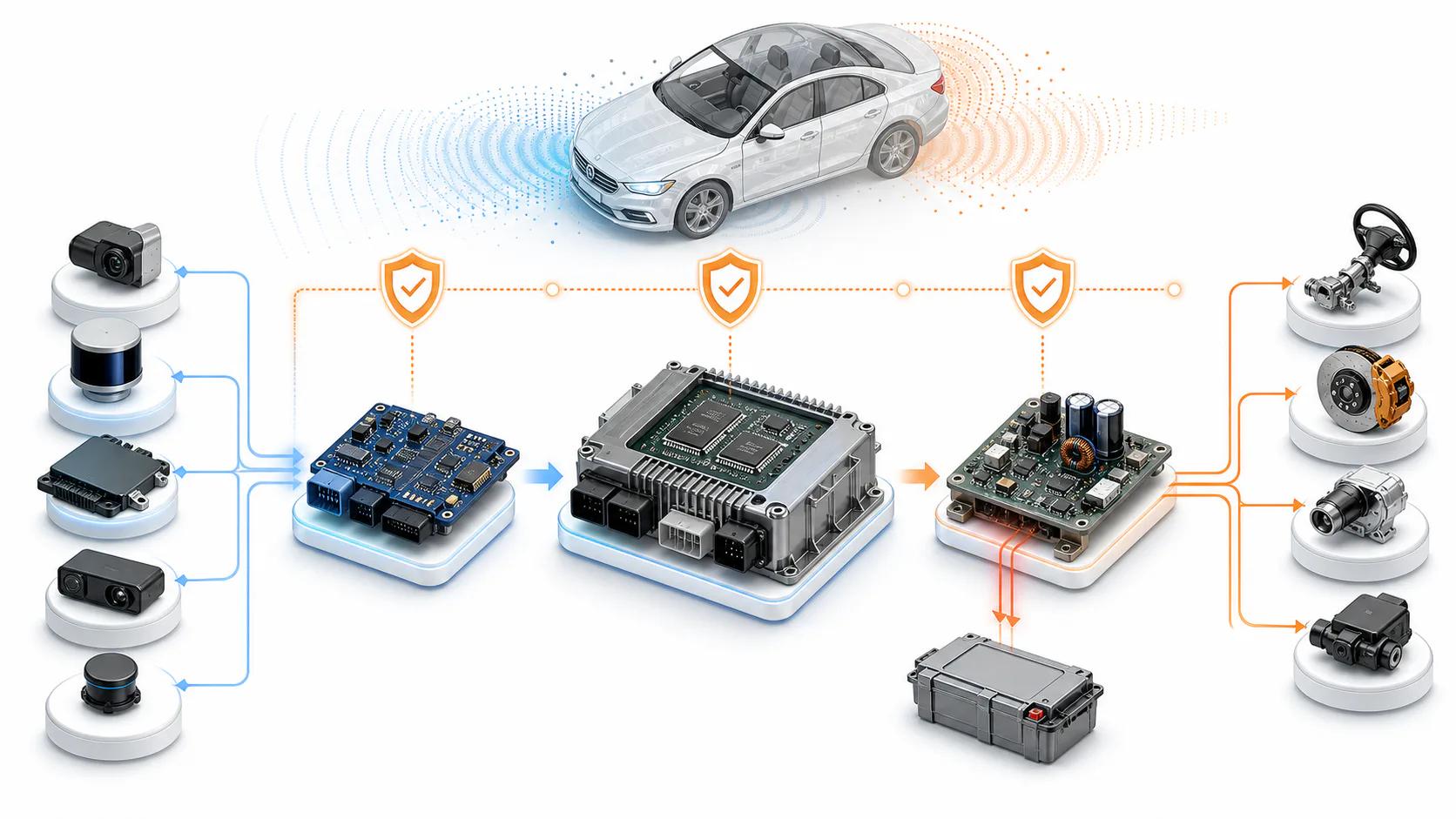
Driver-assistance systems combine sensors, power, compute, networks, software, actuators and human interaction. Safety depends on how those layers detect degradation and move the vehicle to a controlled state.
Perception needs diversity and diagnostics
Cameras, radar and other sensors have different strengths and failure modes. Glare, weather, contamination, blockage and calibration can reduce performance.
The system should detect implausible or missing data and communicate the limitation. Redundancy is useful only when the channels do not share the same blind spot, power failure or network path.
Buyers should review sensor diagnostics, calibration process, heating or cleaning functions and supplier evidence for environmental performance.
Compute must fail predictably
Higher TOPS does not automatically improve safety. The processor, memory and software need timing margin, error detection, watchdogs and a defined response to faults.
Functional-safety documentation, diagnostic coverage and development tools matter alongside benchmark performance. Memory corruption, thermal throttling or a stalled task should be detected before control output becomes unsafe.
Power sequencing and reset behavior need testing under brownout and transient conditions.
Networks and actuators close the loop
Perception is useful only if commands reach steering and braking systems with bounded latency. Ethernet, CAN and gateways require monitoring, redundancy and safe behavior under congestion or partial loss.
Actuators need independent diagnostics and enough authority to perform the minimum-risk maneuver. A system that detects failure but cannot execute a safe response has an incomplete architecture.
Procurement should identify common dependencies, including one regulator, connector or harness segment feeding multiple “redundant” channels.
Human handoff is an engineered interface
Driver monitoring, alerts and takeover time must reflect the real capability boundary. An alert that is late, ambiguous or easy to ignore is a system defect, not merely a user issue.
Test visual, acoustic and haptic warnings under distraction, noise and different seating conditions. Confirm how the system behaves when the driver does not respond.
Qualify evidence, not marketing levels
For each critical supplier, request safety manuals, assumptions of use, FMEDA-related evidence, cybersecurity process, errata and change control. Trace component requirements to system hazards and validation tests.
Incident analysis should preserve logs and distinguish sensor limitation, software decision, communication fault, actuator response and driver state. Avoid changing parts before the failure mechanism is understood.
The procurement conclusion
Driver-assistance safety is created across the entire path from sensing to controlled motion. A faster processor or additional sensor can add capability, but it cannot replace fault containment and a credible handoff.
Buyers should source diagnostics, documentation and lifecycle support with the hardware. The right question is how the system degrades when one layer is wrong.
This article is general engineering analysis, not a finding about any specific incident or a substitute for a formal safety investigation.