
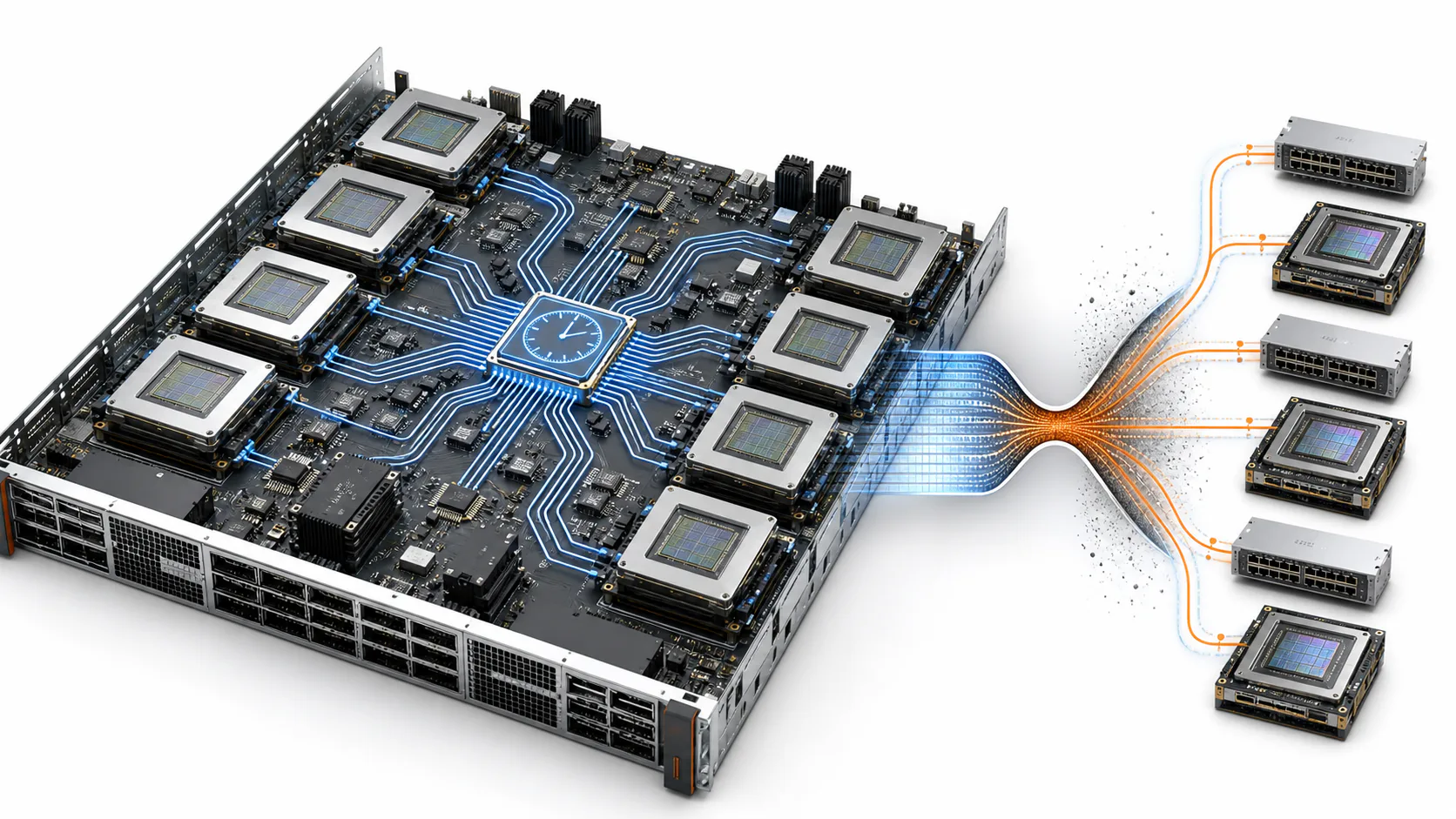
The July 2026 source described clocking as an underappreciated AI-server dependency. As PCIe signaling reaches 64 GT/s and planning moves toward 128 GT/s, timing margin becomes a system budget shared by reference source, buffers, board and receivers.
The clock components are low-cost compared with accelerators, but a failure can disable the entire platform.
Start with the jitter budget
Phase noise and integrated jitter must be evaluated over the bands defined by the interface requirement and platform design. A single “low jitter” number from two vendors may use different integration limits and test conditions.
Additive jitter, output format, frequency accuracy and power-supply rejection all matter. The board's power and layout can degrade a strong data-sheet result.
Require the original measurement method and compare like with like.
One server contains several timing roles
A platform can use oscillators, jitter cleaners, fanout buffers and redundancy or synchronization devices. They are not interchangeable clocks.
Map every endpoint, output standard, frequency, enable sequence and failure response. Record which clock affects boot, GPU links, switches, storage and management. This turns a vague “ten clock chips” estimate into an auditable tree.
Critical nodes deserve separate availability and alternate plans.
Qualification extends into firmware
Clock programming, strap settings, BIOS sequence and management telemetry interact. A replacement can meet steady-state frequency while failing startup, spread-spectrum behavior or fault recovery.
Validate cold boot, warm reset, degraded input, redundancy switching and temperature. Measure link training and error counters at the complete system level.
Preserve configuration files and register versions with the BOM.
Sampling is not production supply
Domestic and international vendors may demonstrate promising clock products, but procurement should distinguish specification release, sampling, customer qualification and mass production.
Ask for the exact approved MPN, package site, PCN process and production test coverage. Confirm application support for signal-integrity debugging and long-duration failure analysis.
Price is considered after the timing tree has passed.
Keep a clock-tree evidence package with schematic, layout constraints, power-noise measurements, register image, phase-noise plots and link-error results. Alternate testing should use the same server firmware and endpoint population. If a board revision changes power distribution or routing, reopen the timing budget instead of assuming the previously approved clock device remains equivalent in the new environment. Assign one owner to approve the complete evidence package.
The procurement conclusion
PCIe clocking can become an AI-server bottleneck because small timing errors propagate across expensive links. The scarce asset is a validated clock tree, not merely a low-jitter crystal.
Buyers should manage timing sources, buffers, configuration and board implementation as one subsystem. Second sourcing requires repeated link and fault testing; it cannot be established from nominal frequency and package alone.
This article reflects technology context available in July 2026 and is not a current PCIe product recommendation.