
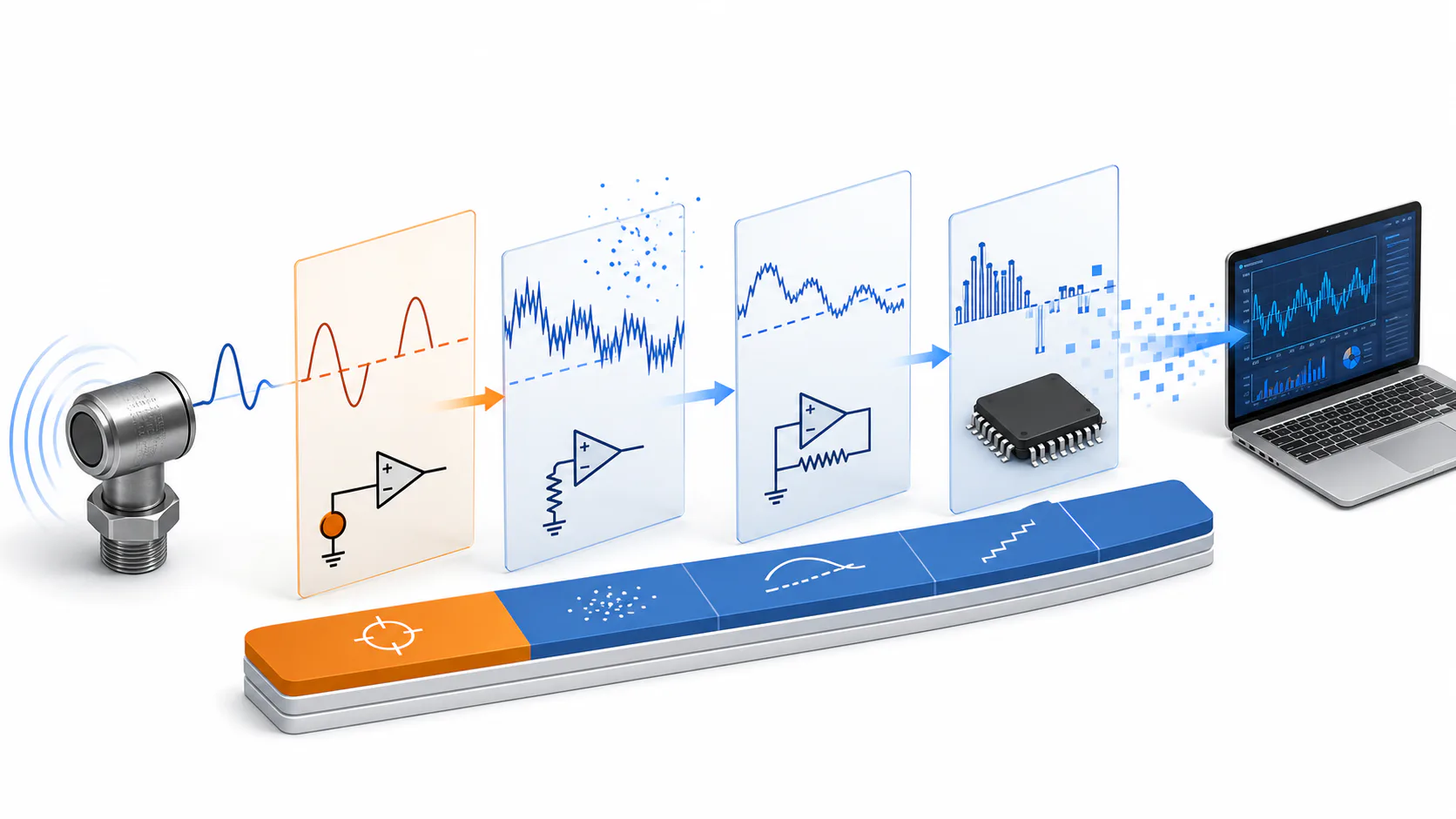
A sensor converts a physical condition into an electrical signal, but that signal is not automatically accurate. It can be small, noisy, nonlinear and sensitive to temperature, supply voltage and mounting stress. Before an MCU can use it, an analog front end must amplify, filter, level-shift and convert it.
For procurement, this means the sensing function cannot be qualified by the sensor MPN alone. The complete measurement chain owns the error.
Start with the physical measurement
Define the range, bandwidth, response time and total allowable error at system level. A battery-current measurement, industrial pressure loop and wearable temperature channel need different priorities.
Then allocate error across the sensor, excitation source, amplifier, reference, filter, ADC and PCB. Typical specifications are unsuitable for this budget. Use worst-case limits over voltage, temperature and lifetime where the supplier provides them.
Without an allocation, teams often buy a high-resolution converter while losing accuracy in the reference or amplifier. More output bits do not recover a corrupted input.
The analog front end changes the signal
Amplifiers contribute offset, gain error, noise, bias current and common-mode limitations. Filters remove unwanted energy but add settling time and phase shift. ADCs add quantization, nonlinearity, reference sensitivity and latency.
These effects interact with source impedance and sampling rate. A converter that performs well with a low-impedance laboratory source may not settle when connected to the real sensor and filter. An amplifier can be stable in isolation and oscillate with a capacitive ADC input.
Qualification therefore needs the actual circuit, not only component evaluation boards.
Calibration is not a free correction
Software calibration can remove known offset or gain error at a defined condition. It cannot reliably remove random noise, unstable drift, saturation or missing dynamic range. Calibration also creates production requirements: fixtures, reference standards, stored coefficients and traceability.
When evaluating an alternate, determine whether existing calibration coefficients remain valid. A device with a different drift shape or reference behavior may require a new calibration model and manufacturing step.
Power, layout and environment matter
Sensor accuracy depends on clean supplies, grounding and routing. Switching-regulator ripple, digital return current, electromagnetic interference and thermal gradients can all appear as measurement error.
Test the chain near motors, relays, radios and power converters under realistic operating states. Include startup, brownout, overload and recovery. A part that meets steady-state accuracy but recovers slowly from saturation may miss the event the system was designed to detect.
A sourcing checklist
For each alternate, compare input range, noise density, offset and gain drift, common-mode rejection, reference requirements, settling, latency and fault behavior. Request characterization data and models, not only a summary table.
Run a component-level comparison, then repeat system accuracy, transient and EMC tests. Record which specification consumes each part of the error budget. If the supplier cannot explain behavior outside nominal conditions, the apparent second source is not mature.
The procurement conclusion
Sensors begin the measurement, but analog circuitry determines what the digital system believes. A safe sourcing decision preserves the entire error budget, timing path and recovery behavior.
Treat the signal chain as one qualified function. That approach makes alternates slower to approve on paper and much less likely to fail in the field.
Final accuracy depends on the complete design and environment. Confirm limits in current documentation and application testing.