
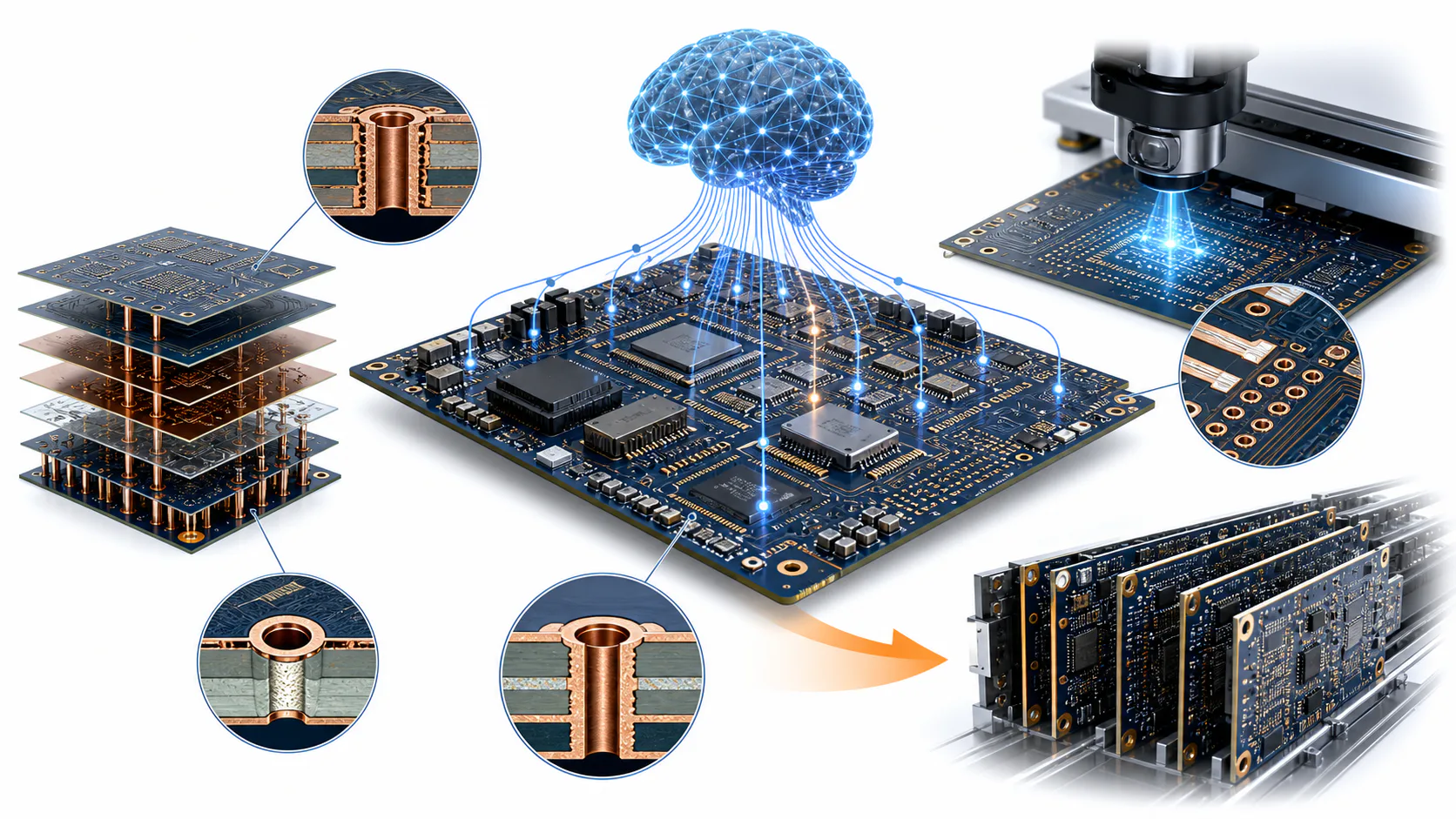
Victory Giant, WUS Printed Circuit, Shennan Circuits and TTM Technologies were all associated with AI infrastructure opportunities in the July 2026 source. Their market narratives diverged because “AI PCB” covered different products and manufacturing difficulty.
For a hardware buyer, the meaningful metric is repeatable accepted output for the named board.
AI boards are not one category
Accelerator baseboards, switch boards, backplanes, optical-module boards and power boards differ in layer count, size, stack-up, via structure, loss budget and thermal demand.
A supplier qualified for one product cannot be assumed ready for another. Translate the program into board dimensions, materials, impedance, HDI level, registration and reliability requirements.
Capacity should be quoted against that process route, not total factory square meters.
HDI difficulty compounds
High-order HDI requires repeated build-up, laser drilling, plating, alignment and lamination. Each process step introduces another yield opportunity. Larger boards and finer structures make registration and warpage harder.
The supplier must control stacked or staggered microvias, copper thickness, dielectric behavior and high-speed loss together. Passing a prototype does not establish stable volume yield.
Ask for distribution data and defect modes, not only a best-case sample.
Yield determines usable capacity
Nominal line capacity can expand while saleable output remains constrained during ramp. Low yield consumes material, machine time and inspection capacity and can turn a low quote into missed deliveries.
Review first-pass yield, rework limits, electrical-test escapes and improvement trend for comparable structures. Confirm whether reported yield refers to panels, individual boards or customer-accepted units.
Commercial planning should use the same denominator as production acceptance.
A second site needs customer approval
An overseas factory is not an automatic copy of a qualified domestic line. Equipment, material sources, operators and process windows differ. The customer may require a full site qualification.
Map laminate, copper foil, chemistry and critical equipment dependencies for each site. Require controlled transfer lots and reliability evidence before counting the second plant as available capacity.
The sourcing dashboard should show committed panels, first-pass yield, accepted boards and on-time delivery separately. It should also preserve the stack-up revision and customer approval attached to each number. This keeps a high-volume conventional line from being counted as advanced-HDI capacity and exposes when apparent growth is being consumed by scrap or requalification.
The procurement conclusion
The four suppliers could participate in AI hardware while occupying different capability and qualification positions. An order announcement alone did not reveal margin, yield or scalable capacity.
Buyers should source the exact board process, track customer-accepted yield and qualify each manufacturing site. In advanced HDI, resilience is the ability to reproduce a narrow process window across lots and factories, not the number of factories shown in a presentation.
This analysis reflects July 2026 observations and is not an investment view on any PCB company.