
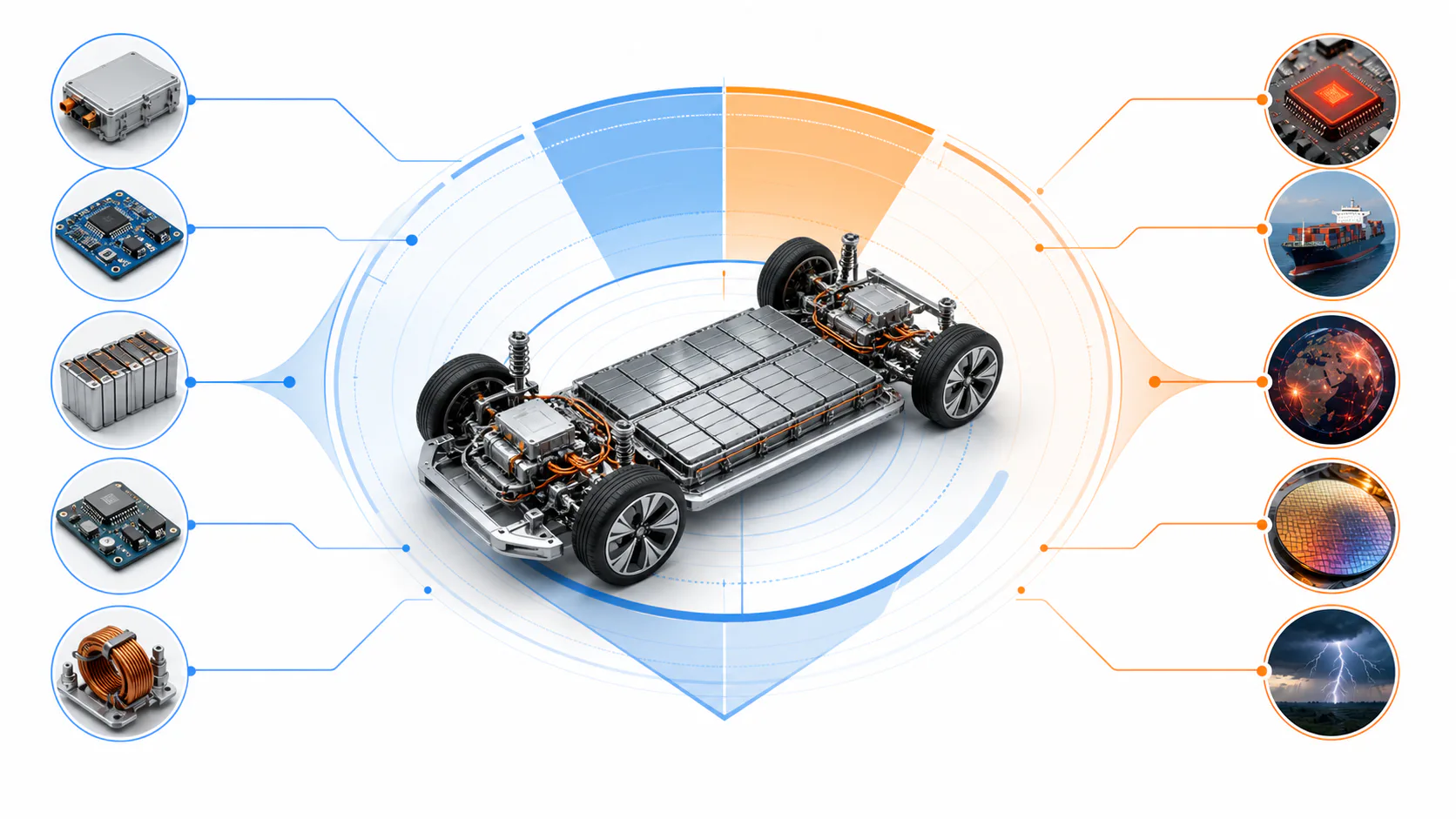
An EV BOM can contain thousands of components, but weekly market commentary tends to compress them into one direction. In late May 2026, power-semiconductor pricing, battery electronics and automotive demand were sending mixed signals.
A useful risk radar should preserve that disagreement. Its job is to identify where a program can stop, not to produce one mood for the whole vehicle.
Organize risk by vehicle function
Separate traction inverter, on-board charger, DC-DC, battery management, thermal system, body electronics, cockpit and connectivity. Each uses different device classes and qualification constraints.
Power modules may have long redesign cycles. A commodity passive may have several sources. A connector can be physically available but locked to tooling and harness approval.
Assign criticality based on line-stop impact, time to qualify and number of truly independent sources.
Turn market signals into MPN evidence
A supplier price notice or news report should create an investigation record. Link it to exact affected parts, source date, channel and confidence.
Then verify authorized inventory, confirmed lead time, allocation status and program demand. A signal that cannot be connected to an approved MPN should not drive a purchase.
Point-in-time distributor listings can reveal pressure, but they are not live market-wide transactions.
Watch shared dependencies
Two approved device suppliers may use one foundry, substrate source, package house or connector subcomponent. The AVL can show two logos while the supply chain still has one failure point.
Map wafer, assembly, test and critical materials for high-risk parts. Include geographic and logistics dependencies, then update after PCNs and site transfers.
For batteries and high-voltage systems, software and safety documentation can also be shared dependencies that slow migration.
Use staged actions
Red items need executive ownership, confirmed coverage and an active alternate plan. Amber items need samples, validation dates and supplier monitoring. Green items remain under normal control.
Inventory is only one action. Other options include forecast alignment, design changes, firmware portability, approved package variants and contractual capacity.
Avoid raising every buffer simultaneously. Working capital should follow quantified line-stop exposure.
Close the loop with outcomes
Review whether each warning became a delayed delivery, price realization or false alarm. This calibrates the radar and prevents recurring headlines from overwhelming real evidence.
Record the capture date, because a May signal should not appear as a current condition months later. Keep data history so buyers can see duration and reversal.
The procurement conclusion
EV component risk is fragmented. A vehicle program becomes resilient when market observations are translated into exact parts, common dependencies and qualification actions.
The useful radar does not predict the whole market. It shows which released BOM position lacks time, evidence or another route.
This article is a framework based on a May 2026 market snapshot, not a current availability report.