
Small in price, not in responsibility
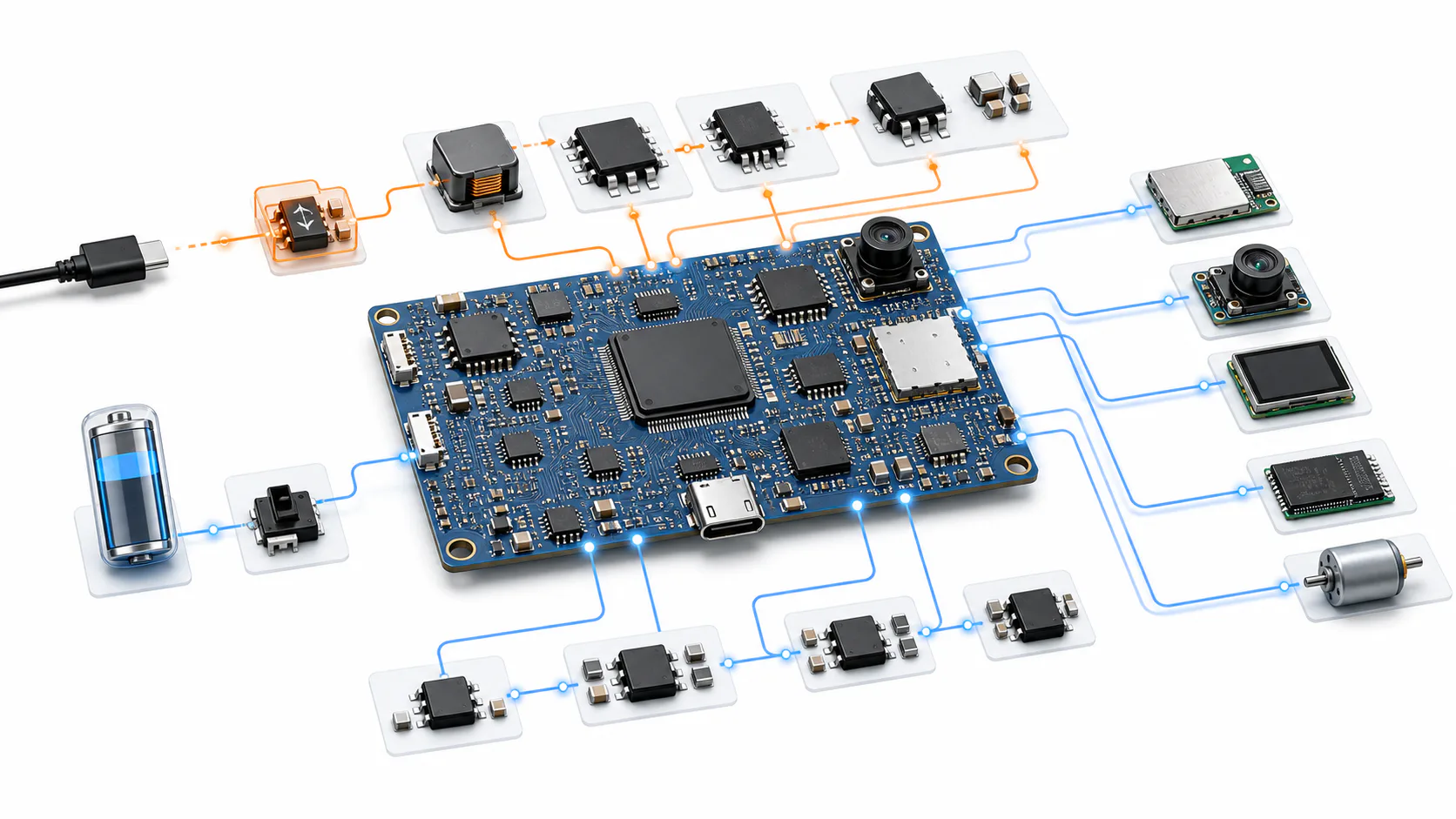
DC-DC converts "coarse" 12 V, 24 V or 48 V into the 5 V, 3.3 V or 1.8 V a system can eat. LDO trades efficiency for a clean output, feeding sensors, ADCs, RF, cameras and MCU analogue sections. Load switches decide who gets powered, who gets cut, and who gets isolated on a short. Push into automotive and high-side switches, smart switches and eFuses add diagnostics, current limiting, over-temperature and short-circuit protection.
None of these are expensive. All of them decide whether a system has a temper. An unsuppressed DC-DC EMI signature can fail whole-board certification; a noisy LDO can turn a night-vision camera into a snow channel; an under-protected load switch lets one shorted peripheral drag down an entire rail. "It powers up" is step one. Staying stable, not nuisance-tripping and not screaming on the spectrum analyser is the actual job.
DC-DC: stepping the voltage down is the entry exam, not the test
Efficiency matters, but in automotive, industrial and high-end consumer contexts EMI, transient response, quiescent current, protection and thermal design are what separate parts. A 12 V vehicle battery rail is not a gentle input: cold crank, voltage dips, load steps and surge all arrive uninvited.
| Role | Part | Note |
|---|---|---|
| China-based alternative | Silan SQD3430 series | Automotive first-stage DC-DC; per public data AEC-Q100, for cockpit clusters, T-BOX, lighting and body domain control; emphasises efficiency, low quiescent current and EMI |
| China-based alternative | Saizhuo VE8600Q / VE8602Q | 60 V buck controller / 60 V boost controller, AEC-Q100, 4.5–60 V — suits 24 V, 48 V, industrial and automotive rails |
Don't frame this as "a domestic buck against an imported buck." Frame it by rail: 12 V first stage → wide input, cold crank, EMI, low Iq; 48 V zonal → standoff voltage, efficiency, thermal, protection; camera and sensor supplies → ripple, noise, transient response; AI and industrial → power density and long-term reliability.
LDO: the most dismissed, and the most likely to save you
LDOs get a bad name for efficiency. Half fair — they are wrong for large drops at high current, but for low-noise supply they are the water filter. Sensors, ADCs, cameras, RF and MCU analogue blocks all hate supply noise; feed them a noisy rail and they return beautifully formatted wrong data.
| Role | Part | Note |
|---|---|---|
| China-based alternative | NOVOSENSE NSR31 / 33 / 35 | Automotive LDO for battery-connected rails; 3–40 V wide input, transient to 45 V |
| China-based alternative | LN20X4YQ1 | Automotive LDO family, 100–450 mA; cited for BMS, BCM and VCU applications |
Judge an LDO on four axes: noise, PSRR, quiescent current, protection. Insufficient PSRR lets upstream DC-DC ripple leak into sensitive circuits; high Iq makes parked standby consumption ugly; weak protection takes downstream chips with it on a fault.
Load switch: the value is not switching — it is not passing the blame
In automotive and high-reliability systems a load switch is not a light switch. It must know whether the load is shorted, over-current or over-temperature, and report state back to the MCU. With cameras, radar, cockpit displays, zonal controllers and multi-sensor rails, the old approach — power everything from one rail — no longer holds. Whoever fails gets cut; whoever shorts gets isolated; whoever recovers gets powered again.
| Role | Part | Note |
|---|---|---|
| China-based alternative | 3PEAK TPW20400QQ | Four-channel high-side switch for automotive camera and radar; over-current, short-circuit and open-load detection, thermal shutdown, I²C configuration and status readback; AEC-Q100 |
| China-based alternative | NOVOSENSE | Automotive high-side switches for resistive, capacitive and inductive loads — body domain, cockpit, headlamps |
The upgrade path is from "can switch" to "can diagnose, protect and partition." In zonal architectures these parts increasingly behave like small distribution engineers.
Bottom line
These chips are underrated because they have no story to tell. MCUs talk TOPS, SiC talks 800 V, image sensors talk pixels, memory talks capacity. DC-DC, LDO and load switches talk about nothing going wrong — which sells badly and matters enormously. They set the floor of a system, not the highlight of a launch event. The next stage of second-sourcing is completing the power chain.