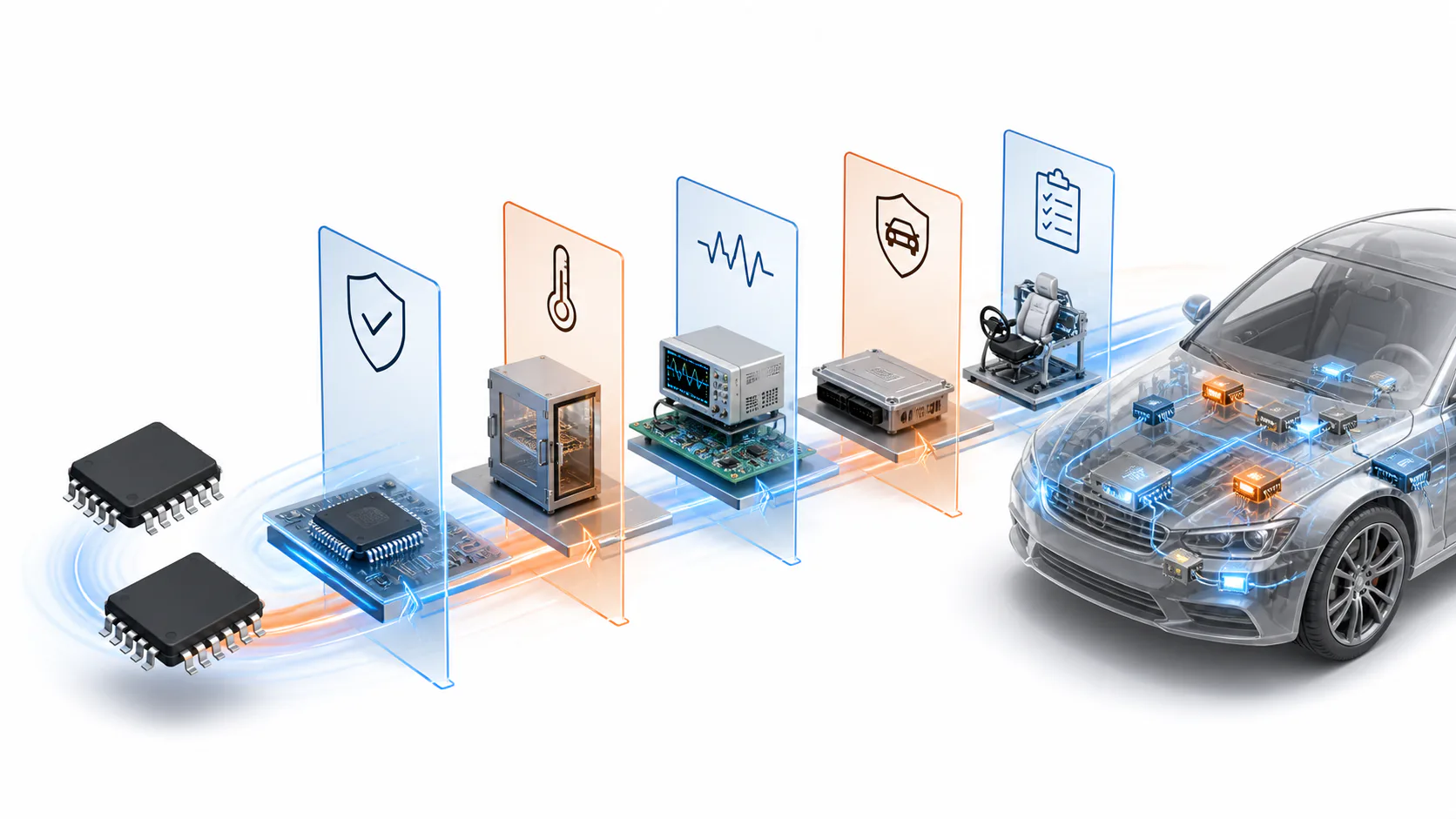
NOR Flash stores code and critical data in many automotive controllers. It may hold a boot image, calibration, security material or an update fallback. A failure can stop startup or leave a controller unable to recover.
That role makes automotive NOR difficult to second-source. Density and interface identify candidates, but they do not prove that a device will preserve timing, reliability and update behavior.
Define what the memory protects
Start with the function. A boot device for a domain controller has different risk from small parameter storage. Record image size, execute-in-place needs, startup deadline, update frequency, retention period and recovery strategy.
If the design uses dual images or over-the-air updates, confirm erase and program timing during the actual update flow. Power loss at each step should leave a recoverable state.
The system safety and security teams should identify which data require integrity checks, authentication or protected regions.
Interface compatibility has corners
Two serial NOR devices can support the same command family while differing in status registers, dummy cycles, deep-power-down behavior, reset sequence and protection bits. Quad or octal modes add signal-integrity and controller-configuration dependencies.
Firmware must identify the device correctly and handle its error states. Test cold and hot startup, maximum clock rate, low supply, sleep transitions and interrupted program or erase operations.
A pin-compatible package can still require bootloader and manufacturing-programmer changes.
Reliability evidence must match the device
Automotive use requires the exact orderable product, package and manufacturing site to have appropriate qualification evidence. Review endurance, data retention, temperature range, FIT data, process maturity and lot traceability.
Retention and endurance interact with temperature and usage. A device that stores frequently updated logs has a different stress profile from one programmed once at the factory.
Ask how the supplier manages die revisions and process transfers. A PCN can trigger software or reliability review even when the MPN remains unchanged.
Supplier readiness includes lifecycle
GigaDevice and other memory suppliers can provide additional choices, but an automotive program needs long-term supply, quality response and failure analysis alongside the silicon.
Request lifecycle commitment, capacity visibility, PPAP-related support where applicable, change notification and a named escalation route. Confirm where wafer fabrication, assembly and test occur and whether the alternate shares an upstream dependency with the incumbent.
Qualify the recovery path
Run the candidate in the final MCU or processor platform. Verify boot time, memory-mapped reads, update, rollback, diagnostic logging and fault injection. Cycle power during critical operations and inspect both data integrity and software response.
Use multiple lots and temperature corners. Production programming time and yield should be included because a technically acceptable part can create a factory bottleneck.
The procurement conclusion
Automotive NOR Flash is small in value and large in system consequence. A real second source reproduces boot, update, retention and recovery behavior over the program life.
Buyers should approve the memory together with firmware and lifecycle evidence. A matching density creates a candidate; system validation creates an alternate.
Confirm qualification, endurance and lifecycle for the exact device and application.