
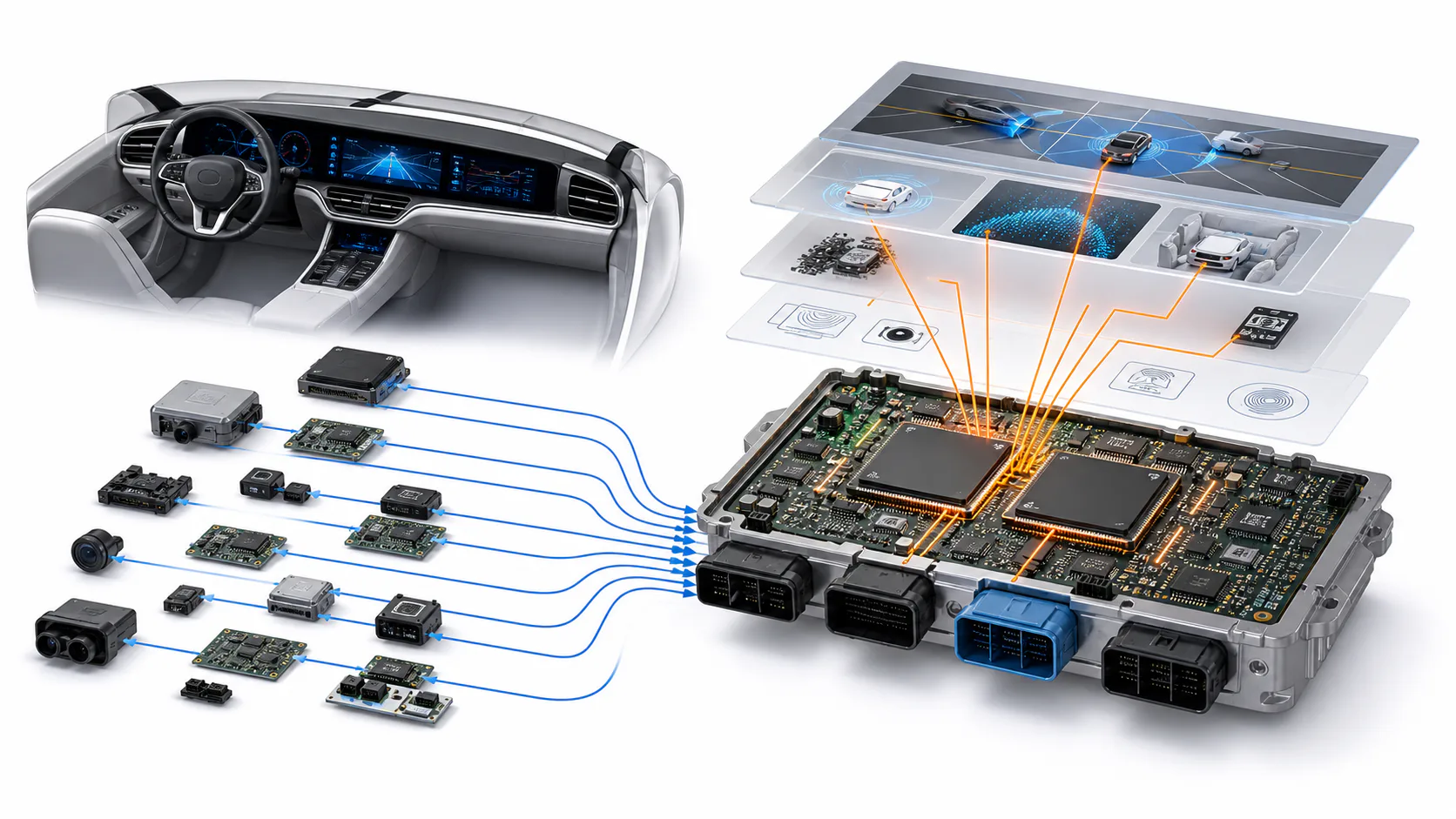
Automotive platforms increasingly combine cockpit and driver-assistance functions in fewer computing units. Integration can reduce hardware duplication, wiring and cost. It also concentrates supply and validation risk.
When one processor, memory device or PMIC supports several vehicle functions, a shortage or design defect affects a larger portion of the program. Procurement needs to manage the platform BOM differently from a collection of independent ECUs.
Integration changes criticality
A central SoC may host displays, audio, connectivity, perception and other workloads using isolation and virtualization. Its memory and power requirements are larger, and software is more tightly coupled.
The line-stop impact of each core device rises. A component that once affected one feature can now delay the whole vehicle trim.
Update criticality ratings after architectural consolidation rather than carrying over the old ECU assessment.
Memory becomes part of the compute qualification
High-capacity DRAM and managed storage support graphics, models, maps and software. Density, bandwidth, thermal behavior and firmware compatibility are platform requirements.
An alternate memory source can require new training, layout, signal-integrity and workload testing. Storage changes can affect boot, update and retention behavior.
Qualify processor and memory combinations, not isolated catalog parts.
Power and thermal paths are concentrated
Integrated compute needs multiple rails, strict sequencing and high transient current. A platform PMIC or power module can become a single source. Cooling and enclosure design limit substitute options.
Compare startup, reset, fault and degraded behavior across the entire power tree. A pin-compatible PMIC may have different firmware, sequencing or safety documentation.
Thermal margin should be measured under simultaneous cockpit and ADAS workloads.
Networks and software add migration cost
Automotive Ethernet, CAN and SerDes connect cameras, displays and actuators. Switching devices or processors can change drivers, hypervisors, security provisioning and diagnostic tools.
Supplier readiness includes software releases, vulnerability response, functional-safety evidence and long-term support. Hardware availability without a maintained software baseline is not an alternate.
Create platform-level contingencies
Map exact processor, memory, storage, PMIC, clock and network dependencies. Identify which have drop-in candidates, which require a board spin and which require a platform migration.
Secure forecast and lifecycle commitments for locked components. For the next vehicle revision, design portable interfaces and qualify another architecture before the current platform reaches allocation.
Inventory can bridge a short disruption, but it cannot solve a multi-year lifecycle gap.
The procurement conclusion
Cockpit and ADAS integration improves system efficiency while moving risk into fewer, more difficult components. The right sourcing unit is the compute platform and its software evidence.
Buyers should measure concentration explicitly, protect locked parts and fund architecture-level alternatives. Fewer boxes do not automatically mean fewer supply risks.
The dependency register should be reviewed whenever functions move between controllers or software releases change the platform load.
This article reflects a May 2026 automotive risk assessment and provides general supply-chain guidance.