
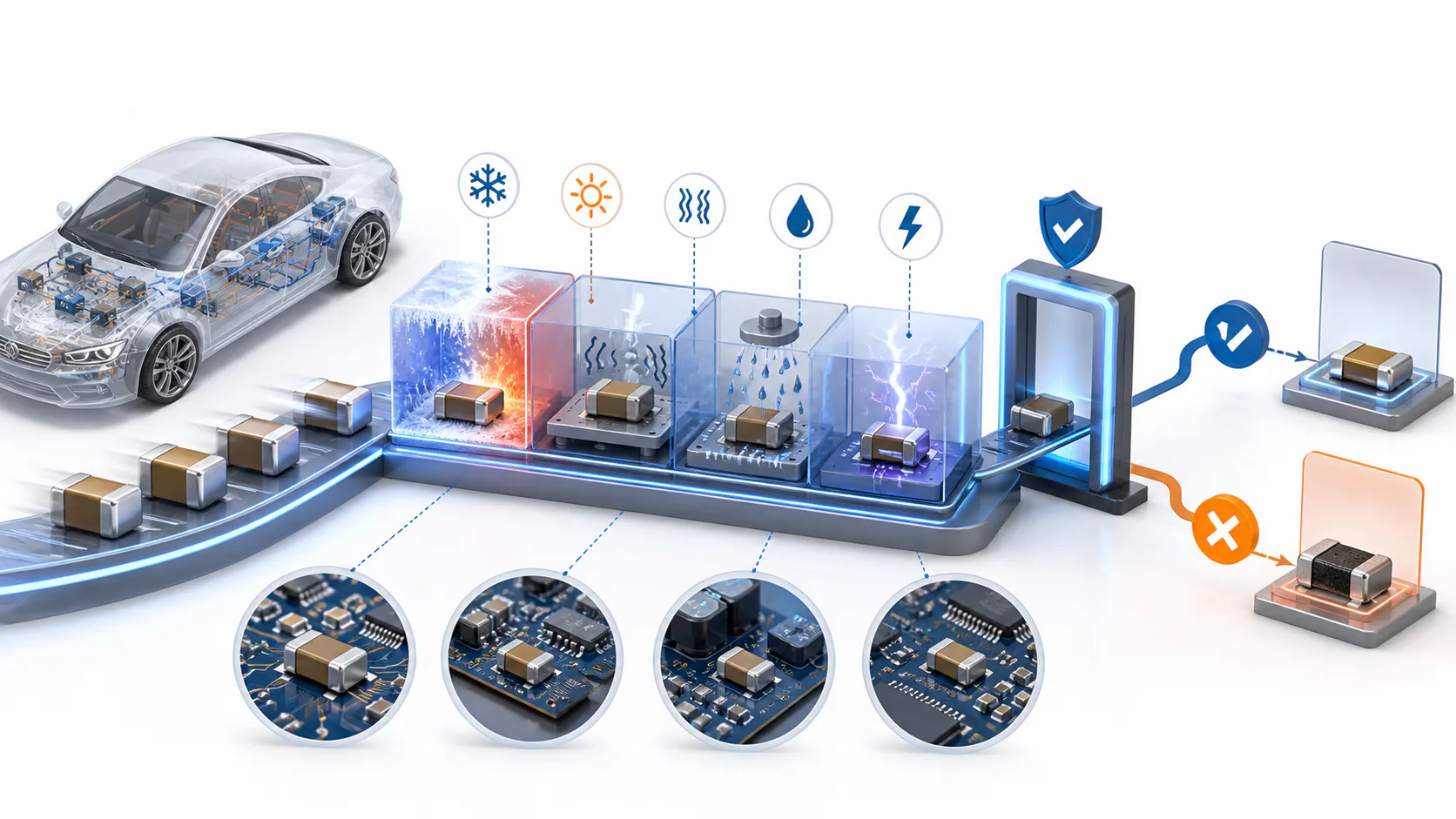
MLCCs are inexpensive compared with processors and power modules, which makes them tempting targets for broad cost-down substitutions. In an automotive design, that approach can move risk into hundreds of positions at once.
The part number encodes more than capacitance and case size. Dielectric, voltage rating, tolerance, thickness, termination, reliability grade and supplier series define how the capacitor behaves under bias, temperature and mechanical stress.
Nominal capacitance is not operating capacitance
Class II ceramics such as X7R and X7S lose capacitance under DC bias. The amount depends on voltage, case size, construction and supplier. Temperature and aging reduce it further.
A replacement should be compared at the circuit’s actual voltage and temperature, not at the zero-bias catalog value. In power rails and hold-up networks, insufficient effective capacitance can increase ripple or destabilize a regulator.
Request bias curves for the exact MPN. Family-level graphs may not represent the selected size and voltage rating.
Mechanical reliability changes the part
Board flex, depaneling, connector insertion and thermal cycling can crack ceramic capacitors. Soft-termination products add a compliant layer intended to reduce stress, but construction and performance vary.
An automotive alternate needs review of termination, mounting guidance, board layout and process controls. A standard termination should not replace a soft-termination device simply because the electrical table looks similar.
Test after realistic assembly and flex exposure. Electrical inspection alone may miss a latent crack.
Qualification labels need scope
Automotive qualification indicates that a device was tested under a defined component standard. It does not approve the customer’s application or guarantee identical performance across suppliers.
Confirm the exact orderable part, production site, qualification report, change-notification terms and any application limitations. For safety-related or harsh-environment positions, align the capacitor review with the system reliability analysis.
Cheap positions can create expensive disruption
An MLCC shortage can stop a board even when its unit value is tiny. Conversely, overbuying every capacitor during a market story consumes working capital and increases aging and handling risk.
Segment the BOM. Protect high-capacitance, high-voltage, soft-termination and specially qualified positions. Maintain multiple approved sources for common grades. Avoid treating all automotive-marked parts as equally constrained.
For broker purchases, strengthen traceability and incoming inspection. Mixed lots, relabeling and storage damage can be difficult to detect in passive components.
A qualification checklist
Compare effective capacitance, ESR and impedance, voltage and temperature derating, thickness, termination, flex performance, solder profile and acoustic behavior where relevant. Review supplier process control, site, PCN policy and lifecycle.
Validate the candidate in the actual circuit and assembly. If the application depends on a special series feature, record that feature in the BOM description so future cost-down work does not remove it.
The procurement conclusion
Automotive MLCC sourcing is not a shopping-cart exercise. The component may be cheap, but its reliability assumptions are embedded in power integrity, EMC and mechanical design.
Buyers save safely by qualifying exact constructions and separating common positions from critical ones. A lower price is valuable only when the effective capacitance and field reliability remain intact.
Confirm exact device qualification and application performance with the supplier and final assembly testing.