
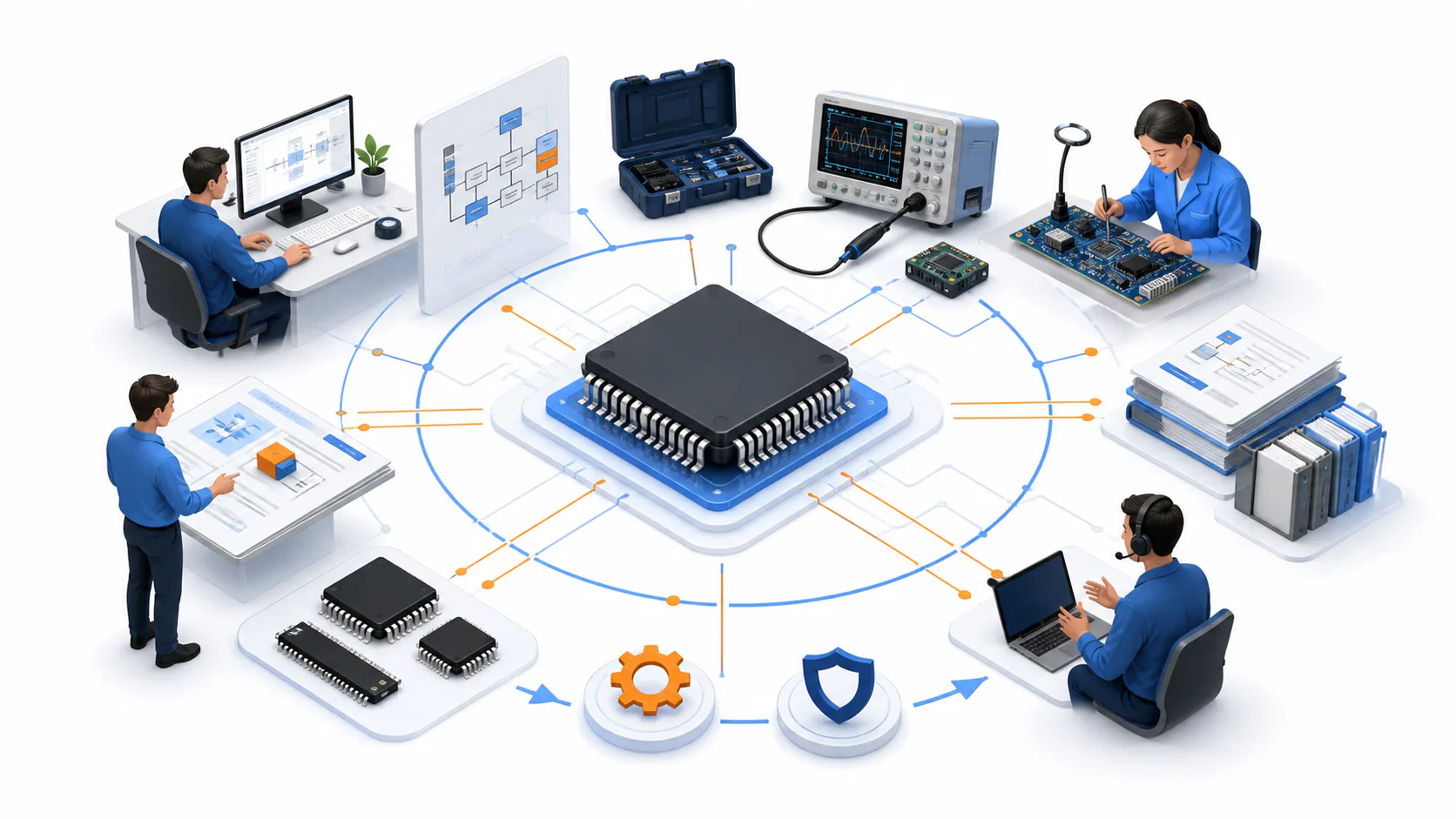
MCU selection discussions often reduce support to the presence of a PDF data sheet. A July 2026 review of China-based MCU adoption showed a larger problem: information could be scattered across languages, portals, distributor folders and private support channels.
A component that cannot be integrated and debugged is not fully available to the buyer.
Documentation is a system
Production work needs a data sheet, reference manual, errata, package drawing, programming specification, application notes, examples and version history. Missing relationships between those files can be as damaging as a missing file.
Check whether examples match the current SDK and silicon revision. Record where old releases remain available so a fielded product can be reproduced years later.
English documentation matters when the design, manufacturing and support teams cross regions.
Public and private support differ
Some critical files may be available only through a distributor or after signing an agreement. That can be reasonable for controlled material, but the dependency must be visible before the BOM is released.
Ask whether the customer retains access if the distributor relationship changes. Determine who can answer register-level questions and who can authorize an errata interpretation.
A web product page is not the same as a durable support entitlement.
Assign responsibility before the first failure
The original manufacturer, representative and distributor may each assume another party owns technical support. Define the escalation path, response expectation and evidence required for a return.
For a device such as AT32F435, preserve lot, date code, firmware, programming log and failing waveform. A useful failure-analysis process needs reproducible evidence from the customer and accountable ownership from the supplier.
The agreement should cover small-volume customers, not only strategic accounts.
Tools have a lifecycle too
Programmers, debug probes, IDE plugins and production scripts can become unavailable before silicon. Archive installers, licenses, configuration and known-good binaries for every released product.
Test a clean workstation build periodically. If a project can be maintained only on one engineer's laptop, the MCU supply plan is incomplete.
Include programming throughput and secure-key handling in manufacturing qualification.
Build a support manifest beside the BOM. It should name the silicon revision, SDK, compiler, probe firmware, production programmer, reference manual, errata and escalation contacts used for release. Archive checksums and access rights. During supplier review, test whether a new engineer can reproduce the build from that package without relying on private messages or an employee who may leave.
The procurement conclusion
MCU support capacity is not an optional service layered onto the part. It determines migration time, production recovery and field reliability.
Buyers should qualify documentation, tools and escalation ownership with the silicon. The effective second source is the supplier and channel that can carry a customer from first sample through an abnormal production lot, including customers too small to command a dedicated FAE.
This article describes support risks observed in July 2026 and does not rank individual suppliers.