Interface ICs don't think — they carry
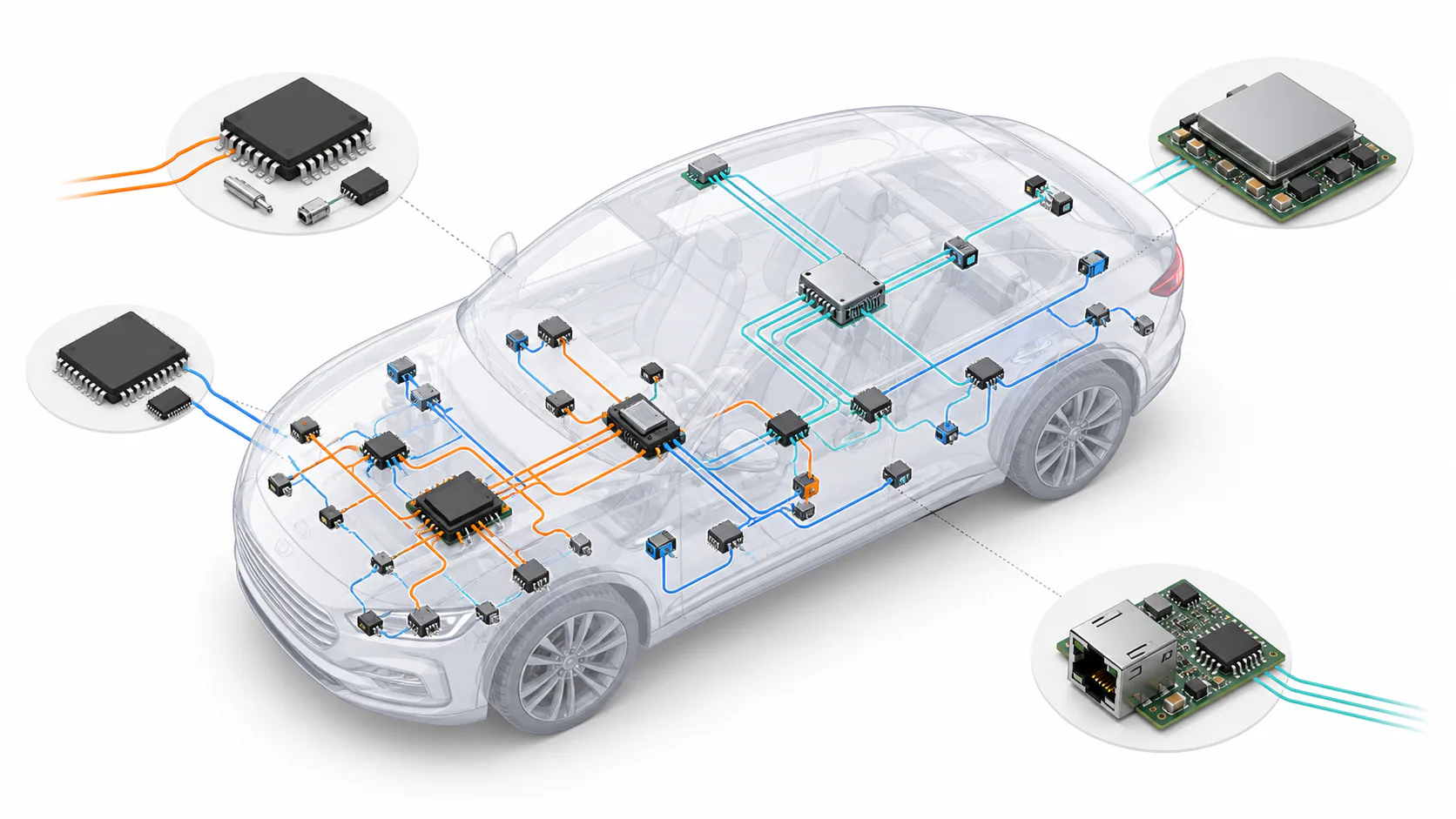
CAN/LIN transceivers, System Basis Chips (SBC) and automotive Ethernet PHYs are the car's nerve endings. They don't compute; they push commands out, pull status back, and isolate faults. Without them a clever MCU just talks to itself.
They share a procurement profile: unit price is modest, but BOM frequency is very high — body control, lighting, windows, seats, HVAC, BMS, OBC, chassis, gateway, cameras, domain controllers. Second-source the MCU but not the interface layer and you land somewhere awkward: a domestic brain still wired with imported nerves.
CAN/LIN: "it communicates" is not the bar
CAN is the veteran — body, powertrain, chassis, diagnostics, BMS. LIN is the odd-job worker: slower, cheaper, fewer wires, fitting windows, seats, wipers, lighting and HVAC flaps. They divide labour rather than replace each other.
An automotive CAN/LIN transceiver is not a simple translator. It must survive EMI, handle bus faults, support low-power wake, avoid dragging the bus down on power loss, and stay stable across temperature, surge and ESD. The feared failure is not "no communication" — it's intermittent wrong communication, which behaves like the office printer that only jams on deadline day.
| Role | Part | Note |
|---|---|---|
| Incumbent / benchmark | NXP TJA144x / TJA10xx / TJA11xx | Long-standing presence across in-vehicle networking |
| Incumbent / benchmark | TI TCAN1044-Q1 · TLIN2029A-Q1 | CAN FD; LIN for body, lighting, cockpit |
| Incumbent / benchmark | Infineon TLE · onsemi NCV | Established automotive interface families |
| China-based alternative | NOVOSENSE NCA1044-Q1 | Automotive CAN FD to 5 Mbps; per public data passed Toyota VeLIO certification and IBEE / FTZ-Zwickau EMC testing |
| China-based alternative | SITRI SIT1043Q | AEC-Q100; CAN FD, high noise immunity, low power |
| China-based alternative | Chipanalog | Automotive CAN and isolators, AEC-Q100, in volume supply |
The NOVOSENSE data point matters more than its specs: clearing an OEM's own conformance programme and a European EMC lab is the step that separates a catalogue part from a qualifiable one. So don't ask "does it support CAN FD." Ask: AEC-Q100? EMC certification? bus-fault protection? low-power wake? any OEM or Tier-1 validation case?
SBC: not a chip, a housekeeping bundle for the body ECU
A System Basis Chip powers the MCU, runs CAN/LIN, and watches the watchdog, wake, low-power and fault protection at the same time. Previously a small body-control system needed separate LDO, PMIC, CAN transceiver, LIN transceiver and watchdog — more parts, bigger board, more compatibility grief. The MCU is the boss; the SBC is facilities, HR and security combined.
| Role | Part | Note |
|---|---|---|
| China-based alternative | GigaDevice GD33AP236x | Automotive SBC integrating LDO, PMU, CAN FD and LIN; AEC-Q100 Grade 1; targets BDC, BCM, lighting and thermal controllers; pairs with GD32A5x / GD32A71x MCUs |
| China-based alternative | 3PEAK TPT1169xQ | Automotive SBC with LDO, watchdog and CAN SIC transceiver |
The strategic read: China-based vendors have understood that an automotive MCU cannot advance alone — it has to enter a programme bundled with SBC, power and interface. As zonal and body domain controllers multiply, the SBC stops being an accessory and becomes a platform piece.
Automotive Ethernet PHY: the high-speed junction
If CAN/LIN are country roads, automotive Ethernet is the motorway. Cameras, radar, lidar, cockpit entertainment, domain controllers and central compute push data volumes past what CAN/LIN can carry. The PHY turns controller-side digital signals into something that survives a vehicle harness — which makes it responsible for link stability, EMC, harness cost, reach and data quality.
| Role | Part | Note |
|---|---|---|
| Incumbent / benchmark | NXP TJA11xx · Marvell · Broadcom · TI | ADAS, infotainment and comms; IEEE BASE-T1 family |
| Incumbent / benchmark | Infineon BRIGHTLANE | 100BASE-T1 / 1000BASE-T1 and above, for zonal architectures and data backbone |
| China-based alternative | Motorcomm YT8011 / YT8011A | 100BASE-T1 and 1000BASE-T1, IEEE 802.3bw / 802.3bp; cameras, radar, perception, high-bandwidth cockpit |
This is the least visible and highest barrier of the three. Judge a PHY on OPEN Alliance compatibility, EMC, link diagnostics, cable matching, power, temperature grade, functional-safety documentation and OEM validation progress — not on "100M or 1G."
Source by node, not by part list
The common mistake is producing three tables — one for CAN, one for LIN, one for PHY. It looks thorough and helps a programme very little. Break it down by network node instead:
- Body ECU → CAN / LIN / SBC
- BMS, OBC → isolated CAN and CAN FD
- Zonal controller → SBC + CAN FD + LIN + Ethernet
- Camera, domain controller → Ethernet PHY + ESD protection + common-mode chokes
Bottom line
Automotive interface ICs are among the most underrated and most second-sourceable lines in a car BOM. CAN/LIN decides whether the body and control networks stay stable; the SBC decides how cleanly an ECU platform integrates; the Ethernet PHY decides whether the high-speed backbone holds. A mature alternative programme doesn't stop when the brain goes domestic — it continues into the nervous system.