
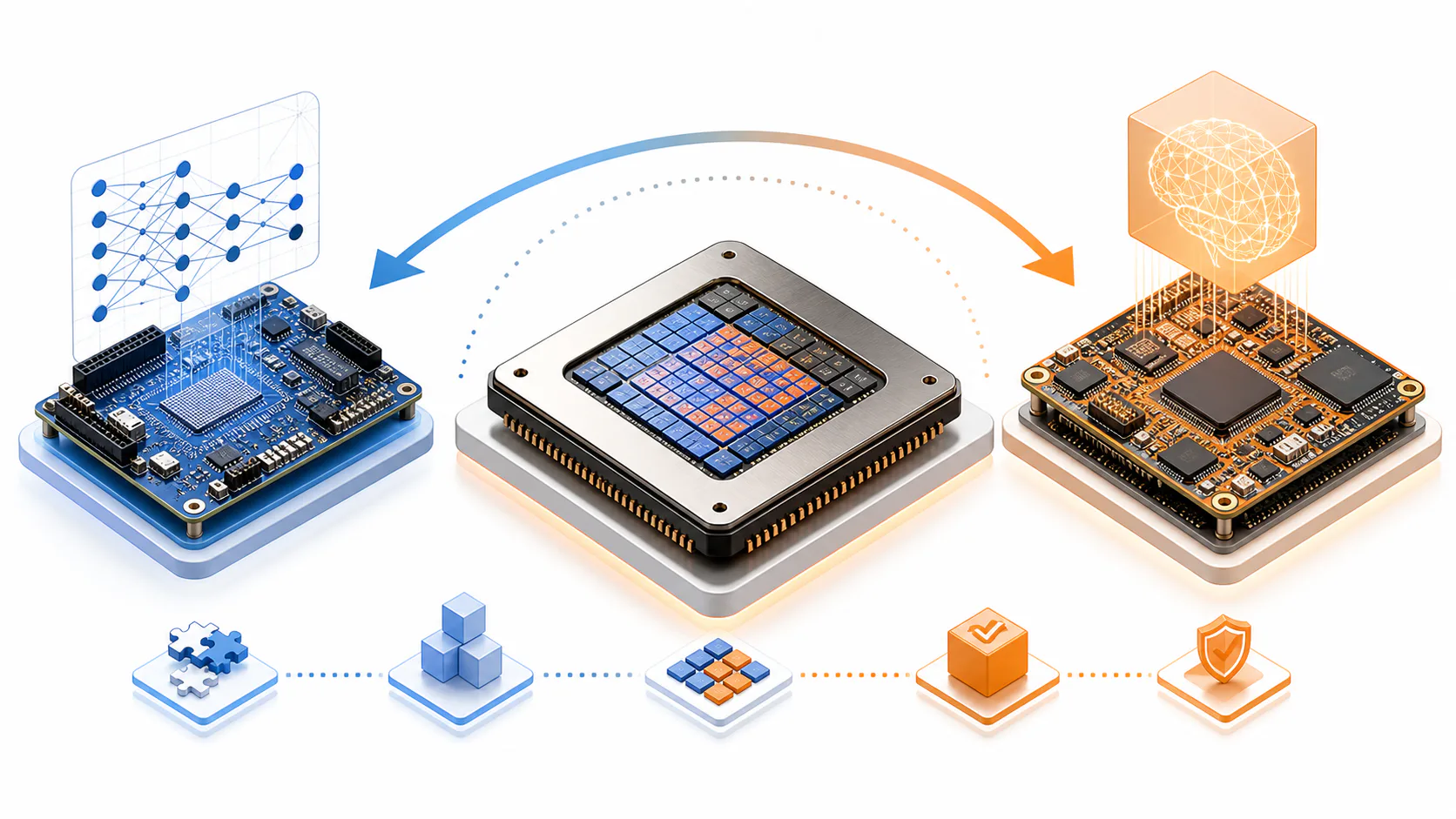
Edge AI is often framed as a contest between GPUs and dedicated accelerators. FPGAs remain relevant where workloads need deterministic latency, custom I/O or hardware that can change after deployment.
That flexibility has a price in power, cost and development effort. Procurement teams should evaluate the complete platform rather than treating the FPGA as a universal accelerator.
FPGAs fit changing workloads
An FPGA can implement parallel pipelines, preprocess sensor data and connect unusual interfaces without waiting for a new chip. Logic can be updated as algorithms or protocols evolve.
This is valuable in industrial vision, robotics, communications and specialized sensing, where volume may not justify an ASIC and a general processor may miss latency targets.
The benefit is strongest when reconfigurability solves a defined risk. If the workload and interfaces are stable, another architecture may be more efficient.
The device is only part of the platform
FPGA selection includes logic capacity, DSP blocks, on-chip memory, transceivers, package, speed grade and temperature range. External memory, configuration Flash, clocks and power rails add dependencies.
AI performance depends on model structure, precision, memory bandwidth and tool mapping. A peak operations number does not predict application throughput.
Require a benchmark using the target model, latency, power and accuracy requirements.
Tools can create supplier lock-in
Design files, IP cores, compilers, debug tools and trained engineers are tied to an ecosystem. Moving between FPGA suppliers can be a redesign even when device capacity appears similar.
Review license terms, version support, operating-system requirements and availability of critical IP. Archive the complete build environment and confirm that production images can be recreated years later.
For edge deployments, secure boot, bitstream encryption and update recovery also need qualification.
Power delivery needs early work
FPGAs often require several rails with sequencing and transient demands that change by design. PMICs, controllers, inductors and capacitors must support the final configuration.
Thermal behavior depends on logic utilization and switching activity. Estimate power with the mapped design, then verify on hardware under worst-case ambient and airflow.
An alternate FPGA can require a different power tree and PCB, expanding the second-source scope.
Manage lifecycle and allocation
Record exact family, package and speed grade because these define manufacturing and inventory pools. Ask for lifecycle commitments, capacity visibility, PCN policy and last-time-buy support.
Maintain migration options at the architecture level: portable interfaces, modular HDL, versioned toolchains and documented external memory requirements. A pin-for-pin alternate may not exist.
The procurement conclusion
FPGAs occupy the uncertain middle where edge-AI requirements are real but still moving. Their value is the ability to adapt hardware after the board exists.
Buyers should pay for that flexibility only with a plan for tools, power, memory and lifecycle. The resilient source strategy is often a portable design and scheduled migration path, not an emergency chip swap.
Performance depends on the mapped workload and complete hardware platform. Validate with current tools and production devices.