
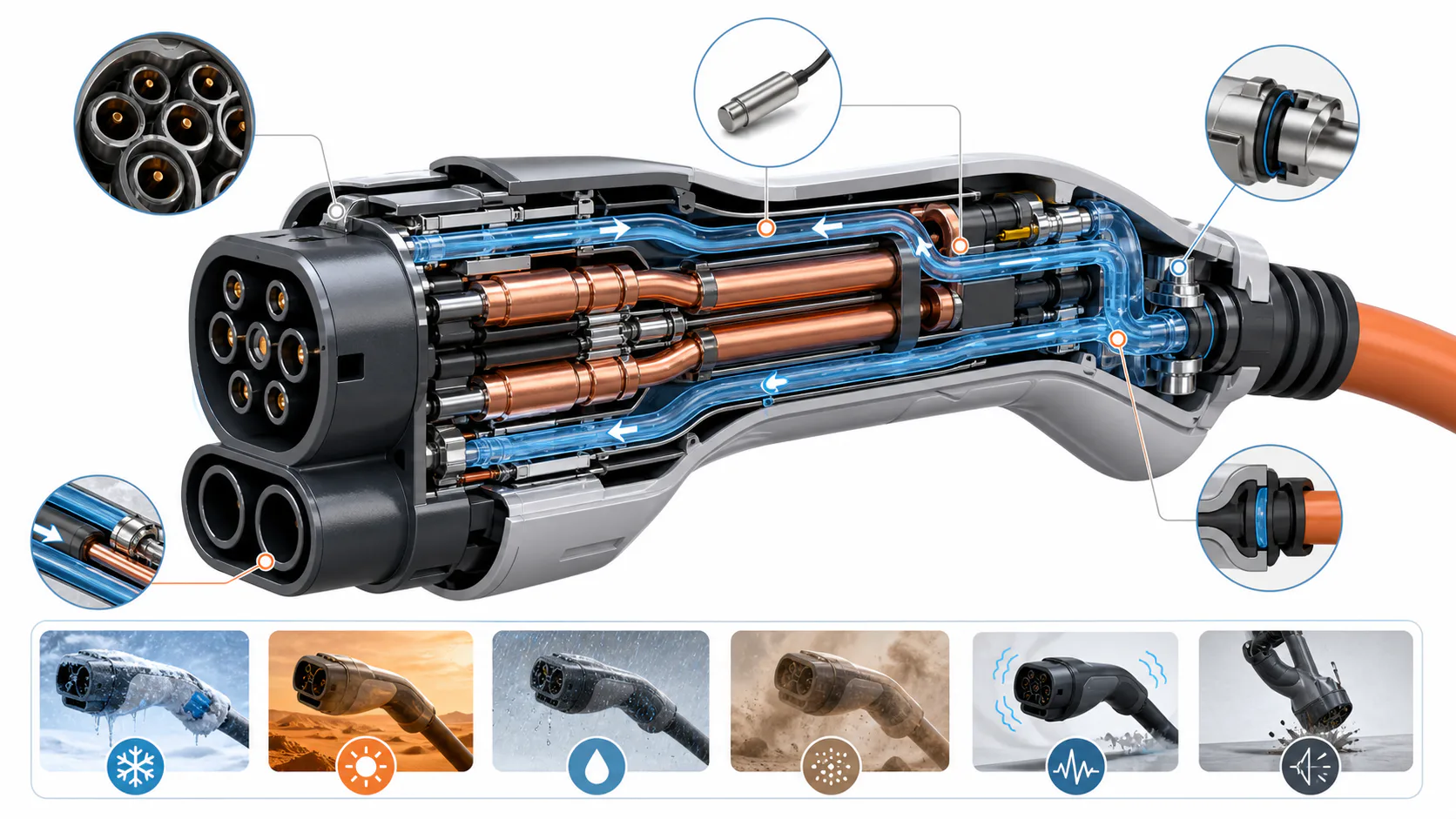
The most visible part of an ultra-fast charger is also one of its hardest components to qualify. Battery voltage and power-module efficiency get most of the attention, but the charging connector must carry high current through a device that is repeatedly handled, dropped, exposed to weather and expected to remain safe after thousands of mating cycles.
At that point, a liquid-cooled charging gun is not just a connector. It combines power contacts, cable conductors, coolant paths, seals, temperature sensing, locking, control contacts and a service procedure. Buying it as if it were a larger conventional plug is how a high-power charging program acquires a field-reliability problem.
Higher voltage helps, then the market spends the margin
Moving toward an 800 V vehicle platform can reduce current for a given power level. In practice, charging networks use part of that benefit to push power higher. The connector therefore continues to face high current density and substantial heat at the contact interface.
The underlying relationship is unforgiving: a small increase in contact resistance produces much more heat when current is high. Wear, contamination, incomplete mating, terminal relaxation or a damaged cooling path can all reduce the available thermal margin. A current label on a product page says little unless the duty cycle, ambient conditions, inlet coolant temperature, cable length and allowable contact temperature are also defined.
The qualification unit is the complete assembly
International products such as Phoenix Contact's liquid-cooled CCS assemblies show the system approach: active cooling, temperature sensing, environmental sealing and leak-related safeguards are engineered around the electrical contacts. China-based suppliers including Yonggui Electric and AVIC Jonhon likewise market liquid-cooled vehicle connectors for high-power DC charging.
Those portfolios demonstrate that a local supply base exists. They do not establish drop-in equivalence. Connector geometry, charging standard, vehicle inlet, cooling equipment and station controls have to work as one system.
A realistic supplier comparison should cover six layers:
- Electrical interface: steady-state and boost current, contact resistance, insulation coordination and fault-current behavior.
- Thermal path: coolant type, flow and pressure window, hose routing, heat extraction from both conductor and contact, and behavior after partial flow loss.
- Sensing and control: sensor placement, accuracy, redundancy and the derating or shutdown response.
- Mechanical life: mating cycles, cable bend radius, strain relief, drop resistance, locking and user handling force.
- Environmental protection: water and dust ingress, corrosion, condensation, temperature cycling and chemical compatibility.
- Service model: leak detection, replaceable modules, diagnostic access, spare availability and safe field procedures.
Why a sample can pass while a station fails
A new connector can perform well in a controlled test and still age badly in the field. The contact surface changes with repeated mating. Users pull and twist the cable. The gun may be left on the ground, driven over or exposed to rain and road contamination. Coolant chemistry and seals age. A station may operate in direct summer sun after months of maintenance variation.
That is why buyers should ask for test evidence that reflects the intended duty cycle, not only a fresh-sample current run. Temperature rise should be reviewed over contact life and after environmental conditioning. Leakage and insulation behavior should be tested with realistic mechanical stress. The control system should demonstrate safe derating when a temperature sensor, pump or coolant loop degrades.
Where China-based suppliers have a real advantage
The strongest local-sourcing case is not simply a lower piece price. Charging networks require fast customization around national standards, cable length, gun weight, station packaging and maintenance practice. They also consume spare parts and engineering support after installation. A supplier close to the charger and vehicle ecosystem can shorten iteration and field-response time.
That advantage only matters if quality data travel with the product. A buyer should require controlled drawings, material and plating specifications, process-change notification, traceability for terminals and cables, coolant compatibility evidence and a documented escalation path for field failures.
How to introduce a second source without creating two systems
Start with an interface-control document shared by the charger, cable-cooling unit, connector and software teams. Define the electrical, fluid, sensor and mechanical boundaries before comparing suppliers. Then qualify the alternate through bench, environmental and endurance testing using the same operating envelope as the incumbent.
Do not begin with a fleet-wide swap. Introduce the second source in a controlled station cohort, monitor temperature and fault data, inspect returned assemblies and confirm that maintenance teams can service both variants without special workarounds.
The procurement conclusion
Ultra-fast charging makes the connector a core power component. The battery determines how much energy can be accepted, and the power electronics determine how efficiently it can be converted. The charging gun and inlet determine whether that power can cross the user-facing interface repeatedly, safely and at a manageable temperature.
For procurement teams, the right question is no longer “Which supplier can quote the same amperage?” It is “Which supplier can reproduce the electrical, thermal and service behavior of the whole charging interface over its field life?”
Current ratings and environmental claims depend on the applicable standard, operating conditions and exact product variant. Confirm them in current supplier documentation and system-level validation.