
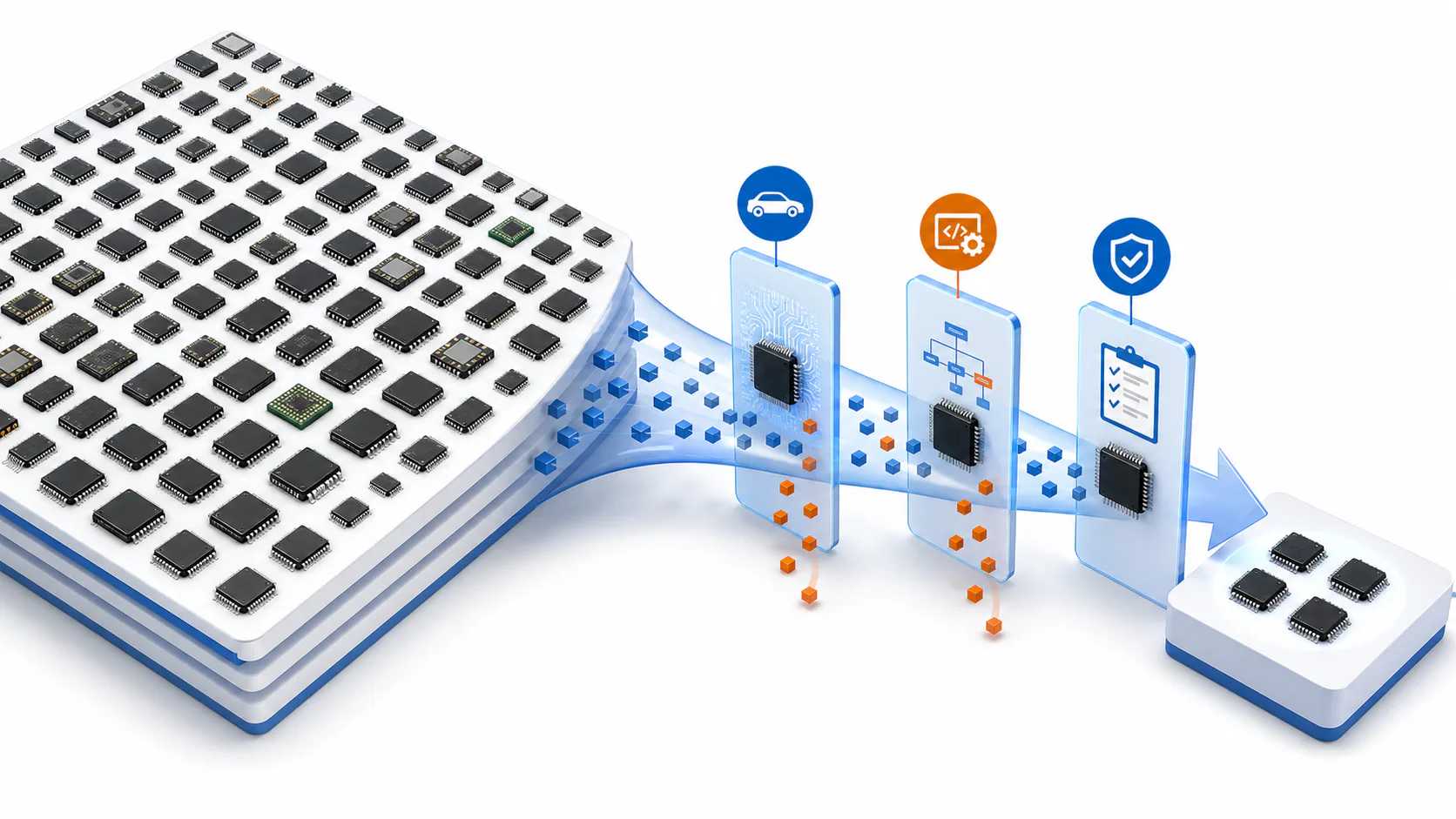
A July 2026 dataset contained 2,605 orderable China-based MCU codes from eleven suppliers. The number suggested breadth, but it could not be interpreted as 2,605 independent design choices.
One silicon platform can generate many SKUs through Flash size, pin count, package, temperature and commercial variants.
Count platforms before codes
Normalize each orderable code to its core family, die generation and peripheral set. Then separate package and memory derivatives from genuinely different architectures.
This reveals whether a supplier offers a coherent migration ladder or a long catalog concentrated around a narrow performance band. Both can be useful, but they answer different sourcing needs.
An SKU count without that normalization overstates diversity.
Parameter similarity hides peripheral behavior
Two MCUs can share core, clock and memory values while differing in ADC timing, timer synchronization, pin multiplexing, clock accuracy and errata. These details determine firmware and board migration.
Compare reference manuals, errata, software packages and measured peripherals. Verify that the exact package exposes the interfaces needed simultaneously.
A table filter produces candidates; a prototype produces evidence.
The channel shows a second catalog
Manufacturer websites describe designed products. Authorized inventory, lead time and order acknowledgement describe products that a buyer can actually receive.
Track the exact suffix, production status, approved factory and recent delivery performance. An NRND flag, sparse authorized stock or dependence on one distributor can matter more than the total family size.
Do not treat broker listings as equal to committed production supply.
Support reduces effective choice
A technically suitable MCU may remain unusable if programming tools, English documentation, example code or failure analysis are unavailable. This is especially important for small customers without direct access to factory application engineers.
Ask who owns migration, response time, PCN delivery and lot investigation. Record which support assets are public and which require a relationship that may not survive a distributor change.
The final shortlist should be deliberately small. For each program, select candidates that meet the exact peripheral and package need, then score delivered samples, documentation completeness, authorized availability and measured migration work. Keep rejected candidates with the reason and test date. That history prevents the same attractive but unsuitable SKU from reappearing every time a price changes. It also makes future catalog growth measurable in qualified platforms instead of marketing rows.
The procurement conclusion
The 2,605-code dataset demonstrated substantial catalog activity, but orderable codes were not the correct unit for measuring second-source resilience.
Buyers should count qualified platforms, released derivatives and supported migration paths. A smaller family with stable tools and delivered stock can offer more real choice than hundreds of codes that collapse onto one die or one unsupported channel.
This analysis reflects a July 2026 catalog snapshot; product and channel status should be verified at the exact MPN.