
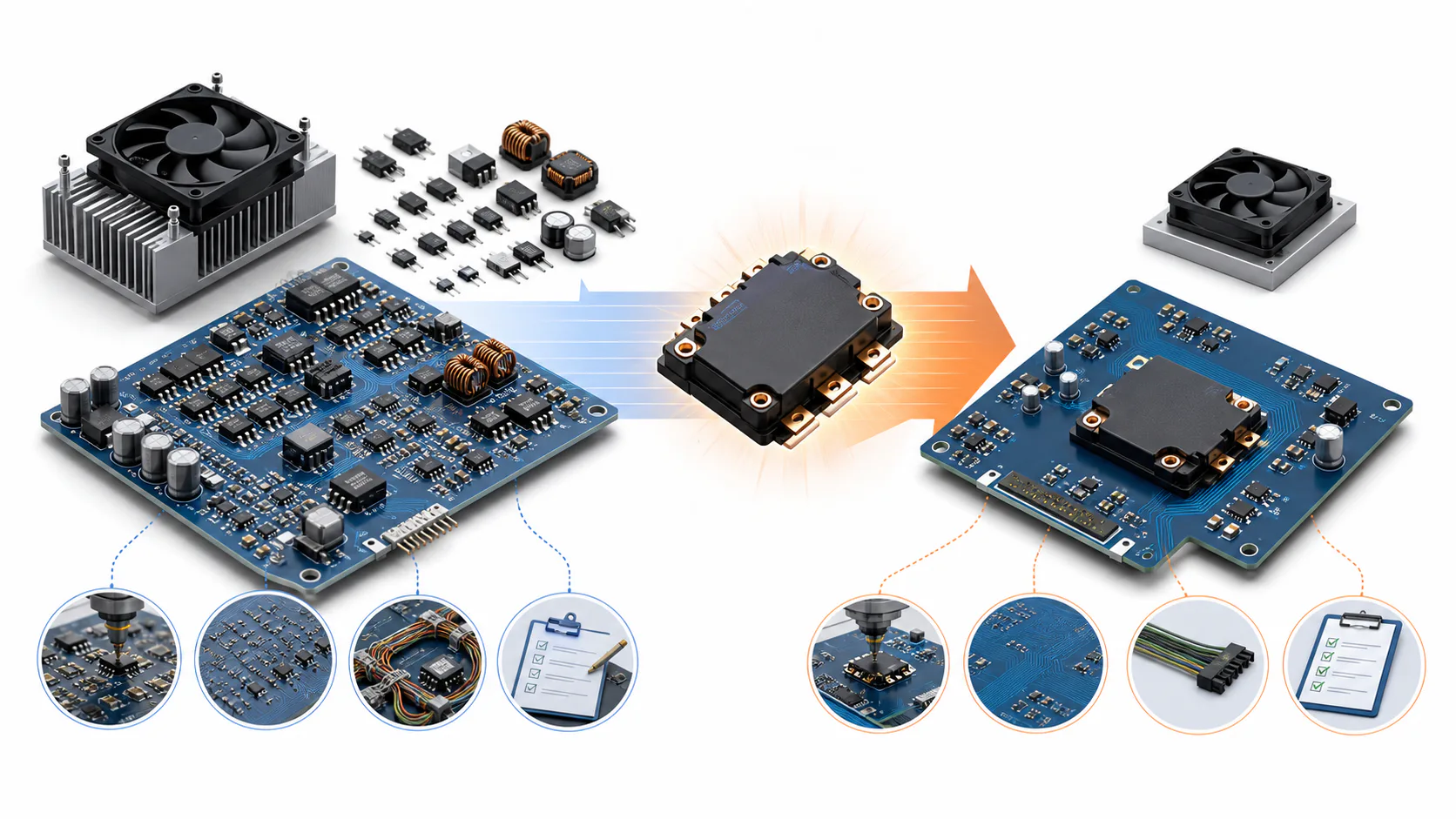
LTM8053 can appear expensive beside a regulator IC or a competing module. The July 2026 article asked why engineers still select it. The answer lies in what the package absorbs: switching devices, magnetics and part of the layout and component-selection burden.
Integration changes cost placement; it does not eliminate design work.
A module is a constrained implementation
LTM8053 provides a defined power stage inside a tested package. That can reduce external component count and shrink the number of high-frequency nodes the customer must lay out.
The board still needs input and output capacitors, thermal copper and compliance with layout guidance. Input range, output current, transient response and ambient temperature must be checked against the real mission profile.
“Module” does not mean electrically universal.
The premium can buy schedule certainty
A discrete design may use cheaper individual parts while requiring inductor selection, loop tuning, EMI iterations and more board area. The value of integration rises when engineering time, certification and launch schedule are expensive.
Compare prototypes and validation cycles, not only the component subtotal. A module that avoids one board spin can justify a large unit-price difference at moderate volume.
At very high volume, the economics may reverse and reward a custom discrete design.
Similar modules are not drop-in
Texas Instruments TPSM63603 can enter a functional comparison for some requirements, but voltage range, current, package, pinout, control behavior and EMI results differ. Parameter proximity does not create footprint compatibility.
An alternate needs a new schematic and layout review, followed by transient, thermal, stability and emissions testing. Check protection behavior and startup into the actual load.
The qualification effort belongs in the sourcing calculation.
Audit hidden supply concentration
Integration reduces customer BOM lines but concentrates more function into one supplier and package. Review lifecycle, approved manufacturing sites, lead time and allocation history.
Maintain the design files and validation plan for a fallback path. If the product cannot tolerate a module redesign during its service life, coverage and lifecycle monitoring deserve more attention than small annual price savings.
Create a comparison at three expected volumes and include yield loss, assembly inspection and warranty exposure. Record the assumed engineering rate and certification schedule rather than treating development as free. The model should identify the volume or redesign event at which a discrete solution becomes preferable, giving sourcing a rational trigger instead of a permanent argument about unit price.
The procurement conclusion
LTM8053 is costly when evaluated as one line item and potentially economical when evaluated as a delivered power function. Neither conclusion applies automatically.
Buyers should compare complete implementations at expected volume, including board area, labor, validation, EMI, thermal margin and supply concentration. The right choice is the design with the lower controlled system cost, not the cheaper catalog cell.
This article is a design-cost framework and is not a current quote or cross-reference recommendation.