
Where the efficiency gap actually comes from
A fixed-speed air conditioner is switch control: room too warm, compressor on; target reached, compressor off. Simple and cheap — but temperature swings, high inrush at every start, and frequent cycling that costs both energy and comfort over long runs.
An inverter unit modulates compressor speed instead. High frequency at start-up to pull the room down fast, then lower frequency to hold the setpoint. Smaller temperature swing, less noise, smoother compressor duty, lower long-run consumption.
The 20–40% figure is not fixed — it is highly scenario-dependent. Short run times show little advantage. Long summer-night operation in a well-insulated room, where the unit holds close to setpoint, is where the inverter compressor drops frequency and avoids repeated inrush, and the saving shows up.
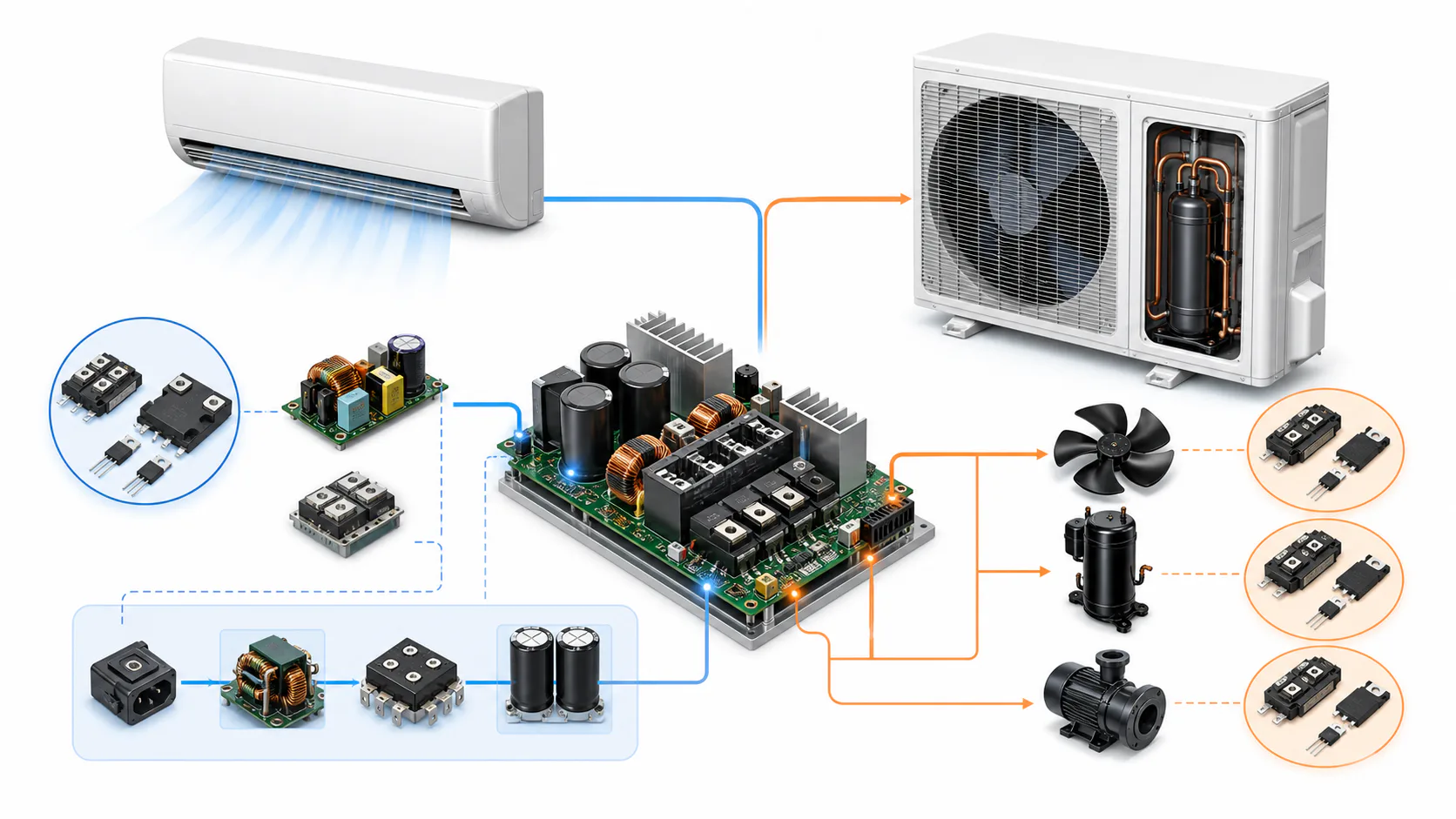
The efficiency chain is five component groups, not one
- IGBT / IPM intelligent power modules — convert DC into variable-frequency, variable-voltage AC to drive compressor and fan motors. Without stable modules, efficient inverter control is not achievable.
- Main and motor-control MCU — sample temperature, current, voltage and pressure, then govern compressor frequency, fan speed, electronic expansion valve and protection strategy.
- PFC and power management — raise system power factor and cut grid-side loss: PFC controllers, AC-DC, PMIC, MOSFET, FRD, gate drivers.
- Sensors — temperature, pressure, current sampling, Hall, NTC. Inverter control is closed-loop on real data, not open-loop guessing.
- Connectivity — Wi-Fi/BLE modules, offline voice, touch keys, display drivers. Not efficiency-critical, but a rising share of the electronic BOM.
On price, the two to watch are IGBT/IPM and MOSFET. Several makers have publicly confirmed 10–20% increases on MOSFET and IGBT lines. Peak appliance season stacked on rising power-device cost puts visible pressure on the inverter control board.
The second-source landscape
High-reliability appliance power devices used to sit largely with overseas brands. That has changed materially.
| Role | Supplier | Note |
|---|---|---|
| Incumbent / benchmark | Infineon · Mitsubishi · onsemi · ST | Established white-goods IGBT / IPM supply |
| China-based alternative | Silan · China Resources Micro | Low- and mid-voltage MOSFET, IGBT, IPM; closest to the appliance IPM mainstream |
| China-based alternative | StarPower · Macmic | Module strength; better suited to mid-to-high power and commercial units |
| China-based alternative | NCE Power · Yangjie · JJW | Discretes, rectifier bridges, fast-recovery diodes filling out the periphery |
What the shift actually buys an appliance maker
Not simply a lower unit price. Three things:
- Supply security. Air conditioning is mass manufacturing; unstable module lead times hit build schedules directly. A second source reduces single-import dependence.
- Cost structure flexibility. To push inverter models down-market, power-device cost has to be controllable — that is what lets a mid-tier unit carry a high-efficiency configuration.
- Faster iteration. Closer appliance-to-supplier working means quicker adaptation and validation around compressor, fan, PFC and control board.
Bottom line
The gap between inverter and fixed-speed is not "does the compressor vary speed" — it is the whole electronic control chain. IGBT/IPM handle efficient inversion, the MCU carries the control algorithm, PFC and power devices carry efficiency and stability, sensors close the loop. What looks like an appliance upgrade at the shelf is a power-semiconductor maturity story underneath. For a buyer, seasonal appliance demand is best read not from unit sales but from component data: for air conditioning, watch IGBT, IPM, MOSFET, PFC and motor-control MCU.