
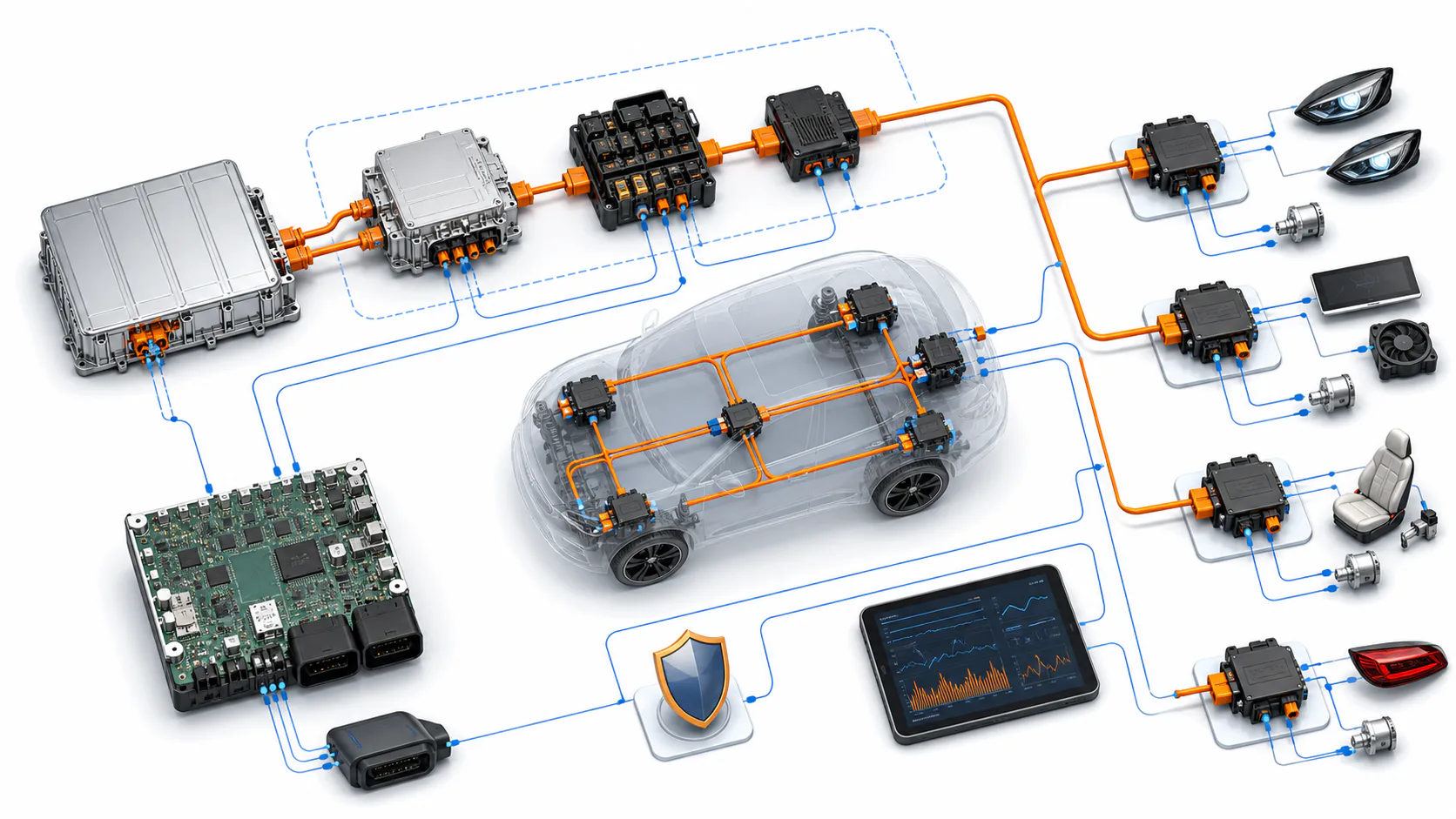
Vehicle zonal architecture moves communication, sensing and power distribution closer to physical loads. Adding a 48 V low-voltage backbone can carry more power with lower current than a 12 V rail, helping reduce harness weight. It also creates a mixed-voltage qualification problem inside every zone controller.
Some loads can operate directly from 48 V. Existing 12 V loads still need local conversion. Each branch needs protection, diagnostics and a defined response to faults. Buyers should therefore treat the 48 V power path as a coordinated subsystem, not a collection of similarly rated ICs.
The zone controller has several power jobs
Texas Instruments’ TIDA-020094 reference design illustrates a 48 V backbone with 48 V-to-12 V conversion, high-side switching, smart eFuses and motor drivers. Infineon’s zonal-architecture guidance likewise describes local 48 V/12 V conversion while higher-power loads remain on 48 V.
Those diagrams expose the sourcing boundaries. The DC-DC stage must tolerate the real input range and transients while meeting efficiency, thermal and EMI limits. High-side switches must control loads and report faults. Smart eFuses or controllers must protect wiring and isolate a failed branch. Ideal-diode and reverse-polarity functions manage power entry and backfeed.
Changing one device can alter the assumptions of the others.
Voltage rating is only the first filter
A candidate power switch needs more than headroom above nominal 48 V. Compare transient capability, operating resistance, current sense, protection timing, inductive-load behavior, standby current, diagnostics and safe operating area.
For an eFuse or external-FET controller, examine how current limiting, I²t wire protection, retry behavior and latch-off are implemented. A different timing model can protect the semiconductor while overstressing the harness, or protect the wire while creating nuisance shutdowns.
For DC-DC conversion, compare topology, switching frequency, magnetics, control stability, efficiency across the duty cycle, startup, pre-bias behavior and fault response. An alternate controller can require new MOSFETs, compensation and layout even when input and output voltage match.
Mixed-voltage faults need system tests
A zone may contain 48 V, 12 V, 5 V and 3.3 V domains. The validation plan should include shorts between domains, load dump and other transients, reverse battery, jump-start conditions, open ground, connector faults and loss of communication.
Diagnostics must remain available during degraded operation. Confirm current-sense accuracy, fault coding, SPI or discrete-interface behavior and how the MCU distinguishes overload, short circuit, overtemperature and open load. Safe behavior should not depend on software receiving a perfect message from a failing power device.
Thermal tests need the final enclosure, copper area, airflow and harness. A low-resistance switch can still run hot when many channels are active or the zone controller sits near a wheel well or powertrain heat source.
Introduce alternatives by function and gate
Freeze the interface for each power function before comparing suppliers. Qualify silicon on an evaluation board, then in the real PCB, then under system fault injection. Preserve oscilloscope records, thermal data and diagnostic logs for the incumbent and candidate.
Do not call a family an approved second source until the external MOSFETs, magnetics, software configuration and protection thresholds are included in the comparison. In many cases the realistic result is a second design option, not a drop-in part.
The procurement conclusion
48 V zonal power distribution creates opportunities for more suppliers, but it raises the cost of a shallow comparison. Conversion, protection, switching, diagnostics and wiring protection form one fault-containment system.
A resilient sourcing plan qualifies that behavior end to end. The goal is not a matching voltage number; it is a second power path that fails safely in the same vehicle.
This is a newly researched English analysis because the stored Chinese body for report 39482 is corrupted. Component limits must be confirmed in current supplier documentation and vehicle-level validation.