In June 2026, NXP introduced the pre-production SAF8444 single-chip radar SoC, integrating a CPU, MCU and radar accelerator at the sensor edge. As computing moves into radar and camera modules, the change extends well beyond the main processor. Sensors, SoCs, memory and SerDes links need different rails, while power-up sequencing, brownout monitoring, thermal behavior and EMI must be coordinated as one system. The automotive PMIC is therefore moving from a supporting part to a device that can determine whether the sensing platform operates reliably.
China-based suppliers have reached this BOM entry point. Silicon Content Technology's SCT61450S targets 77 GHz millimeter-wave radar, while SGMICRO's SGM70276xQ targets automotive camera modules. Across the table are established solutions such as TI's TPS650330-Q1 and NXP's PF5024. The question is no longer whether a China-developed counterpart exists. It is how much validation, safety evidence and platform support still separate a candidate device from a vehicle-program design win.
1. Why radar and camera modules are moving to one PMIC for multiple rails
Discrete power architectures remain flexible, but complexity rises quickly as components are added: board area expands, routing becomes denser, and sequencing and fault monitoring become harder to coordinate. A multi-channel PMIC combines Buck converters, a Boost converter, an LDO or load switch, supervision and a control interface. That can reduce module size and the peripheral bill of materials. It also concentrates risk: a timing, thermal or protection mistake on one rail can propagate through the whole sensing system.
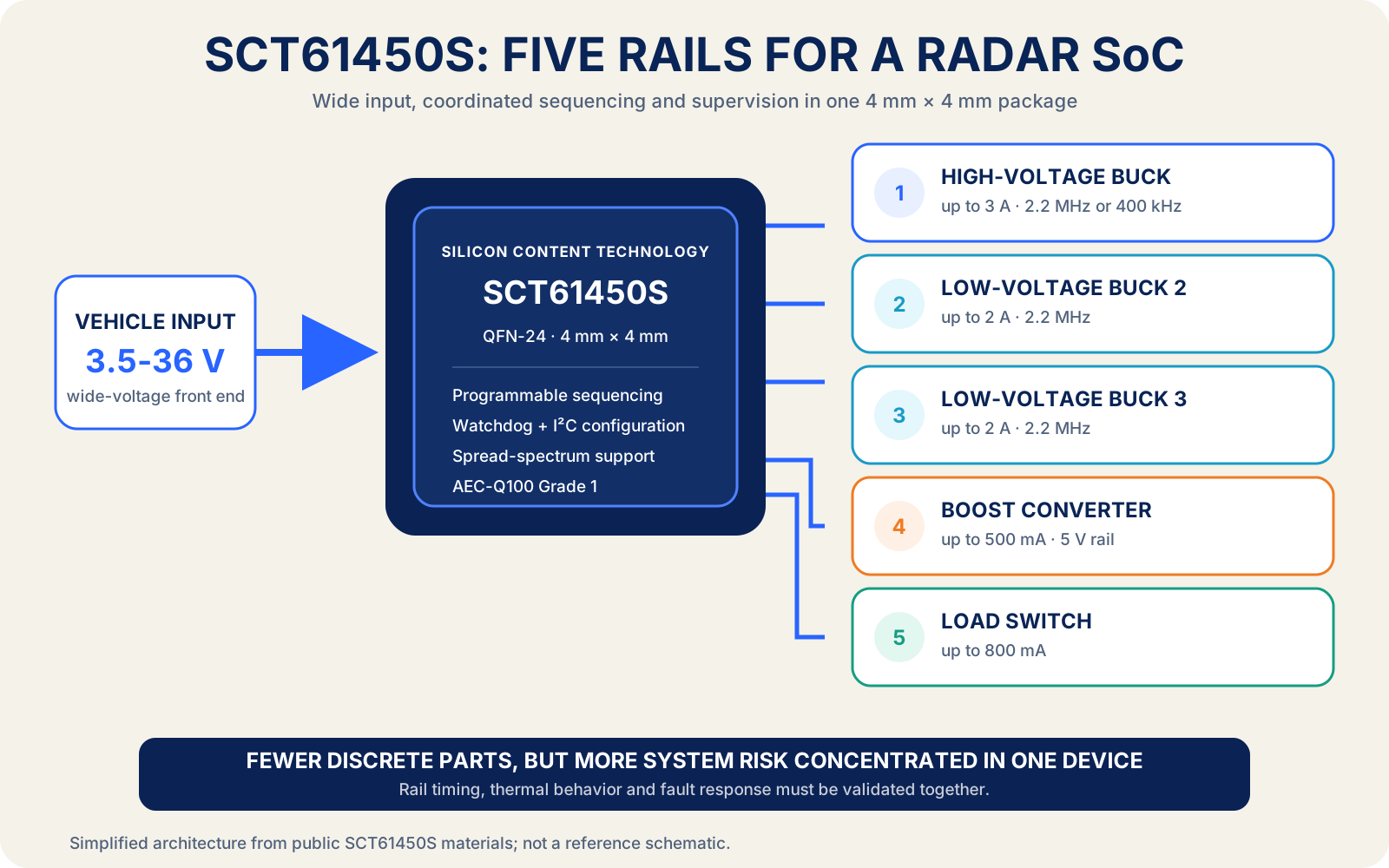
The SCT61450S illustrates the five-rail approach. It accepts 3.5 V to 36 V and integrates one high-voltage Buck rated to 3 A, two low-voltage Bucks rated to 2 A each, a 500 mA Boost converter and an 800 mA load switch in a 4 mm × 4 mm QFN-24 package. The high-voltage Buck can switch at 2.2 MHz or 400 kHz; the other switching rails operate at 2.2 MHz. The device also supports spread spectrum, programmable sequencing, a watchdog and I²C configuration. Public materials state AEC-Q100 Grade 1 qualification and TÜV certification as an ASIL-B component.
The value is not merely replacing several power ICs. A five-rail PMIC puts radar-SoC startup, supervision and fault response under one coordinated control scheme.
2. Five rails versus four: similar headline specifications do not mean the same job
Automotive camera power is not governed by exactly the same priorities as radar power.
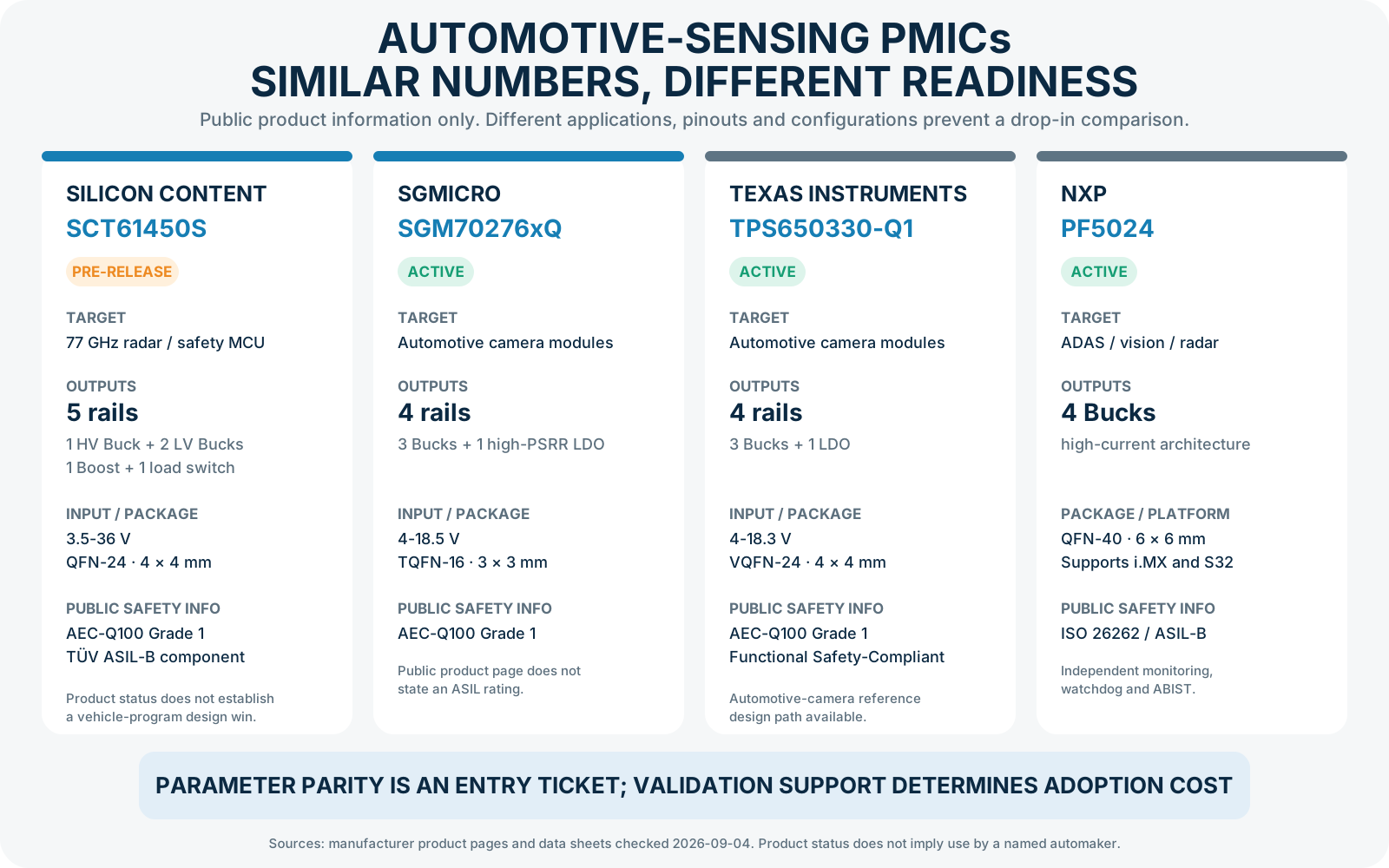
SGMICRO's SGM70276xQ combines three Buck converters with a high-PSRR LDO. The high-voltage Buck accepts 4 V to 18.5 V and delivers up to 1.5 A. The two low-voltage Bucks deliver up to 2 A and 750 mA, and the LDO supplies up to 300 mA. All three Bucks switch at a fixed 2.1 MHz, with phase shift and frequency dithering used to manage EMI. The device offers ten configurable power-up sequences in a 3 mm × 3 mm TQFN-16 package and is listed as Active on SGMICRO's product page.
The LDO is not a token fourth channel. Image sensors and analog signal chains are sensitive to supply noise. SGMICRO specifies LDO power-supply rejection of 72 dB at 1 kHz, 60 dB at 100 kHz and 39 dB at 1 MHz. For a camera PMIC, the challenge is to control noise, sequencing and thermal performance in a very small area, not simply to maximize the channel count.
Comparing the two China-developed devices with overseas alternatives also exposes gaps that a voltage-and-current table cannot show. TI's TPS650330-Q1 likewise uses three Bucks and one LDO, supports inputs to 18.3 V and comes with an automotive-camera reference-design path. NXP's PF5024 focuses on four high-current Buck rails, supports i.MX and S32 processor platforms, and is accompanied by ISO 26262/ASIL-B safety documentation. Both companies have built validation entry points around camera modules or higher-performance ADAS platforms.
3. "Production" is the easiest PMIC label to overread
Products carrying an automotive label can still be at very different maturity levels.
SGMICRO lists the SGM70276xQ as Active, while Silicon Content Technology currently lists the SCT61450S as a pre-release product. The latter is more accurately treated as a candidate seeking project-introduction opportunities. Neither company's public product page identifies end customers, vehicle programs or shipment volumes. SGMICRO's public page also does not state an ASIL level, so no specific vehicle-level functional-safety approval can be inferred from it.
For a price comparison, ic.net reviewed roughly 90 days of distributor samples using the same category, US-dollar currency and 1,000-piece quantity basis. No directly comparable SKU was found for the four selected devices from Silicon Content Technology, SGMICRO, TI and NXP. The available sample therefore cannot support a ranking of price, inventory or movement, and this report does not manufacture one.
When comparable channel data do not exist, saying "unknown" is more useful than filling a league table with weak proxies. Procurement and engineering teams should instead compare data-sheet completeness, sample and production schedules, functional-safety packages, reference designs, configuration tools, lot consistency and long-term supply commitments. Much of TI's and NXP's advantage sits in this documentation, tooling and platform ecosystem around the silicon.
4. A workable China-based alternative starts with dual sourcing on a new platform
An automotive PMIC is rarely replaced by selecting another device with the same input voltage and output current. Pinout, feedback network, compensation, startup sequence, diagnostics, register configuration and failure handling may all differ. Radar and camera modules must also repeat quiescent-current, cold-start, transient, EMI/EMC, thermal-cycle and system-level functional-safety validation.
A more realistic route is to create a dual-source plan when a new platform begins. First screen candidates against input transients, rail loads and sequencing. Then run board-level efficiency, thermal and EMI tests. Review the safety manual, FMEDA or diagnostic-coverage evidence before integrating the sensor, processor, SerDes and vehicle environment. Preserve room to return to the power architecture if thermal, noise, sequencing or software problems appear.
In the near term, a camera PMIC with a clearly bounded application and a more mature product status may enter new or cost-sensitive programs more easily. Radar PMICs offer a larger opportunity but demand a stronger safety evidence chain and deeper platform coordination. China-based suppliers do not simply need one more Buck channel; they need to reduce the customer's validation cost, make faults easier to diagnose and support the program throughout its life.
Conclusion
China-developed PMICs now hold the headline-parameter ticket into the automotive-sensing BOM: four- and five-channel integration, wide input ranges, spread spectrum, programmable sequencing and automotive qualification are all available. But a parameter table does not create a design win. Samples, reference designs, safety documentation, system validation and sustained supply still separate pre-release from product maturity, and product maturity from a nominated vehicle program.
The answer is therefore not a simple yes or no. The camera segment has a clearer productization path today; the millimeter-wave radar segment deserves close tracking but is too early for a victory declaration. The supplier that lowers the cost and risk of validation is the one most likely to turn a candidate listing into repeatable orders.
Disclaimer: This article is based on manufacturer materials and a limited distributor sample set verifiable as of September 4, 2026. It is intended for industry research and technical discussion only and is not purchasing, investment or design advice. Product status, specifications and qualification claims should be checked against the latest manufacturer documents, and every implementation requires independent validation.