
CIOE 2026 opened in Shenzhen on September 9. Among the products in its exhibitor catalog was a device resembling an elongated optical module: a multi-fiber ELSFP developed jointly by Broadex Technologies and Casela Technologies. It uses eight uncooled laser channels, supports 2 × DR4 and 2 × FR4, specifies more than 20 dBm of output per channel and consumes less than 8.5 W in total.
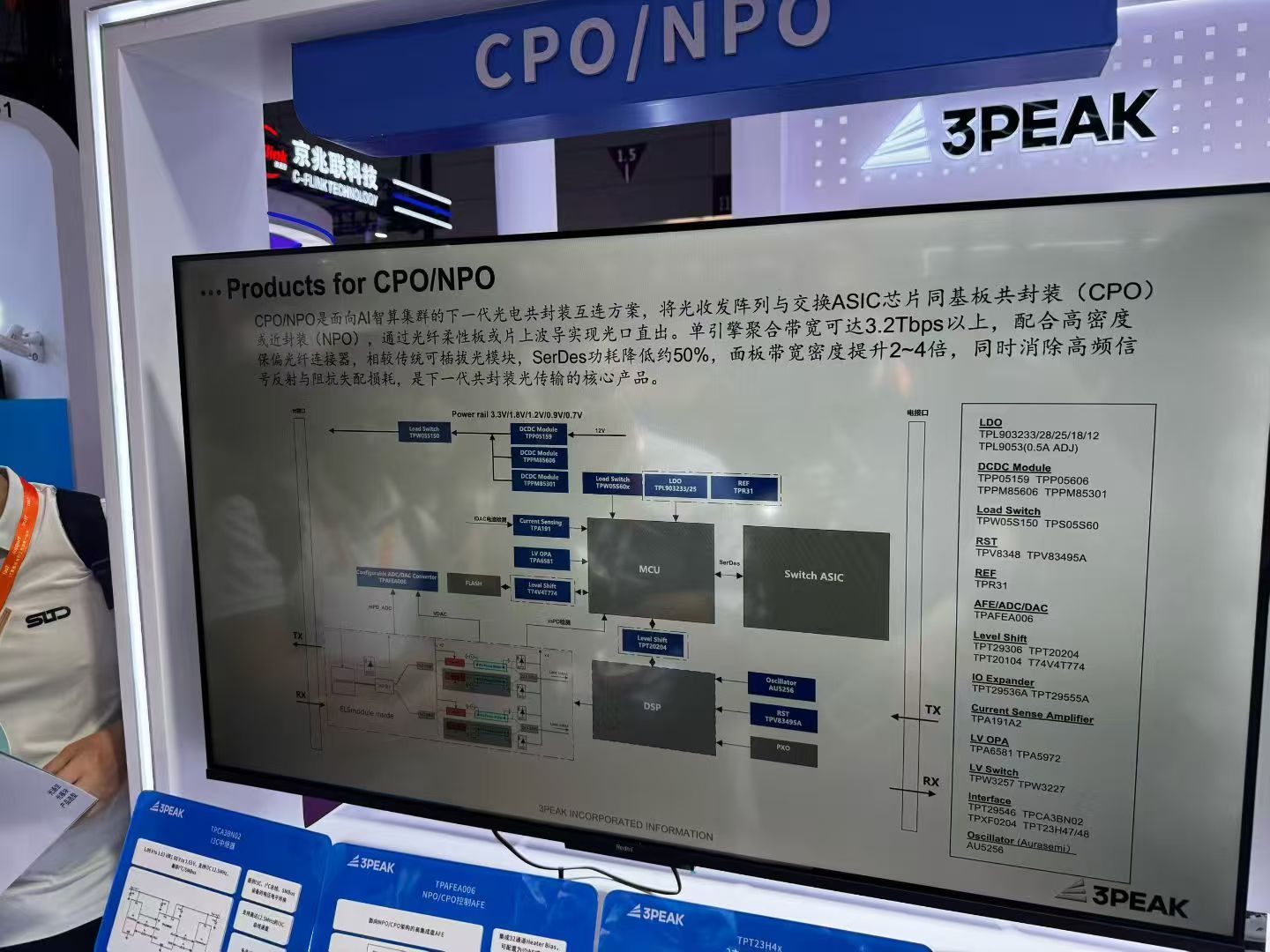
CIOE exhibition photograph showing 3PEAK's CPO/NPO display. This is a separate exhibit from the Broadex–Casela module discussed in this article.
Its job is to supply light to optical engines inside the chassis, rather than convert electrical data into modulated high-speed optical signals. This illustrates a development in CPO: the optical engine moves closer to the switch chip while the laser can move out to the front panel. External lasers are one approach being turned into commercial products, rather than the only possible architecture for CPO.
1. Why move the optical engine in and the laser out?
CPO addresses the limited reach of high-speed electrical signals. Longer copper traces between a switch chip and a conventional pluggable module become increasingly difficult to manage as data rates rise. Loss, equalization and power consumption all become more demanding. Placing the optical engine next to the switch ASIC shortens that electrical journey and allows an earlier conversion to light.
Lasers, however, are sensitive to heat. A switch ASIC creates a hot operating environment, making temperature drift, lifetime and servicing harder to manage if the laser remains nearby. Two approaches have emerged: an integrated light source, or ILS, keeps the laser close to the optical engine; an external light source, or ELS, moves it to a cooler, more accessible location.
The OIF-defined ELSFP packages the external source as a front-panel pluggable module. Rear blind-mate multi-fiber connections can feed one or more optical engines, with field hot-swapping supporting maintenance.
2. Eight channels, 20 dBm and 8.5 W: more than lasers in a housing
The Broadex–Casela product listed at CIOE 2026 makes this architecture concrete. According to the public description, Casela supplies the high-power lasers and Broadex supplies the silicon-photonics coupling platform. The module uses eight uncooled laser channels with more than 20 dBm of output per channel. Since 20 dBm equals 100 mW of optical power, the challenge is to distribute substantial, stable optical power within a constrained electrical-power and size budget.
Laser-chip specifications are only the starting point. The module supplier must manage channel-to-channel power consistency, temperature monitoring, automatic power control, coupling loss, contamination at blind-mate connectors, hot-swap transients and fault isolation. Lighting one channel is a much smaller achievement than keeping eight channels consistent after heat, vibration and prolonged operation. The available public evidence establishes product parameters and exhibition status, but not specific customers, shipment quantities or deployment scale.
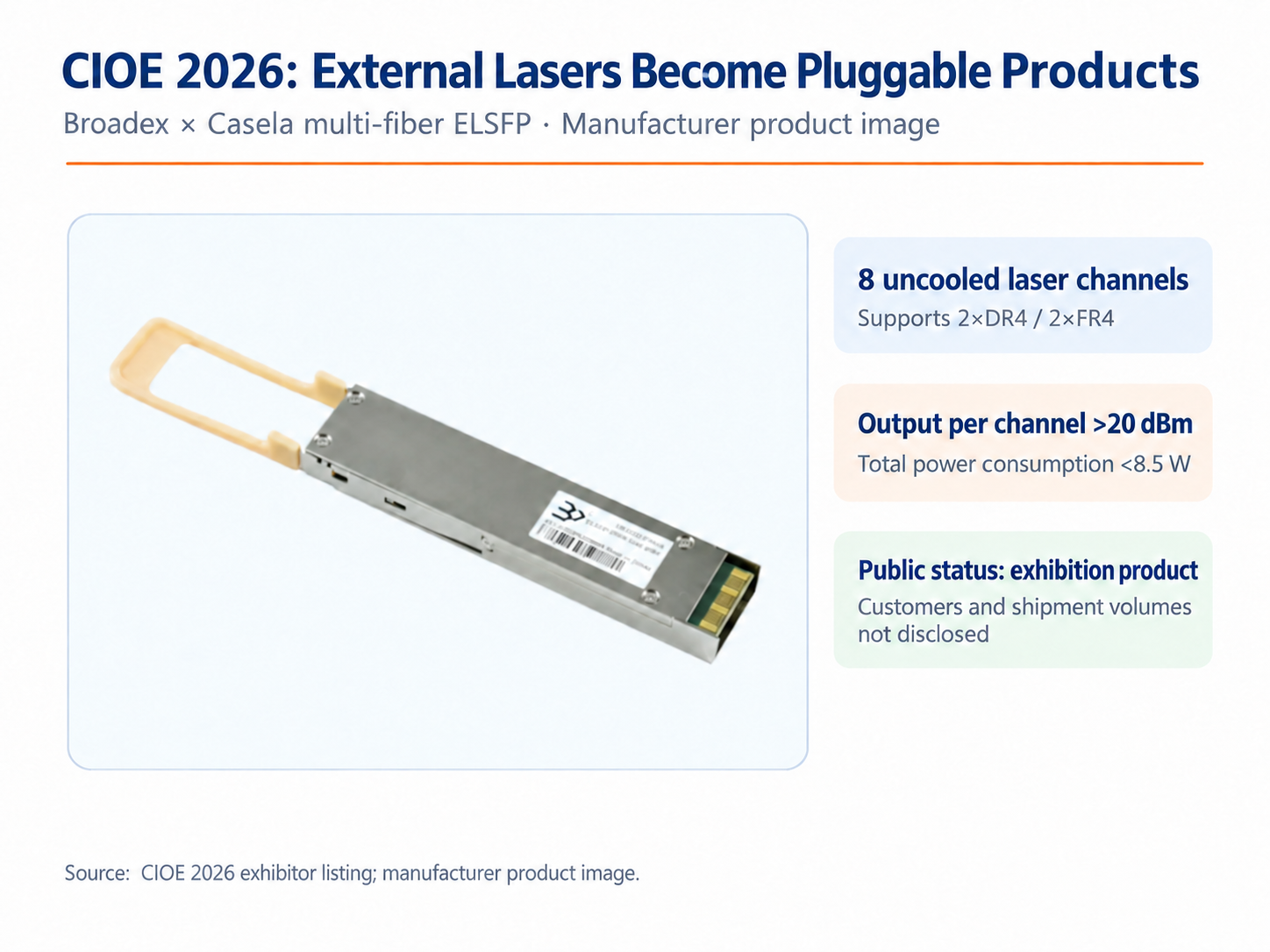
The manufacturer product image is shown with English-localized annotations. The published listing does not identify customers or shipment volumes.
3. A 200 mW chip listing does not establish a qualified replacement
One entry point for China's suppliers is the continuous-wave distributed-feedback laser chip, or CW DFB. Everbright Photonics' EB-DFB-200-1311-01 is listed as a 1311 nm, 200 mW DFB chip with an operating temperature range of 5–80°C. The manufacturer data sheet also gives optical-power performance above 200 mW across the stated temperature range and suitability for non-hermetic packaging. These specifications address demand for high-power continuous-wave sources in 800G/1.6T silicon-photonics and external-source applications.
However, “200 mW” alone is not enough for a procurement decision. Source Photonics showed an ELSFP at OFC 2026 using an internally developed CW DFB with output above 100 mW, offering cooled and uncooled options for 102.4T NPO/CPO switch platforms. One disclosure concerns a bare chip; the other concerns a module-level solution. Temperature, coupling loss, the point at which output is measured and other test conditions differ. Those two numbers cannot support a simple supplier ranking.
For a China-developed chip to qualify as an alternative, the evidence must address lifetime degradation, relative intensity noise, wavelength drift, lot consistency and packaging yield together—not peak power alone.
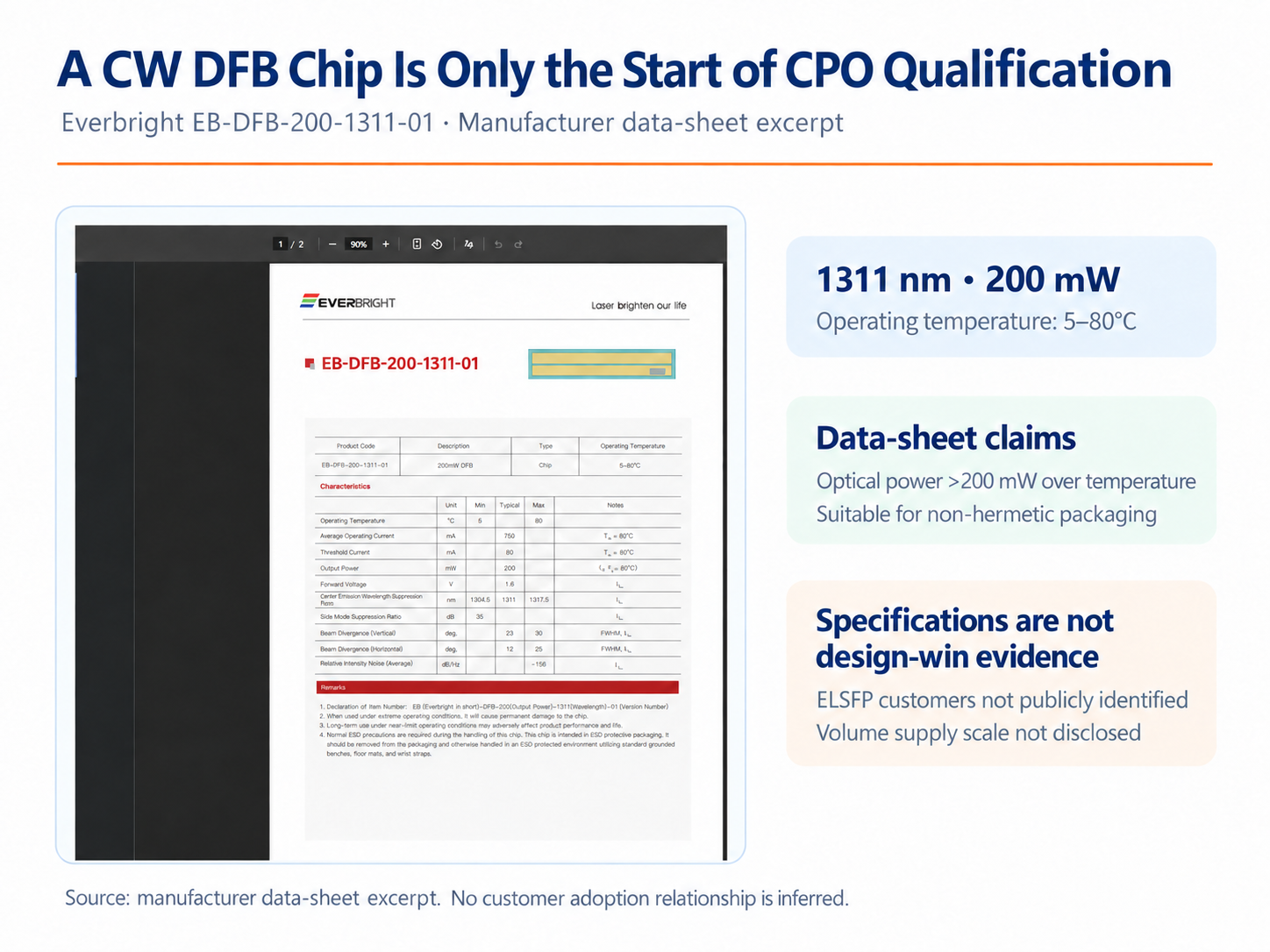
The data-sheet excerpt reports chip-level specifications. It does not identify a specific ELSFP customer or establish the scale of volume supply.
4. Four layers of validation stand between a chip and a deployable system
Chinese suppliers are progressing at different levels. Everbright has published a specific CW DFB part number. Broadex and Casela have disclosed an ELSFP exhibition product. In March 2026, Accelink reported that its complete 3.2T single-mode silicon-photonics NPO solution—combining optical engines, ELSFP and FMU-Shuffle—had completed system validation at a leading Chinese cloud service provider. The public disclosure did not identify the ELSFP's exact model or supplier, or the volume-shipment scale of the 3.2T system.
CIG Shanghai provided another signal on August 25, saying it planned large-volume ELSFP shipments in the second half of 2026. It also reported tighter first-half supply of core materials including silicon-photonics chips, CW light sources and DSPs. The timing needs to remain explicit: this was a plan for the second half, not a statement that volume delivery had already occurred on the disclosure date. It nevertheless shows that CW light sources have become materials capable of affecting high-speed optical-module delivery.
The opportunity is to build a supply chain whose chip, module, fiber-management and system-validation stages can be assessed individually and delivered together. It does not require one company to perform every stage. A practical evaluation has four layers:
- CW DFB chip: optical power across temperature, noise and lifetime.
- ELSFP module: channel consistency, power consumption and hot-swap behavior.
- Optical connections: loss stability in polarization-maintaining fiber, fiber-array units and blind-mate interfaces.
- Switch platform: monitoring, redundancy, fault isolation and long-duration operation.
If any layer fails, a high optical-power specification will not become usable bandwidth in a data center.
Conclusion
External-source CPO turns the laser into a component that can be procured, serviced and potentially second-sourced independently of the optical engine. China's supply chain now includes identifiable laser chips, ELSFP products and system-validation examples. Those separate pieces of evidence do not establish a fully qualified, end-to-end China-sourced system.
The eventual suppliers will need repeatable production capability that combines laser lifetime, module thermal management, fiber coupling, monitoring interfaces and system fault handling. Chinese vendors have a real opportunity, but the presence of a product does not establish that it can replace an existing one without qualification.
Disclaimer: This article is based on public materials and intended for industry discussion, not investment, procurement or part-selection advice. Product specifications, supply relationships and validation status remain subject to the latest manufacturer and customer information.