
Winbond's NOR and F-RAM Deal: Where China's Memory Suppliers Stand
Winbond's agreement to acquire Infineon's NOR Flash and F-RAM business puts product breadth and long-term supply back in focus for automotive and industrial memory buyers. Announced on September 16, 2026, the proposed transaction carries a base consideration of US$1.12 billion. It has been signed, but has not closed.
Alongside this consolidation, mainland Chinese suppliers are making progress at different stages. GigaDevice's 2026 disclosures connect established automotive deliveries with a wider NOR portfolio. Ferroelectric-memory supplier Shunming reports commercial shipments, while work on higher density and 3D architectures still needs to be assessed separately from existing products.
For an international reader assessing these alternatives, the useful comparison is how much of the product and delivery record can be examined today.
The proposed transaction expands an automotive and industrial portfolio
The deal covers NOR Flash and F-RAM. Infineon would retain SRAM, HYPERRAM, nvSRAM and its SONOS-based radiation-hardened memory business. The parties target completion in the second half of 2027, subject to regulatory approval and other conditions.
Their September announcements position the business in automotive, industrial and infrastructure markets. Infineon describes the combination with Winbond's existing business as creating a broader, complementary NOR and F-RAM portfolio. Winbond expects an expansion of global R&D resources, supply capability and customer service. These remain the anticipated benefits of a proposed transaction; product and channel integration is still ahead.
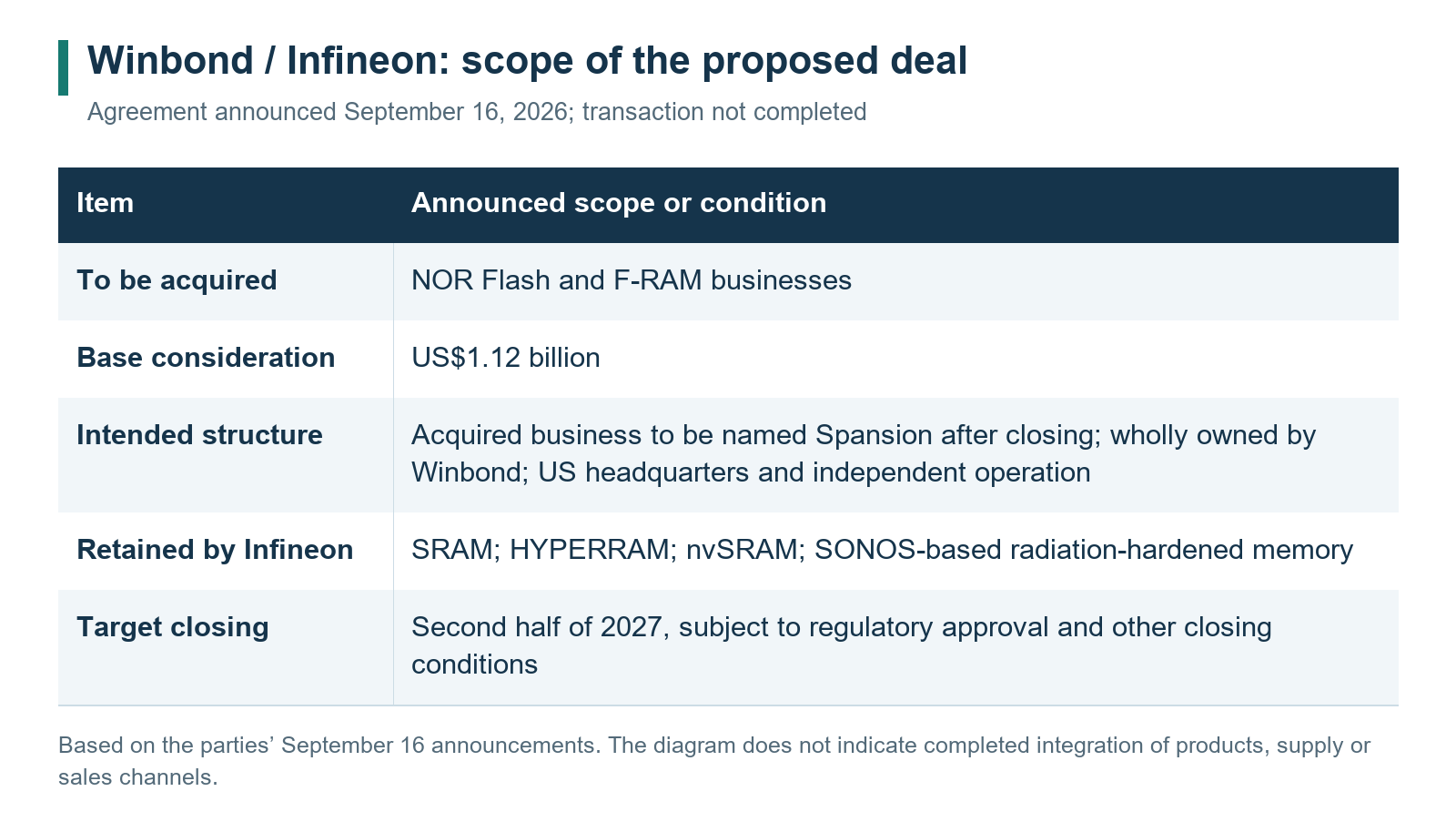
Figure 1. Transaction scope based on the parties' September 16, 2026 announcements. Spansion is the intended post-closing name of the acquired business. The acquisition has not been completed.
The comparison for other suppliers consequently extends beyond the read speed of an individual device. It includes density and voltage options, application coverage and the ability to support continuing deliveries. GigaDevice's recent disclosures address several of those points.
GigaDevice has a delivery base to build on
In its first-half 2026 report, disclosed on August 19, GigaDevice said NOR Flash unit sales had increased to varying degrees across application categories, with substantial year-on-year growth in both revenue and unit sales in industrial and automotive markets.
The company also reported cumulative shipments of more than 450 million automotive-grade Flash devices, used in applications including intelligent cockpits, automated driving and connected vehicles. This is a cumulative figure for automotive-grade Flash. It is neither the number shipped in the first half alone nor the shipment total of a particular NOR part.
The two disclosures show different things: an established automotive delivery base and growth in NOR's industrial and automotive business during the reporting period.
There is also a more specific product reference. In its May 20 introduction to GD25LX128J, GigaDevice said the relevant products were shipping in volume for vehicles in China equipped with navigation-assisted driving. That connects the broader business record to an identified high-speed NOR application.
Broader NOR coverage means more design choices
GD25LX128J and the GD25UF family illustrate two directions in that expansion.
GD25LX128J is a 128 Mb, 1.8 V Octal SPI NOR device with a stated maximum throughput of 400 MB/s, plus execute-in-place (XIP) capability, ECC and CRC. For systems reading code from external memory or executing it directly, read capability affects access to code. ECC and CRC add error-correction and checking functions that need to be considered with the access requirements.
The 400 MB/s figure is the manufacturer's maximum throughput, not a measured result for every application. System performance depends on the host controller's supported interface modes, operating frequency and software access behavior. Migration from an existing design also needs its own compatibility assessment.
GD25UF addresses a different set of requirements. GigaDevice's interim report says the 1.2 V ultra-low-power SPI NOR family expanded to cover densities from 8 Mb to 256 Mb during the reporting period. Designs using that voltage platform can have different firmware sizes and allowances for future features, making a wider density range useful.
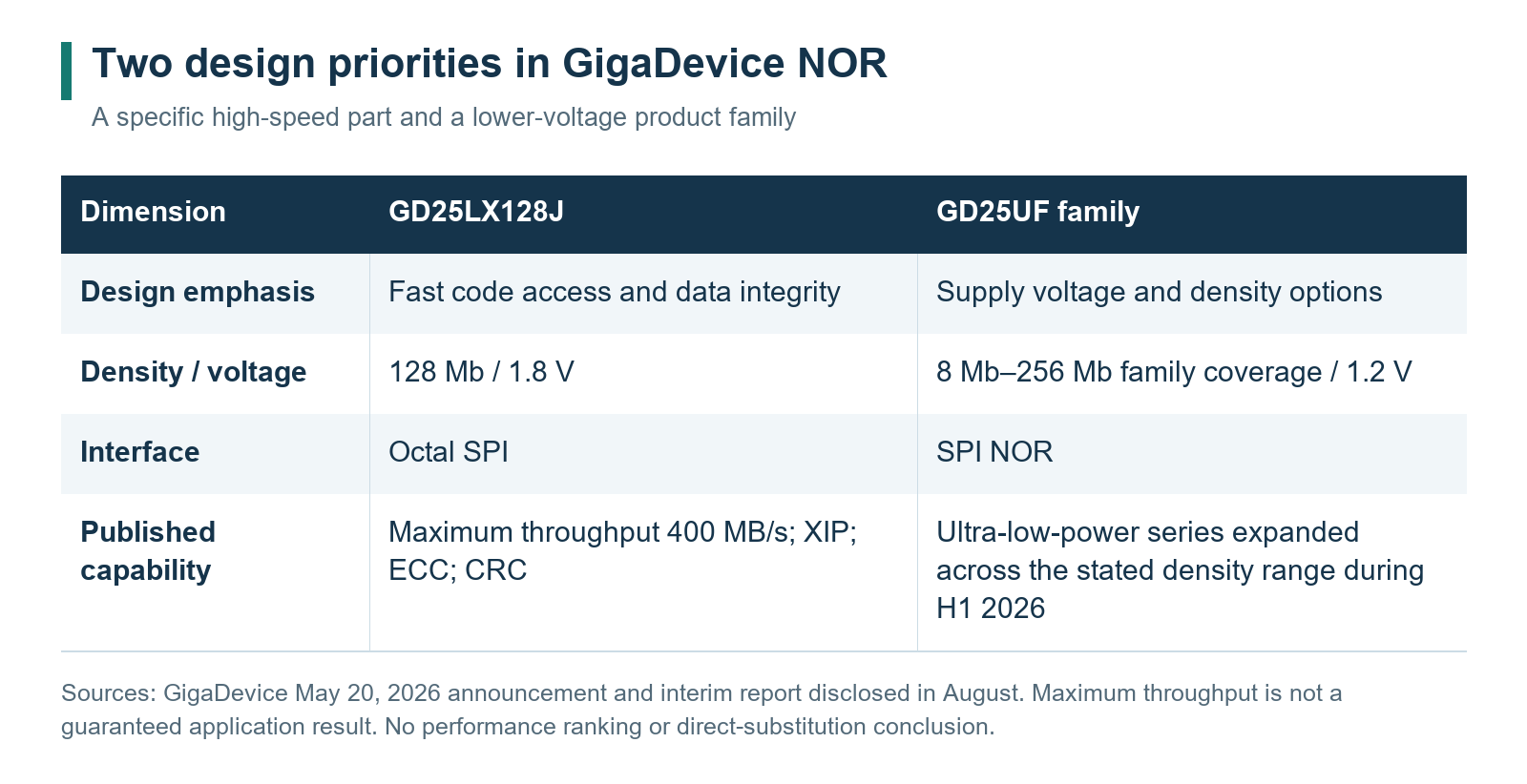
Figure 2. Design choices summarized from GigaDevice's May 20, 2026 announcement and its interim report published in August. The 8 Mb to 256 Mb range describes the GD25UF family. This is not a performance ranking or a direct-substitution comparison.
One project may prioritize code-read performance; another may start with the supply voltage and required capacity. Offering parts for both increases the range of designs a supplier can address. Package, pin and software compatibility between individual family members must still be checked in the relevant device documentation.
The observable progress is therefore product coverage expanding on top of an existing application base. Both the high-speed part and the lower-voltage family contribute to that assessment.
Shunming's shipments and next-generation work are separate milestones
Chinese ferroelectric memory needs to be examined on two tracks: commercial delivery and further technology development.
An interview published by the Hubei Daily app on May 19, 2026 reported that Shunming's products were used in industrial, automotive and Internet of Things applications, with cumulative shipments exceeding 20 million units. That figure covers the company as a whole and was not broken down by part number or customer.
It supports the conclusion that the business has commercial deliveries. To assess the portfolio in more detail, buyers would need to connect those shipments to currently offered parts and examine their density, voltage, interface and application conditions. A company-level shipment total does not establish the status of a particular device.
This is an important difference in the recent information reviewed for the two suppliers. GigaDevice's disclosures connect to GD25LX128J applications and GD25UF density expansion. The recent material used for Shunming primarily describes company-level commercialization and technology development; it does not provide enough detail to reconstruct a complete current product lineup.
Shunming is also pursuing materials and device-structure research. Work on higher density and 3D architectures needs to lead to identifiable new parts, public specifications and delivery information before it can be assessed as a broader commercial offering. The trade-offs among density, power, endurance and cost remain device-level questions.
Follow the product record as the market changes
Winbond's proposed acquisition draws attention to the breadth of automotive and industrial memory portfolios. GigaDevice already reports an automotive delivery base and is extending NOR choices in read performance, operating voltage and density. Shunming reports commercial shipments, with higher-density ferroelectric memory still requiring further product and application evidence.
For buyers, these differences determine what can be evaluated now and what belongs on a technology watch list. Continuing deliveries and a broader selection of devices are observable progress. The point at which new ferroelectric structures produce additional qualified, shipping products remains a question for subsequent disclosures.
Based on public announcements, company disclosures and manufacturer material available through September 20, 2026. Intended for industry discussion, not investment, procurement or direct-substitution advice. Transaction status and specifications are subject to formal disclosures.