
China's Power Management IC Suppliers: Application Coverage, Qualification and Business Performance
For international engineering and sourcing teams assessing Chinese power management IC suppliers, a catalogue entry is only the starting point. Consumer charging, appliance power and processor voltage regulation involve different circuits, qualification programmes and delivery requirements. Suppliers expanding across those markets bring different product histories and levels of commercial maturity.
AI servers, 800 V vehicles and stationary storage attract attention, but each board still needs specific functions: converting voltage, controlling battery charge and discharge, sequencing supply rails and protecting against faults. Recent Chinese disclosures show expansion into adjacent charging functions, higher-power conversion, computing, automotive and industrial applications. Product coverage, customer progress and revenue need to be examined together.
Application boundaries define the market being measured
Power management ICs convert, distribute, monitor and protect electrical power. LDOs provide linear regulation; DC-DC devices convert between DC voltage levels; AC-DC controllers participate in mains conversion; charging ICs control battery charging. In product literature, PMIC can also mean a device integrating multiple power rails and control functions. A market estimate therefore depends on the definition used.
A complete server supply, on-board charger or storage power converter also contains power semiconductors, magnetics, passive components, cooling and mechanical parts. Equipment-market revenue cannot be used as the size of the power management IC market. Similarly, Chinese purchasing demand is different from sales by Chinese suppliers.

Figure 1. Distinct scopes in power-industry analysis. The illustrated revenue measures are not directly additive.
Consumer devices prioritize charging speed, battery life, size and cost. Appliances add standby consumption, peripheral-component count and protection. Industrial equipment emphasizes input disturbances, load changes and sustained operation; medical systems also require equipment-level safety and isolation. AI computing adds fast, high-current load transients, while automotive and storage systems create demand for conversion, isolation and battery monitoring. The suppliers below illustrate recent disclosed activity rather than an exhaustive market roster.
Charging suppliers are extending into adjacent device functions
Southchip's first-half 2026 report lists wired and wireless charging, lithium-battery protection, fuel gauging and display power. These functions serve related mobile platforms but have distinct performance and validation requirements. Expanding from one charging function can increase the supplier's participation in a device without making every new product line equally mature.
Injoinic's portfolio also centres on portable electronics. Its interim report lists power-bank, true-wireless-earbud charging-case, PMIC and wireless-charging products, alongside charge/discharge control, battery protection and fuel gauging. A charging case emphasizes size and standby consumption; a power bank also involves conversion, protocol coordination and battery protection. Integration must suit the end product's trade-offs.
Fuman Micro's reported development areas include USB PD controllers and protocol ICs, power banks, lithium-battery protection, charging ICs and AC-DC/DC-DC controllers. The overlap shows competition extending across several supply functions within the same device. Development priorities, however, do not measure revenue from products already selling.
SG Micro offers a specific multi-rail example. Its August 2026 SGM260421 datasheet describes four buck converters and two LDOs for applications including SSDs and microcontrollers, with configurable power sequencing and operating states. Integration reduces coordination work across rails during startup, sleep and wake-up as well as supplying different voltages.
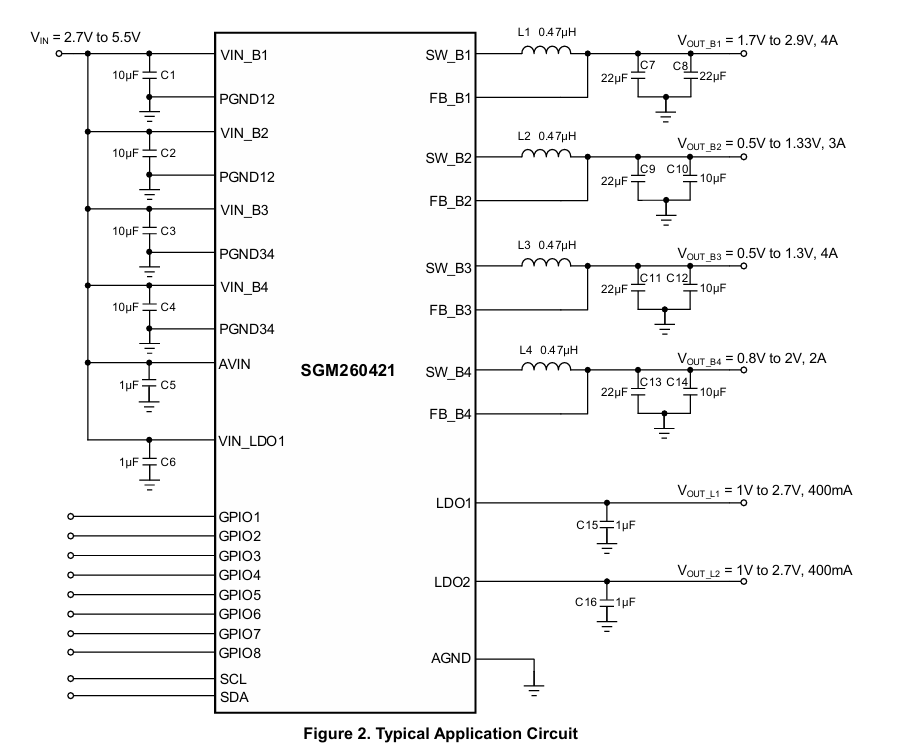
Figure 2. SG Micro's SGM260421 typical application circuit, corresponding to the August 2026 datasheet. This is a manufacturer example, not a disclosed customer BOM.
ETEK Microelectronics reported power conversion, protection and driver products, as well as volume sales of energy-harvesting circuits. These collect small amounts of ambient energy from sources such as light, heat or vibration for low-power IoT devices. For applications including remote controls and electronic labels, the commercial value can include fewer battery replacements and maintenance visits.
Control architecture and manufacturing support broader portfolios
Appliances continue to provide opportunities for product iteration. At an October 2026 appliance-technology exchange, Chipown presented products including PN8733F and PN8077F, focusing on standby consumption, external-component requirements and protection. These affect system energy use, board space, material cost and reliability, and need evaluation within a complete supply.
Kiwi Instruments' first-half report described interleaved PFC and LLC controller activity and said its 100 V CMCOT-architecture DC-DC products had entered customer applications and volume production for industrial power, storage and new-energy vehicles. PFC and LLC controllers participate in conversion control on the AC-input side; the DC-DC products serve a different conversion function.
Shanghai Belling reported Buck-Boost modules for optical communications, PMU chips for smart meters and expansion in LDO, DC-DC and AC-DC products. Optical modules and meters require different rail combinations and operating conditions even when both fall under power management.
Bright Power Semiconductor lists LED drivers, AC/DC and high-performance computing power among its main lines. Its interim report said its sixth-generation high-voltage BCD process platform had begun volume production. Some DrMOS products using its second-generation 40 V BCD process had also reached volume production. Process, circuit and package choices jointly affect voltage capability, conduction loss, die area and cost.
Manufacturing organization varies. ETEK operates a fabless model using external wafer fabrication and assembly/test providers. Fuman outsources wafers while retaining core assembly and test operations, supplemented by external providers. Both must manage capacity, yield and delivery; cost advantages depend on the product and production volume.
Reducing external parts can save area and assembly work while changing thermal, protection and debugging requirements. The relevant commercial comparison therefore includes the full BOM, production testing and maintenance, alongside the IC price. Reusable reference designs and application support can also influence adoption speed.
Computing power spans shipping products and unfinished development
Server power includes input protection, intermediate-bus conversion, processor-core regulation and peripheral rails. Chipown's May 2026 solution places PN68XX multiphase controllers, PN786X power stages, e-fuses and point-of-load supplies in those respective roles. JoulWatt's interim report also describes combinations of multiphase controllers and smart power stages for computing, storage and communications.
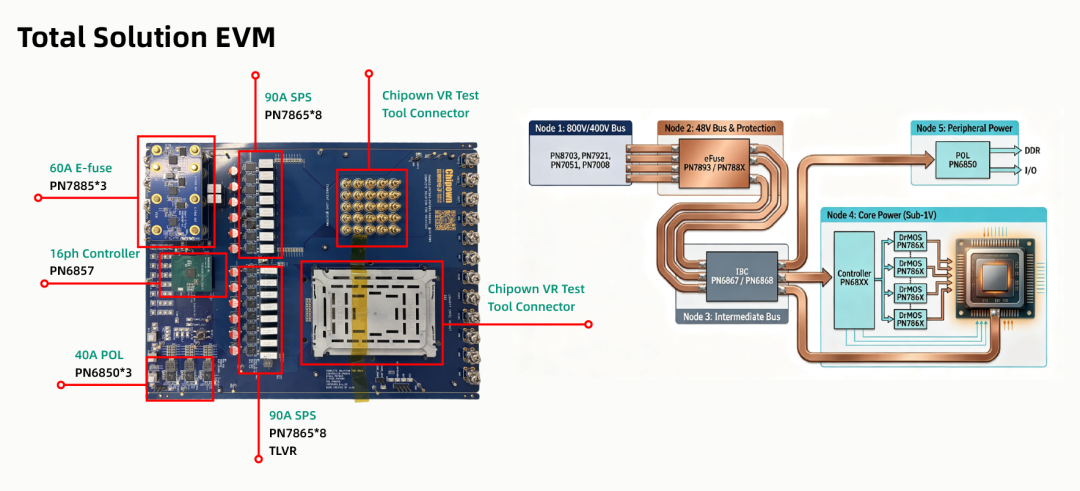
Figure 3. Chipown's official computing-power demonstration board and architecture illustration, published in May 2026. The image presents the manufacturer's solution rather than confirmed customer adoption.
Multiphase power requires controller/power-stage coordination, thermal design, transient response and fault protection. Texas Instruments' March 2026 800 V DC reference architecture brings bus conversion, processor power and protection into a system design. Comparisons with Chinese solutions need common input/output conditions, load ranges and cooling assumptions; one current or efficiency figure is insufficient.
Bright Power reported approximately RMB46 million in high-performance computing power IC revenue for the first half of 2026, with growth from AI computing cards, general-purpose servers and gaming notebooks. That category covers multiple applications and cannot all be attributed to AI servers.
ETEK reported completing development of several products for 48 V power architectures. Shanghai Belling reported technical-development progress on smart multiphase power ICs for AI servers. These statements establish product or R&D milestones, without establishing corresponding volume customer orders. Product availability, customer validation and sustained sales represent progressively different commercial commitments.
Automotive and storage growth depends on the circuit position
On-board chargers, charging stations and photovoltaic inverters require controlled switching of power devices. Isolated gate drivers transfer control signals and drive gates. NOVOSENSE's first-half 2026 report said its single- and dual-channel isolated drivers for SiC devices were shipping at scale into these markets. Its second-generation functional-safety isolated gate drivers were undergoing OEM sample testing and had secured several project designations. Revenue from those designated projects still depends on programme progress and delivery.
Battery systems also need charge/discharge control, protection and state monitoring. Injoinic describes products covering these functions, while Kiwi also has battery-management and isolated gate-driver activities. They serve different functions from high-power conversion devices, so battery-management sales cannot be treated as storage power-conversion-system growth.
Higher-voltage platforms retain multiple internal voltage levels. A supplier's position in a main power stage, auxiliary supply or battery-monitoring circuit determines the applicable requirements. Specific functions, qualification conditions and production stages are more informative than a broad claim of participation in new energy.
Revenue growth, profitability and cash generation follow different paths
SG Micro reported approximately RMB4.304 billion in total revenue for the first nine months of 2026. Its first-half report provides the product breakdown: total revenue of about RMB2.595 billion included RMB1.521 billion from power management, or 58.61%. Power-management revenue increased 35.45% year on year and carried a 47.97% gross margin. Company revenue also includes signal-chain and other business.
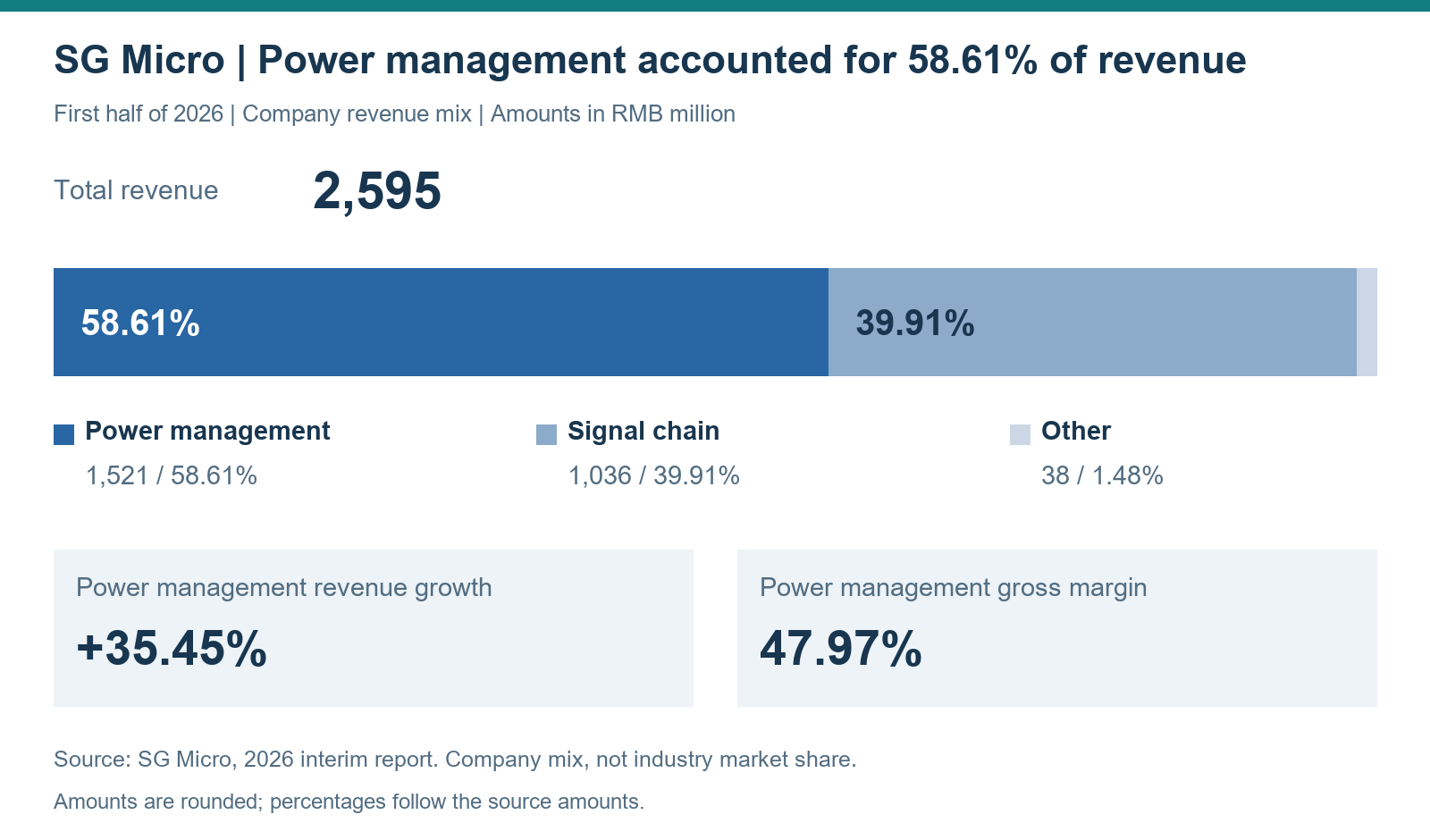
Figure 4. SG Micro's first-half 2026 revenue mix, based on its interim report. This shows the company's internal composition, not industry market share.
Fuman's power management IC revenue was approximately RMB170 million in the same half-year, up 15.56%. Total company revenue reached approximately RMB678 million, up 77.04%. Using company growth as a proxy would materially overstate the growth of its power-management category.
Bright Power's consolidated first-half revenue rose 98.54% to approximately RMB1.452 billion, including Sichuan ConvenientPower from March. Revenue from its existing business was approximately RMB1.049 billion, up 43.46%. The acquisition broadened charging-related coverage and changed the consolidation perimeter, so the reported increase includes both operating growth and scope changes.
JoulWatt reported approximately RMB1.719 billion in revenue, up 44.72%, and a net loss attributable to shareholders of about RMB520 million. It cited deeper customer penetration and a longer consolidation period among revenue drivers. Higher R&D and market spending and pressure on gross margin contributed to the wider loss. Portfolio expansion and profit improvement need not coincide.
Injoinic illustrates the cash-flow distinction. It reported approximately RMB809 million in revenue and RMB104 million in net profit attributable to shareholders, while operating cash flow was about negative RMB96.06 million. It mainly attributed the cash-flow decline to greater inventory purchasing in response to upstream capacity conditions. The timing of inventory conversion into deliveries influences funding needs even when the income statement is profitable.
Chinese suppliers now cover charging, general regulation, appliance control, computing power and isolated drivers, with different foundations and expansion rates. Their positions will change through specific customer programmes: successful qualification, repeatable platform supply and revenue sufficient to cover development and delivery costs. Those outcomes offer a firmer basis for evaluating supplier progress than portfolio size or company-wide sales growth alone.